 Uri dinozore iyihe? Umukino w'ibibazo
 Intambara ya dinozore
 Isiganwa rya dinozore
 Imikino mito ya dinozore
 Alubumu ya sitikeri
 Intonde za TOP za dinozore
 Ntungura!
Yabayeho ryari?

Yanganaga ite?
Amababa yayo yari arambuye angana iki?
Parvavis yanganaga ite ugereranyije NAWE?
Ni imibare gusa ibarirwa muri mushakisha yawe. Nta kintu kibikwa cyangwa cyoherezwa ahandi.
Yihutaga ite?


Utuntu dushimishije
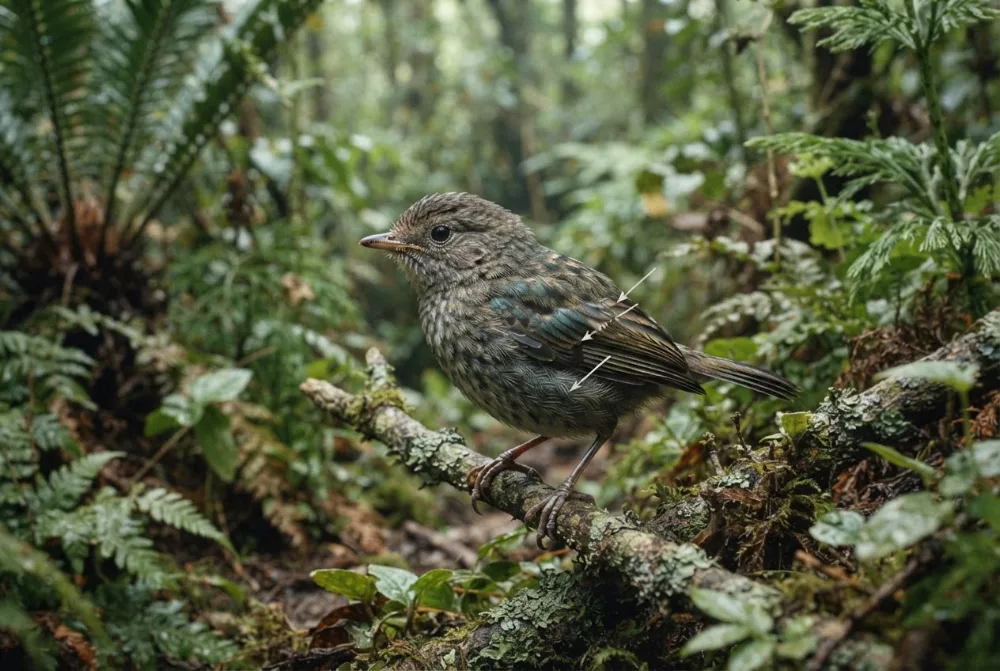
When Parvavis was discovered, it was the smallest known enantiornithine bird, even smaller than Iberomesornis.1
The fossil of Parvavis includes parts of the skull, spine, tail, and even impressions of its feathers in the rock.1
Scientists studied the bone structure and found that Parvavis was nearly full-grown when it died, but it was still surprisingly tiny.12
Parvavis had a special feature: the bottom joint of its second metatarsal (a foot bone) was wider than the joints of its other metatarsals.1
The claw on the fourth toe of Parvavis was reduced, meaning it was smaller than the other toe claws.1
Ku bazobereye muri dinozore
- Izina rya siyansi
- Parvavis
- Yiswe na
- Wang et al. 20143
- Itsinda
- Inyoni za mbere
- Umuryango / ishami
- Enantiornithes3
- Ishyirwa mu byiciro
- Theropoda > Avialae3
- Imyaka y'amabuye
- imyaka miliyoni 94 kugeza 84 (Turonian / Santonian)3
- Inzego z'amabuye
- Jiangdihe3
- Ibihugu
- Ubushinwa3
- Ibisigazwa byanditswe
- 1 muri The Paleobiology Database3
- Ivumburwa
- The skeleton of Parvavis was found in 2010 near Luojumei Village in Yunnan, China. It was named and described in 2014 by Wang Min, Zhou Zhonghe, and Xu Guanghui.1
- Biracyagibwaho impaka
- Scientists are still debating exactly where Parvavis fits on the enantiornithine family tree. Some analyses place it in a relatively basal position, meaning it may have been an early branch of this group.1
Aho amakuru yakuwe
- Parvavis (en.wikipedia.org)
- The first enantiornithine bird from the Upper Cretaceous of China (tandfonline.com)
- Parvavis in The Paleobiology Database (CC BY 4.0): imyaka, ahantu, inzego z'amabuye, ishyirwa mu byiciro.
Buri kintu kiri kuri uru rupapuro gifite nimero yerekana aho cyakuwe. Niba hari icyo twibeshye, tubabarire, turi abakunzi ba dinozore, ntituri ikinyamakuru cya siyansi. Tubwire kuri [email protected] tuzagikosora.
 Rex arashonje! Dino Wiki ni umushinga wa papa umwe yakoreye umuhungu we ukunda dinozore, ni ubuntu, nta matangazo kandi nta bigukurikirana. Abantu bakuru bashobora guha Rex akantu ko kurya kugira ngo Dino Wiki ikomeze kuboneka kuri interineti.Gaburira Rex
 Archaeopteryx
 Hesperornis
 Ichthyornis
 Baptornis
 Jurapteryx
 Gobipteryx
 Tyrannosaurus
 Triceratops
 Velociraptor
 Spinosaurus
 Ankylosaurus
 Parasaurolophus