 Uri dinozore iyihe? Umukino w'ibibazo
 Intambara ya dinozore
 Isiganwa rya dinozore
 Imikino mito ya dinozore
 Alubumu ya sitikeri
 Intonde za TOP za dinozore
 Ntungura!
Qianxisaurus
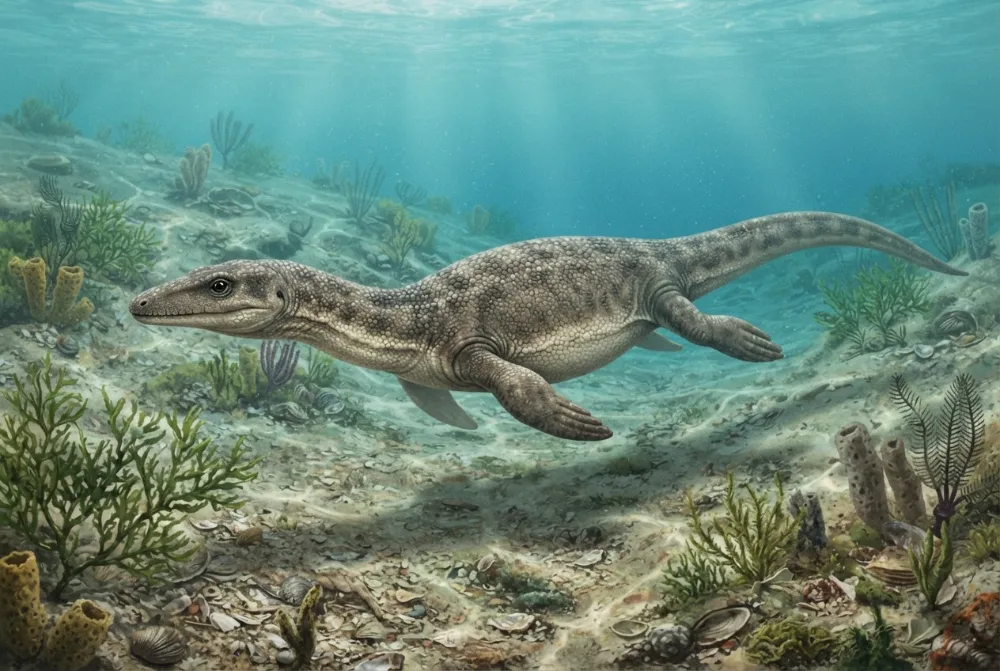
Qianxisaurus was a marine reptile that swam in the warm seas of China about 238 million years ago. It had a long body, a long tail, and a snout longer than the rest of its skull. This creature was not a dinosaur, but a type of eosauropterygian, a group of ancient sea reptiles.1
Yabayeho ryari?
Yanganaga ite?
Yari ndende ite?
 ndende nk'injangwe 1,5 zo mu rugo zikurikiranye🍌ndende nk'imineke 4 ikurikiranye🏊yashoboraga koga uburebure bwa pisine nini (50 m) mu masegonda 26
Qianxisaurus yanganaga ite ugereranyije NAWE?
Ni imibare gusa ibarirwa muri mushakisha yawe. Nta kintu kibikwa cyangwa cyoherezwa ahandi.
Yihutaga ite?


Utuntu dushimishije
Qianxisaurus had 28 back vertebrae and four sacral vertebrae, which is unusual for early sauropterygians.1
Its skull was only 7.6 cm (3 inches) long, but the whole animal was over 80 cm (2 feet 7 inches) in length.1
The name Qianxisaurus comes from 'Qianxi', meaning western Guizhou in Chinese, and 'saurus' meaning lizard.1
Qianxisaurus had a very small supratemporal fenestra, a hole in the skull roof, which was only slightly larger than a foramen in the parietal bone.1
Its dorsal ribs had a longitudinal groove on the upper-back surface, a feature shared with some other early marine reptiles like Corosaurus and Sanchiaosaurus.1
The only known fossil of Qianxisaurus was discovered in 2006 near the Huangnihe River in Xingyi, Guizhou, and is now kept at the National Museum of Natural Science in Taiwan.1
Ku bazobereye muri dinozore
- Izina rya siyansi
- Qianxisaurus
- Yiswe na
- Cheng et al. 20122
- Itsinda
- Ibikururanda byo mu nyanja
- Umuryango / ishami
- Eosauropterygia2
- Ishyirwa mu byiciro
- Sauropterygia2
- Imyaka y'amabuye
- imyaka miliyoni 241 kugeza 237 (Ladinian)2
- Inzego z'amabuye
- Falang2
- Ibihugu
- Ubushinwa2
- Ibisigazwa byanditswe
- 1 muri The Paleobiology Database2
- Ivumburwa
- Qianxisaurus was named by Yen-Nien Cheng, Xiao-Chun Wu, Tamaki Sato and Hsi-Yin Shan in 2012 based on a nearly complete skeleton found in the Zhuganpo Member of the Falang Formation in Guizhou, China.1
- Biracyagibwaho impaka
- Scientists are not sure whether Qianxisaurus was a pachypleurosaur or a more basal eosauropterygian, and its exact relationships within the group are still debated.1
Aho amakuru yakuwe
- Qianxisaurus (en.wikipedia.org)
- Qianxisaurus in The Paleobiology Database (CC BY 4.0): imyaka, ahantu, inzego z'amabuye, ishyirwa mu byiciro.
Buri kintu kiri kuri uru rupapuro gifite nimero yerekana aho cyakuwe. Niba hari icyo twibeshye, tubabarire, turi abakunzi ba dinozore, ntituri ikinyamakuru cya siyansi. Tubwire kuri [email protected] tuzagikosora.
 Rex arashonje! Dino Wiki ni umushinga wa papa umwe yakoreye umuhungu we ukunda dinozore, ni ubuntu, nta matangazo kandi nta bigukurikirana. Abantu bakuru bashobora guha Rex akantu ko kurya kugira ngo Dino Wiki ikomeze kuboneka kuri interineti.Gaburira Rex
 Nothosaurus
 Placodus
 Lariosaurus
 Cyamodus
 Cymatosaurus
 Proneusticosaurus
 Chonespondylus
 Cymbospondylus
 Phalarodon
 Mixosaurus
 Chaohusaurus
 Chensaurus