 Uri dinozore iyihe? Umukino w'ibibazo
 Intambara ya dinozore
 Isiganwa rya dinozore
 Imikino mito ya dinozore
 Alubumu ya sitikeri
 Intonde za TOP za dinozore
 Ntungura!
Qunkasaura
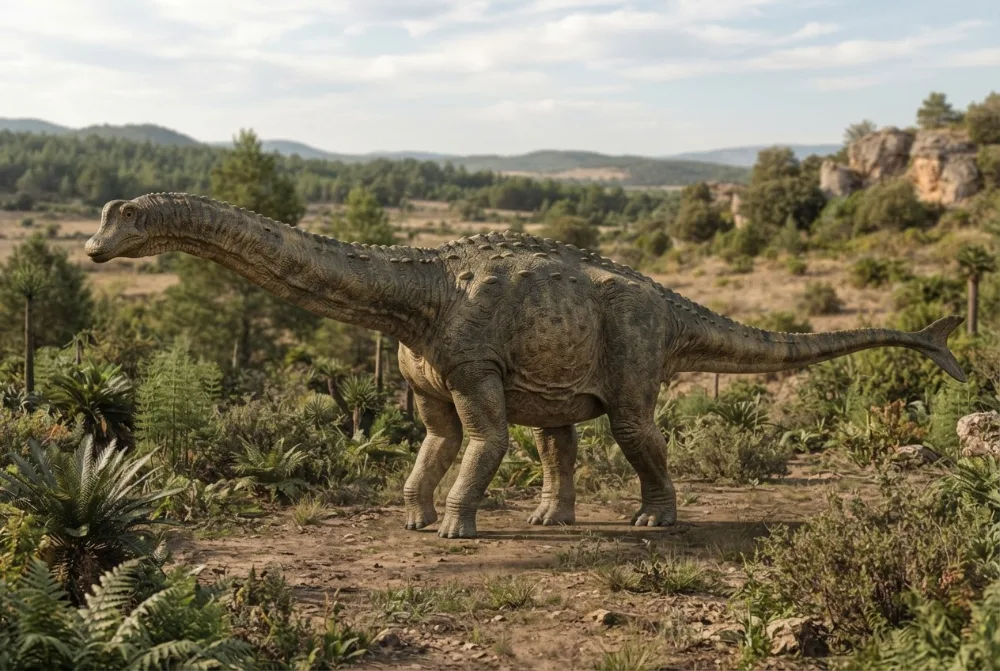
Qunkasaura was a long-necked, plant-eating dinosaur that lived in what is now Spain. It had a special tail shape that looked like the tails of some South American dinosaurs. This giant walked on four sturdy legs and was one of the biggest animals in its home.1
Yabayeho ryari?
Yihutaga ite?


Utuntu dushimishije
Qunkasaura's full scientific name is Qunkasaura pintiquiniestra. The species name 'pintiquiniestra' comes from a character in the book Don Quixote.1
This dinosaur is known from a single partial skeleton that includes ten back bones, six fused hip bones, the first eleven tail bones, and parts of its legs and hips.1
Qunkasaura lived about 83 to 66 million years ago, during the Late Cretaceous period.3
It belonged to a group of sauropods called titanosaurs, which were some of the largest land animals ever.1
The Lo Hueco fossil site where Qunkasaura was found has yielded more than 10,000 fossils, nearly half of which are from titanosaurs.1
Scientists think Qunkasaura might be closely related to another European titanosaur called Abditosaurus.1
Ibibazo bibazwa cyane kuri Qunkasaura
?How big was Qunkasaura?
Scientists don't know its exact size yet, but it was a large titanosaur, one of the biggest animals in its home. The partial skeleton includes a femur (thigh bone) that is still being studied.12
?What did Qunkasaura eat?
Qunkasaura was a plant-eater. It used its long neck to reach leaves and other plants.2
?When did Qunkasaura live?
Qunkasaura lived during the Late Cretaceous period, about 83 to 66 million years ago.2
Ku bazobereye muri dinozore
- Izina rya siyansi
- Qunkasaura
- Yiswe na
- Mocho et al. 20243
- Itsinda
- Izifite amajosi maremare
- Umuryango / ishami
- Saltasauridae3
- Ishyirwa mu byiciro
- Sauropodomorpha > Sauropoda > Titanosauria > Macronaria3
- Imyaka y'amabuye
- imyaka miliyoni 84 kugeza 66 (Campanian / Maastrichtian)3
- Inzego z'amabuye
- Villalba de la Sierra3
- Ibihugu
- Esipanye3
- Ibisigazwa byanditswe
- 1 muri The Paleobiology Database3
- Ivumburwa
- Qunkasaura was named in 2024 by paleontologist Pedro Mocho and his team. The skeleton was found at the Lo Hueco fossil site in Spain, which was discovered in 2007.1
- Biracyagibwaho impaka
- Scientists are still debating whether Qunkasaura belongs to the group Opisthocoelicaudiinae or is more closely related to other saltasaurids.1
Aho amakuru yakuwe
- A Spanish saltasauroid titanosaur reveals Europe as a melting pot of endemic and immigrant sauropods in the Late Cretaceous | Communications Biology (nature.com)
- Qunkasaura (en.wikipedia.org)
- Qunkasaura in The Paleobiology Database (CC BY 4.0): imyaka, ahantu, inzego z'amabuye, ishyirwa mu byiciro.
Buri kintu kiri kuri uru rupapuro gifite nimero yerekana aho cyakuwe. Niba hari icyo twibeshye, tubabarire, turi abakunzi ba dinozore, ntituri ikinyamakuru cya siyansi. Tubwire kuri [email protected] tuzagikosora.
 Rex arashonje! Dino Wiki ni umushinga wa papa umwe yakoreye umuhungu we ukunda dinozore, ni ubuntu, nta matangazo kandi nta bigukurikirana. Abantu bakuru bashobora guha Rex akantu ko kurya kugira ngo Dino Wiki ikomeze kuboneka kuri interineti.Gaburira Rex
 Brachiosaurus
 Diplodocus
 Brontosaurus
 Argentinosaurus
 Camarasaurus
 Morosaurus
 Tyrannosaurus
 Triceratops
 Velociraptor
 Spinosaurus
 Ankylosaurus
 Parasaurolophus