 Uri dinozore iyihe? Umukino w'ibibazo
 Intambara ya dinozore
 Isiganwa rya dinozore
 Imikino mito ya dinozore
 Alubumu ya sitikeri
 Intonde za TOP za dinozore
 Ntungura!
Yabayeho ryari?

Yanganaga ite?
Yari ndende ite?
Ubutumburuke bwayo bwanganaga iki?
igereranya
Yari iremereye ite?
 ndende nk'injangwe 3 zo mu rugo zikurikiranye🍌ndende nk'imineke 8 ikurikiranyeiremereye nk'injangwe yo mu rugo🍌iremereye nk'imineke 42🏃yashoboraga kwiruka metero 100 mu masegonda 12 (umuntu wihuta kurusha abandi akenera 9,6)
Shanag yanganaga ite ugereranyije NAWE?
Ni imibare gusa ibarirwa muri mushakisha yawe. Nta kintu kibikwa cyangwa cyoherezwa ahandi.
Yihutaga ite?


Utuntu dushimishije
Shanag is known from only a partial skull: a right maxilla (upper jaw bone), dentary (lower jaw bone), and part of the splenial (a jaw bone).2
It was a dromaeosaurid, meaning it was a close relative of famous raptors like Velociraptor and Deinonychus.2
Shanag had special air pockets inside its jawbone between the tooth sockets, called interalveolar pneumatic cavities.2
Unlike many other theropods, Shanag lacked a promaxillary fenestra, a small opening in the front of the snout.2
Shanag lived alongside Psittacosaurus, a small horned dinosaur, and large sauropods in the Öösh region.1
The fossils of Shanag were found in rocks that are about 130 million years old, from the Early Cretaceous period.1
Ibibazo bibazwa cyane kuri Shanag
?How big was Shanag?
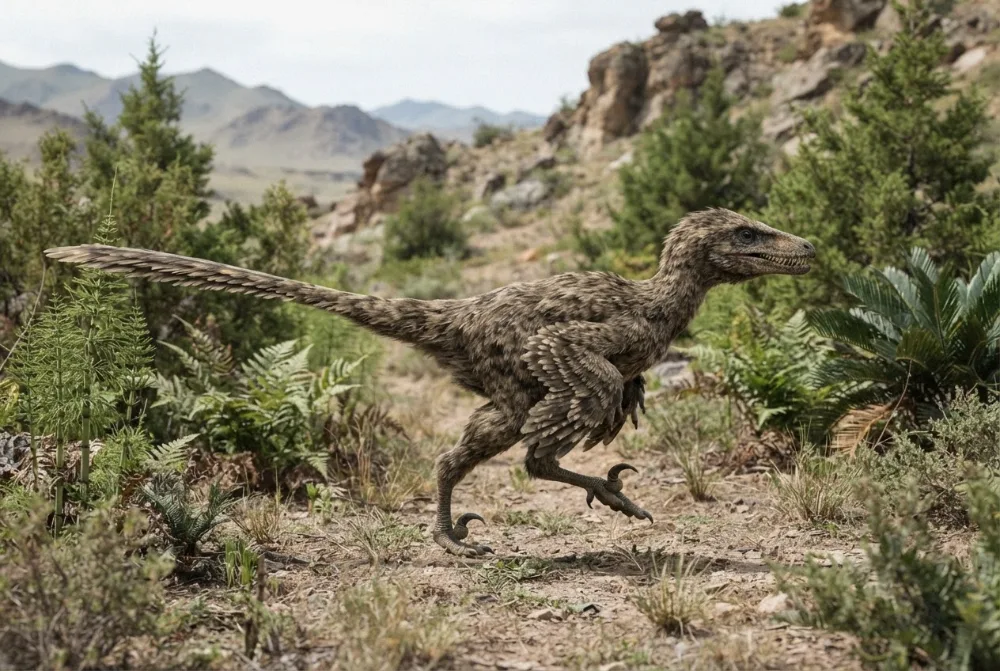
Shanag was a small predator, about 1.5 metres (4.9 feet) long and weighing around 5 kilograms (11 pounds).3
?Did Shanag have feathers?
Yes, as a theropod, Shanag had hollow bones and feathers. Its feathers helped with climbing, thermoregulation, and stabilizing while on prey.3
?What did Shanag eat?
Shanag was a meat-eating dinosaur with sharp teeth and claws. It likely used its claws to grip and pin down prey, similar to modern birds of prey.3
?Is Shanag a dromaeosaurid?
It may be a dromaeosaurid, but some researchers are skeptical. It shows a mix of dromaeosaurid, troodontid, and basal avialan traits, so its exact classification is debated.3
Ku bazobereye muri dinozore
- Izina rya siyansi
- Shanag
- Yiswe na
- Turner et al. 20074
- Itsinda
- Raputori
- Umuryango / ishami
- Dromaeosauridae4
- Ishyirwa mu byiciro
- Theropoda > Dromaeosauridae4
- Imyaka y'amabuye
- imyaka miliyoni 143 kugeza 100 (Berriasian / Albian)4
- Inzego z'amabuye
- Öösh4
- Ibihugu
- Mongoliya4
- Ibisigazwa byanditswe
- 1 muri The Paleobiology Database4
- Ivumburwa
- Shanag was named in 2007 by Alan H. Turner, Sunny H. Hwang, and Mark A. Norell. The only known fossil was found by a Mongolian Academy of Sciences,American Museum of Natural History expedition in 1999 at the Öösh locality in Mongolia.21
- Biracyagibwaho impaka
- Scientists are unsure about the exact size of Shanag because only a partial skull has been found.2
Aho amakuru yakuwe
- digitallibrary.amnh.org (digitallibrary.amnh.org)
- A small derived theropod from Öösh, early Cretaceous, Baykhangor Mongolia ; American Museum novitates, no. 3557 (digitallibrary.amnh.org)
- Shanag (en.wikipedia.org)
- Shanag in The Paleobiology Database (CC BY 4.0): imyaka, ahantu, inzego z'amabuye, ishyirwa mu byiciro.
Buri kintu kiri kuri uru rupapuro gifite nimero yerekana aho cyakuwe. Niba hari icyo twibeshye, tubabarire, turi abakunzi ba dinozore, ntituri ikinyamakuru cya siyansi. Tubwire kuri [email protected] tuzagikosora.
 Rex arashonje! Dino Wiki ni umushinga wa papa umwe yakoreye umuhungu we ukunda dinozore, ni ubuntu, nta matangazo kandi nta bigukurikirana. Abantu bakuru bashobora guha Rex akantu ko kurya kugira ngo Dino Wiki ikomeze kuboneka kuri interineti.Gaburira Rex
 Velociraptor
 Microraptor
 Deinonychus
 Asiamericana
 Richardoestesia
 Saurornitholestes
 Stegosaurus
 Iguanodon
 Archaeopteryx
 Giganotosaurus
 Baryonyx
 Paronychodon