 Uri dinozore iyihe? Umukino w'ibibazo
 Intambara ya dinozore
 Isiganwa rya dinozore
 Imikino mito ya dinozore
 Alubumu ya sitikeri
 Intonde za TOP za dinozore
 Ntungura!
Sinornithoides
Sinornithoides was a tiny, bird-like dinosaur that lived about 113 million years ago. It was probably a fast hunter of small prey like insects. One fossil was found curled up like a sleeping bird, with its snout tucked under its arm.12
Yabayeho ryari?
Yanganaga ite?
Yari ndende ite?
Ubutumburuke bwayo bwanganaga iki?
Yari iremereye ite?
 ndende nk'injangwe 2 zo mu rugo zikurikiranye🍌ndende nk'imineke 6 ikurikiranyeiremereye nk'injangwe yo mu rugo🍌iremereye nk'imineke 21🪑nto ku buryo yanyura munsi y'intebe🏃yashoboraga kwiruka metero 100 mu masegonda 14 (umuntu wihuta kurusha abandi akenera 9,6)
Sinornithoides yanganaga ite ugereranyije NAWE?
Ni imibare gusa ibarirwa muri mushakisha yawe. Nta kintu kibikwa cyangwa cyoherezwa ahandi.
Yihutaga ite?


Utuntu dushimishije
Sinornithoides had a sickle claw on its second toe, like other troodontids, which it may have used to grip prey.1
The fossil was preserved in a sleeping pose, with its snuck under one hand, just like a modern bird resting.1
Its skull was long and pointed, but the head was short compared to its body length.1
The teeth on the front of its upper jaw had no serrations, but the back teeth had small serrations only on one edge.1
Sinornithoides had a furcula (wishbone) and a basket of fifteen pairs of belly ribs called gastralia.1
Troodontids like Sinornithoides had some of the highest brain-to-body sizes among non-bird dinosaurs, meaning they were probably smart.1
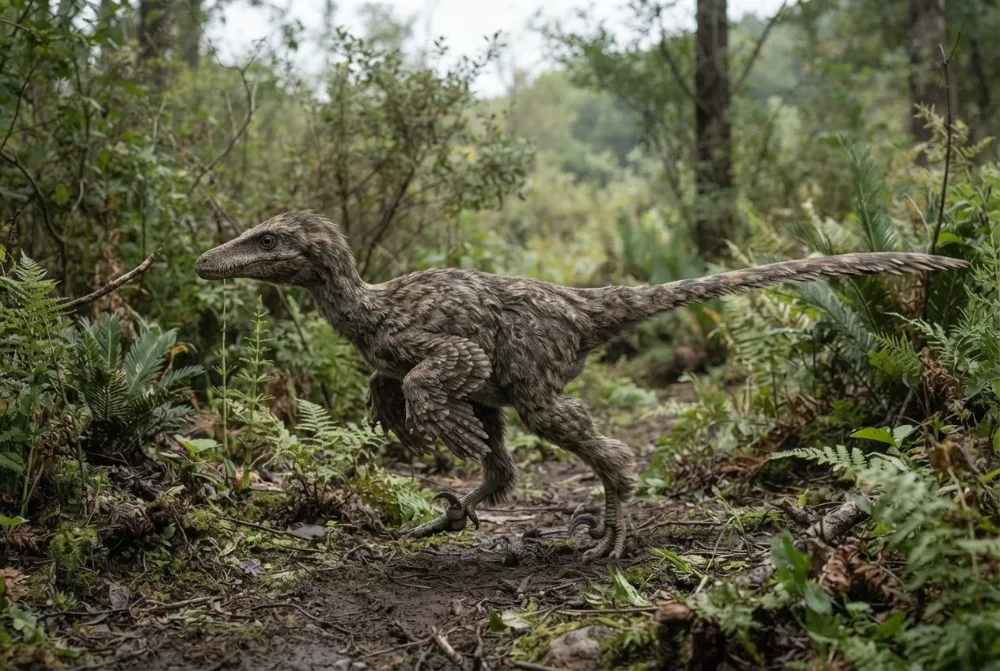
Ibibazo bibazwa cyane kuri Sinornithoides
?How big was Sinornithoides?
About 1 metre long, and weighed around 2.5 kilograms. That is about the size of a large chicken.13
?What did Sinornithoides eat?
It probably ate invertebrates and other small prey, like insects and lizards.1
?Was Sinornithoides a dinosaur?
Yes, it was a small, bird-like theropod dinosaur from the Early Cretaceous period.1
?Did Sinornithoides have feathers?
The sources do not mention feathers directly, but as a troodontid closely related to birds, it likely had feathers. Many troodontid fossils show evidence of feathers.1
Ku bazobereye muri dinozore
- Izina rya siyansi
- Sinornithoides
- Yiswe na
- Russell and Dong 19944
- Itsinda
- Raputori
- Umuryango / ishami
- Troodontidae4
- Ishyirwa mu byiciro
- Theropoda > Troodontidae4
- Imyaka y'amabuye
- imyaka miliyoni 113 kugeza 110 (Albian)4
- Inzego z'amabuye
- Zhonggou, Ejinhoro4
- Ibihugu
- Ubushinwa4
- Ibisigazwa byanditswe
- 2 muri The Paleobiology Database4
- Ivumburwa
- A Chinese-Canadian expedition found the nearly complete skeleton in 1988 near Huamuxiao, in the Ordos Basin of Inner Mongolia. Dale Russell and Dong Zhiming named it Sinornithoides youngi in 1993/1994, honoring paleontologist Yang Zhongjian.12
Aho amakuru yakuwe
- Sinornithoides (en.wikipedia.org)
- cdnsciencepub.com (cdnsciencepub.com)
- SINORNITHOIDES : DinoChecker dinosaur archive (dinochecker.com)
- Sinornithoides in The Paleobiology Database (CC BY 4.0): imyaka, ahantu, inzego z'amabuye, ishyirwa mu byiciro.
Buri kintu kiri kuri uru rupapuro gifite nimero yerekana aho cyakuwe. Niba hari icyo twibeshye, tubabarire, turi abakunzi ba dinozore, ntituri ikinyamakuru cya siyansi. Tubwire kuri [email protected] tuzagikosora.
 Rex arashonje! Dino Wiki ni umushinga wa papa umwe yakoreye umuhungu we ukunda dinozore, ni ubuntu, nta matangazo kandi nta bigukurikirana. Abantu bakuru bashobora guha Rex akantu ko kurya kugira ngo Dino Wiki ikomeze kuboneka kuri interineti.Gaburira Rex
 Velociraptor
 Microraptor
 Deinonychus
 Asiamericana
 Richardoestesia
 Saurornitholestes
 Stegosaurus
 Iguanodon
 Archaeopteryx
 Giganotosaurus
 Baryonyx
 Paronychodon