 Uri dinozore iyihe? Umukino w'ibibazo
 Intambara ya dinozore
 Isiganwa rya dinozore
 Imikino mito ya dinozore
 Alubumu ya sitikeri
 Intonde za TOP za dinozore
 Ntungura!
Yabayeho ryari?

Yanganaga ite?
Yari ndende ite?
Ubutumburuke bwayo bwanganaga iki?
Yari iremereye ite?
 ndende nk'imbwa 7 zikurikiranye🍌ndende nk'imineke 39 ikurikiranye🍉iremereye nk'imbuto 180 za watermelon🧸iremereye nk'abana 47 bo mu ishuri ry'incuke🎒iremereye nk'abanyeshuri 28🐻❄️iremereye nk'idubu 2 zo mu rubura🏃yashoboraga kwiruka metero 100 mu masegonda 11 (umuntu wihuta kurusha abandi akenera 9,6)
Tenontosaurus yanganaga ite ugereranyije NAWE?
Ni imibare gusa ibarirwa muri mushakisha yawe. Nta kintu kibikwa cyangwa cyoherezwa ahandi.
Yihutaga ite?


Utuntu dushimishije
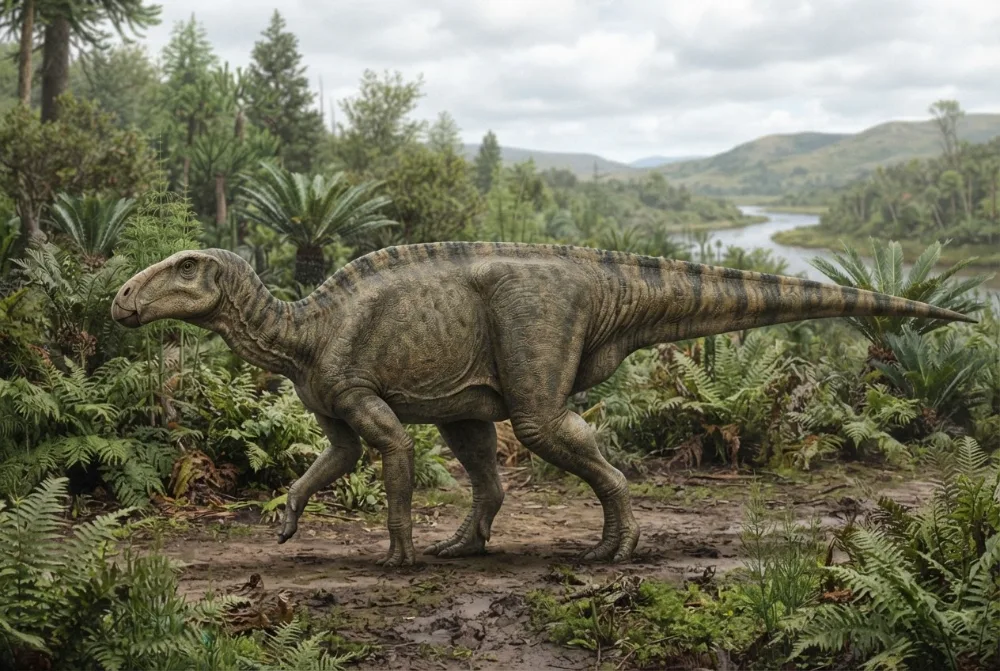
Tenontosaurus had an unusually long and broad tail, stiffened by a network of bony tendons, which is why it is called 'sinew lizard'.1
An adult Tenontosaurus could reach a browsing height of about 3 meters (10 feet) if it stood on its hind legs, but it usually walked on all fours.1
Its beak was U-shaped and thick, and its lower jaw had a special bone called a predentary that helped form the lower beak.1
Tenontosaurus lived alongside the predator Deinonychus, and fossils of both are common in the same rocks.1
The first Tenontosaurus fossil was found in 1903 in Montana, but it was not named until 1970.1
There are two species: Tenontosaurus tilletti and Tenontosaurus dossi. T. dossi is known from only a few specimens in Texas.1
Ibibazo bibazwa cyane kuri Tenontosaurus
?How big was Tenontosaurus?
About 6 to 8 metres long and around 1,000 kilograms, though estimates vary by species and study.12
?What did Tenontosaurus eat?
It was a plant-eater. It used its U-shaped beak and chopping teeth to eat leaves, wood, fruit, and low-growing ferns and shrubs.12
?Did Tenontosaurus walk on two legs or four?
It usually walked on all four legs, but could stand on its hind legs to reach higher plants, up to about 3 metres.12
?Was Tenontosaurus bigger than Deinonychus?
Yes, adult Tenontosaurus were much larger than adult Deinonychus. Deinonychus probably hunted young or sick Tenontosaurus.1
?When did Tenontosaurus live?
It lived during the Early Cretaceous period, about 115 to 108 million years ago, in western North America.12
?Why did Tenontosaurus have a long tail?
Its tail was unusually long and broad, stiffened by bony tendons. This helped support the tail, but scientists aren't sure of its exact purpose.1
Gusenya ibinyoma
Ibivugwa: Some people think Tenontosaurus was a slow, clumsy dinosaur.
Ukuri: Scientists think it was a common and successful herbivore, and its stiff tail may have helped it balance.1
Ku bazobereye muri dinozore
- Izina rya siyansi
- Tenontosaurus
- Yiswe na
- Ostrom 19704
- Itsinda
- Izirya ibimera zifite umunwa w'inyoni
- Umuryango / ishami
- Tenontosauridae4
- Ishyirwa mu byiciro
- Ornithischia > Ornithopoda > Iguanodontia4
- Imyaka y'amabuye
- imyaka miliyoni 121 kugeza 94 (Aptian / Cenomanian)4
- Inzego z'amabuye
- Cloverly, Antlers, Cedar Mountain4
- Ibihugu
- Amerika4
- Ibisigazwa byanditswe
- 83 muri The Paleobiology Database4
- Ivumburwa
- The first fossil was found in 1903 by an American Museum of Natural History expedition in Montana. John Ostrom named it Tenontosaurus tilletti in 1970 after studying many specimens.1
- Biracyagibwaho impaka
- Scientists still debate exactly how Tenontosaurus moved, whether it was mostly quadrupedal or could run on two legs.1
Aho amakuru yakuwe
- Tenontosaurus (en.wikipedia.org)
- Tenontosaurus | Natural History Museum (nhm.ac.uk)
- All about Tenontosaurus (animalia.bio)
- Tenontosaurus in The Paleobiology Database (CC BY 4.0): imyaka, ahantu, inzego z'amabuye, ishyirwa mu byiciro.
Buri kintu kiri kuri uru rupapuro gifite nimero yerekana aho cyakuwe. Niba hari icyo twibeshye, tubabarire, turi abakunzi ba dinozore, ntituri ikinyamakuru cya siyansi. Tubwire kuri [email protected] tuzagikosora.
 Rex arashonje! Dino Wiki ni umushinga wa papa umwe yakoreye umuhungu we ukunda dinozore, ni ubuntu, nta matangazo kandi nta bigukurikirana. Abantu bakuru bashobora guha Rex akantu ko kurya kugira ngo Dino Wiki ikomeze kuboneka kuri interineti.Gaburira Rex
 Iguanodon
 Thescelosaurus
 Zalmoxes
 Camptosaurus
 Rhabdodon
 Nanosaurus
 Stegosaurus
 Archaeopteryx
 Giganotosaurus
 Microraptor
 Deinonychus
 Baryonyx