 Uri dinozore iyihe? Umukino w'ibibazo
 Intambara ya dinozore
 Isiganwa rya dinozore
 Imikino mito ya dinozore
 Alubumu ya sitikeri
 Intonde za TOP za dinozore
 Ntungura!
Tsintaosaurus
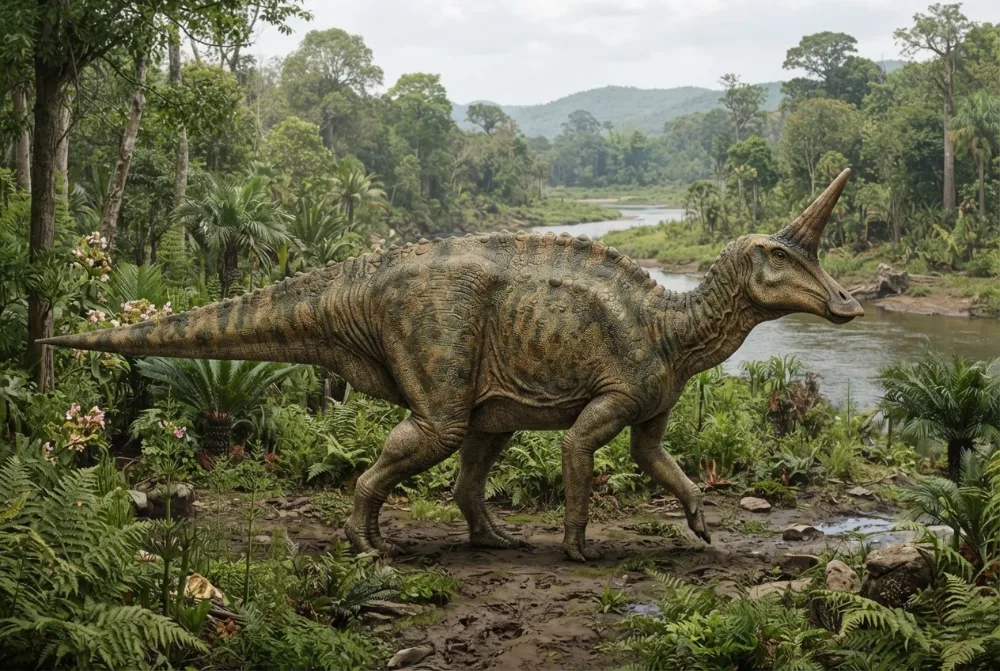
Tsintaosaurus was a duck-billed dinosaur that lived in China during the Late Cretaceous. It had a strange, hollow crest on its head that looked a bit like a unicorn horn. This plant-eater could walk on four legs or run on two to escape predators.21
Yabayeho ryari?
Yanganaga ite?
Yari ndende ite?
Ubutumburuke bwayo bwanganaga iki?
Yari iremereye ite?
 ndende nk'imodoka 2,5 ziparitse ku murongo🍌ndende nk'imineke 67 ikurikiranye
 iremereye nk'imbwa 120🍉iremereye nk'imbuto 500 za watermelon🎒iremereye nk'ibyumba 3 by'amashuri byuzuye abana🐻❄️iremereye nk'idubu 6 zo mu rubura🏃yashoboraga kwiruka metero 100 mu masegonda 14 (umuntu wihuta kurusha abandi akenera 9,6)
Tsintaosaurus yanganaga ite ugereranyije NAWE?
Ni imibare gusa ibarirwa muri mushakisha yawe. Nta kintu kibikwa cyangwa cyoherezwa ahandi.
Yihutaga ite?


Utuntu dushimishije
Tsintaosaurus was first thought to have a unicorn-like horn, but scientists now think the crest was actually part of a larger, hollow structure on its snout.2
The crest was hollow and may have been used to make loud honking sounds to communicate with other Tsintaosaurus.2
It lived about 84 to 71 million years ago, during the Campanian stage of the Late Cretaceous.1
Tsintaosaurus is known from skulls and a partial skeleton, so scientists are still learning about its body.1
Like other hadrosaurs, Tsintaosaurus probably traveled in herds for protection.2
The name Tsintaosaurus comes from the old spelling of Qingdao, the city near where it was found.2
Ibibazo bibazwa cyane kuri Tsintaosaurus
?How big was Tsintaosaurus?
About 8.3 metres (27 feet) long and weighed 2.5 tonnes (2.8 short tons), according to Wikipedia. The Natural History Museum gives a length of 12.0 metres, so estimates vary.21
?What did Tsintaosaurus eat?
It was a plant-eater. It had a duck-like beak and strong teeth for chewing vegetation.21
?Why did Tsintaosaurus have a crest?
The crest was hollow and may have been used to make loud honking sounds to communicate. It might also have helped attract mates, and the hollow tube made the crest lighter.24
?Could Tsintaosaurus swim?
It had a large tail that may have helped it swim, according to the Australian Museum. It probably lived near lakes and rivers.4
Gusenya ibinyoma
Ibivugwa: Tsintaosaurus had a single, solid horn like a unicorn.
Ukuri: The crest was actually hollow and was the back part of a larger, flat crest that ran from the tip of the snout.2
Ku bazobereye muri dinozore
- Izina rya siyansi
- Tsintaosaurus
- Yiswe na
- Young 19585
- Itsinda
- Iminwa y'imbata
- Umuryango / ishami
- Hadrosauridae5
- Ishyirwa mu byiciro
- Ornithischia > Ornithopoda > Iguanodontia > Hadrosauridae5
- Imyaka y'amabuye
- imyaka miliyoni 84 kugeza 72 (Campanian)5
- Inzego z'amabuye
- Jingangkou5
- Ibihugu
- Ubushinwa5
- Ibisigazwa byanditswe
- 4 muri The Paleobiology Database5
- Ivumburwa
- Chinese paleontologist C. C. Young named Tsintaosaurus in 1958 after fossils were found near Laiyang, Shandong, China.21
- Biracyagibwaho impaka
- Scientists still debate the exact shape and function of Tsintaosaurus's head crest, because only a few fossils have been found.2
Aho amakuru yakuwe
- Tsintaosaurus | Natural History Museum (nhm.ac.uk)
- Tsintaosaurus (en.wikipedia.org)
- Tsintaosaurus: Discover more about this Dinosaur | Dinosaurland (dinosaurland.es)
- Dinosaurs - Tsintaosaurus spinorhinus - The Australian Museum (australian.museum)
- Tsintaosaurus in The Paleobiology Database (CC BY 4.0): imyaka, ahantu, inzego z'amabuye, ishyirwa mu byiciro.
Buri kintu kiri kuri uru rupapuro gifite nimero yerekana aho cyakuwe. Niba hari icyo twibeshye, tubabarire, turi abakunzi ba dinozore, ntituri ikinyamakuru cya siyansi. Tubwire kuri [email protected] tuzagikosora.
 Rex arashonje! Dino Wiki ni umushinga wa papa umwe yakoreye umuhungu we ukunda dinozore, ni ubuntu, nta matangazo kandi nta bigukurikirana. Abantu bakuru bashobora guha Rex akantu ko kurya kugira ngo Dino Wiki ikomeze kuboneka kuri interineti.Gaburira Rex
 Parasaurolophus
 Edmontosaurus
 Saurolophus
 Hypacrosaurus
 Corythosaurus
 Kritosaurus
 Tyrannosaurus
 Triceratops
 Velociraptor
 Spinosaurus
 Ankylosaurus
 Pteranodon