 Uri dinozore iyihe? Umukino w'ibibazo
 Intambara ya dinozore
 Isiganwa rya dinozore
 Imikino mito ya dinozore
 Alubumu ya sitikeri
 Intonde za TOP za dinozore
 Ntungura!
Umoonasaurus
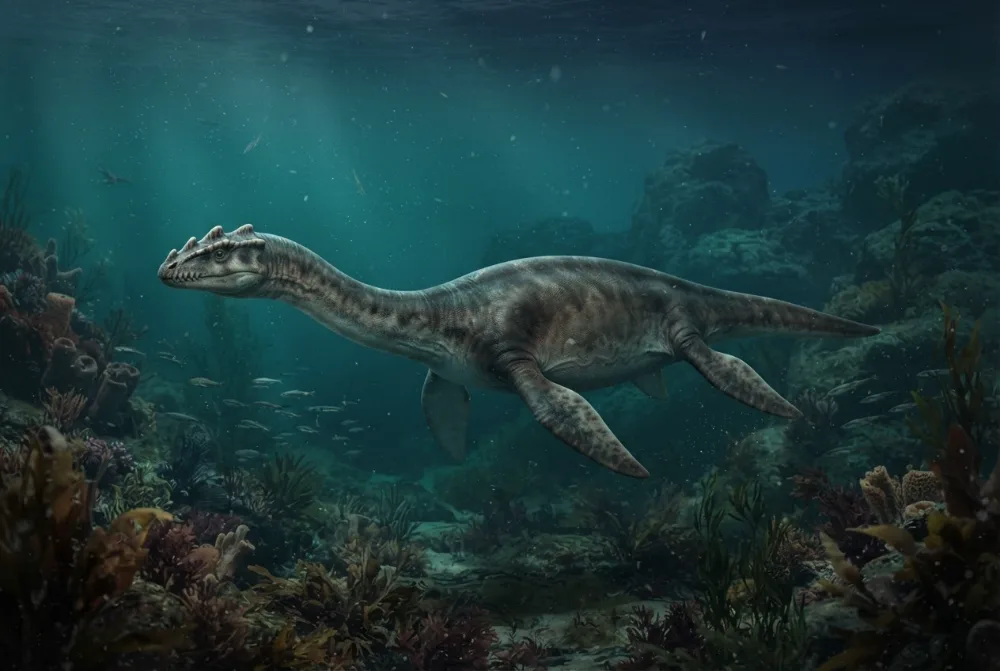
Umoonasaurus was a small, crested marine reptile that swam in cold seas near Antarctica about 115 million years ago. It had three bony crests on its head, like a tiny underwater dinosaur, but it was actually a plesiosaur, not a dinosaur. Its fossils are famous because they are preserved in beautiful blue opal.12
Yabayeho ryari?
Yanganaga ite?
Yari ndende ite?
 ndende nk'imbwa 2,5 zikurikiranye🍌ndende nk'imineke 14 ikurikiranye🏊yashoboraga koga uburebure bwa pisine nini (50 m) mu masegonda 6,9
Umoonasaurus yanganaga ite ugereranyije NAWE?
Ni imibare gusa ibarirwa muri mushakisha yawe. Nta kintu kibikwa cyangwa cyoherezwa ahandi.
Yihutaga ite?


Utuntu dushimishije
Umoonasaurus is known from several partial skeletons, and one of them is the most complete opalized vertebrate fossil ever found.1
It had three thin, blade-like crests on its skull: one along the top of its snout and a pair above its eyes. These crests may have been used for display, like a peacock's tail.1
Umoonasaurus lived in a cold, high-latitude inland sea near the South Pole, where water temperatures were near freezing.12
It was a small plesiosaur, only about 2.5 metres (8 feet) long as an adult. A juvenile specimen was less than 1 metre long.1
Umoonasaurus is the most primitive and also the last surviving member of its group, the rhomaleosaurids. It lived about 115 million years ago.12
Its tail ended in a 'pygostyle-like' structure made of fused vertebrae, similar to the tail tip of some modern birds.1
Ibibazo bibazwa cyane kuri Umoonasaurus
?What did Umoonasaurus eat?
Umoonasaurus ate small fish. Preserved gut contents show it ate small teleost fish.1
?Why did Umoonasaurus have crests?
Scientists think the three crests on its skull were used for display, like a peacock's tail, to help recognise each other or attract mates. They were too fragile for fighting.1
Ku bazobereye muri dinozore
- Izina rya siyansi
- Umoonasaurus
- Yiswe na
- Kear et al. 20065
- Itsinda
- Plesiyozore
- Umuryango / ishami
- Leptocleididae5
- Ishyirwa mu byiciro
- Plesiosauria > Sauropterygia5
- Imyaka y'amabuye
- imyaka miliyoni 121 kugeza 100 (Aptian / Albian)5
- Inzego z'amabuye
- Bulldog Shale5
- Ibihugu
- Ositaraliya5
- Ibisigazwa byanditswe
- 4 muri The Paleobiology Database5
- Ivumburwa
- Umoonasaurus was named in 2006 by Benjamin Kear and colleagues. The holotype skeleton, nicknamed 'Eric', was bought by public donations and is preserved in opal from the Zorba Extension Opal Field near Coober Pedy, Australia.1
- Biracyagibwaho impaka
- Scientists are not sure what the three crests on its head were used for. They were too fragile for fighting, so they might have been for display or recognizing other Umoonasaurus.1
Aho amakuru yakuwe
- An archaic crested plesiosaur in opal from the Lower Cretaceous high-latitude deposits of Australia (pmc.ncbi.nlm.nih.gov)
- An archaic crested plesiosaur in opal from the Lower Cretaceous high-latitude deposits of Australia (royalsocietypublishing.org)
- Umoonasaurus (en.wikipedia.org)
- Umoonasaurus demoscyllus - The Australian Museum (australian.museum)
- Umoonasaurus in The Paleobiology Database (CC BY 4.0): imyaka, ahantu, inzego z'amabuye, ishyirwa mu byiciro.
Buri kintu kiri kuri uru rupapuro gifite nimero yerekana aho cyakuwe. Niba hari icyo twibeshye, tubabarire, turi abakunzi ba dinozore, ntituri ikinyamakuru cya siyansi. Tubwire kuri [email protected] tuzagikosora.
 Rex arashonje! Dino Wiki ni umushinga wa papa umwe yakoreye umuhungu we ukunda dinozore, ni ubuntu, nta matangazo kandi nta bigukurikirana. Abantu bakuru bashobora guha Rex akantu ko kurya kugira ngo Dino Wiki ikomeze kuboneka kuri interineti.Gaburira Rex
 Elasmosaurus
 Pliosaurus
 Plesiosaurus
 Cimoliasaurus
 Colymbosaurus
 Trinacromerum
 Stegosaurus
 Iguanodon
 Archaeopteryx
 Giganotosaurus
 Microraptor
 Deinonychus