 Uri dhino ripi? Kwizi
 Hondo yemadhino
 Mujaho wemadhino
 Mitambo midiki yemadhino
 Arubhamu yemasitika
 Rondedzero dzeTOP dzemadhino
 Ndishamise!
Ceratocaudia
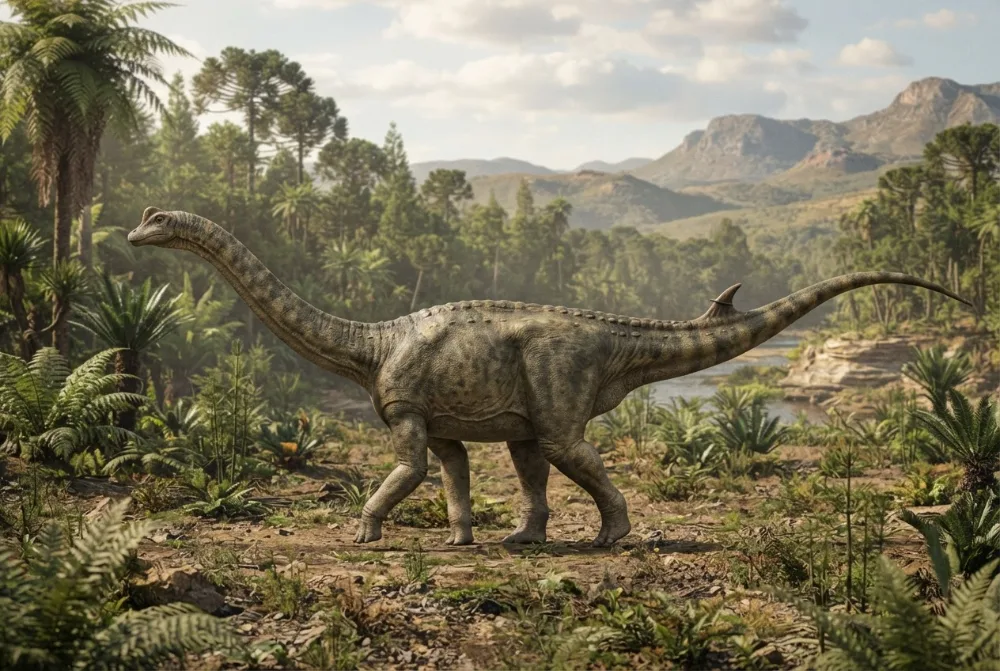
Ceratocaudia was a small, plant-eating sauropod dinosaur that lived in what is now India during the Jurassic Period. It had a horn-like crest on its tail bones, and scientists think it might have used its tail to scare away predators.1
Rairarama rini?
Raiva hombe sei?
Raiva refu zvakadii?
Raiva rakakwirira zvakadii?
fungidziro
 kureba seimbwa 7 kubva pamhino kusvika kumuswe🍌kureba semabhanana 39 akatevedzana🏃raigona kumhanya mamita 100 mumasekonzi 12 (munhu anomhanya kupfuura vose anoda 9.6)
Ceratocaudia raiva hombe sei kana richienzaniswa NEWE?
Masvomhu chete mubrowser yako. Hapana chinochengetwa kana kutumirwa kupi zvako.
Raimhanya zvakadii?


Zvinonakidza
Ceratocaudia is one of the smallest known macronarian sauropods, measuring only about 7 metres (23 feet) long.1
The horn-like crest on its tail vertebrae gave the dinosaur its name, meaning 'horned tail'.1
Scientists think Ceratocaudia might have been a dwarf species because the only known skeleton is from an old individual but is still very small.13
The holotype skeleton includes neck bones, tail bones, an ulna, thighbones, shinbones, and even finger and toe bones.1
Ceratocaudia lived in an estuary environment alongside petrified wood, clams, and a much larger sauropod that was about 20 metres long.1
Mibvunzo inonyanya kubvunzwa nezve Ceratocaudia
?How big was Ceratocaudia?
Ceratocaudia was about 7 metres (23 feet) long, making it one of the smallest known macronarian sauropods.1
?Did Ceratocaudia have a horn on its tail?
Yes, it had a horn-like crest on its tail bones, which is why its name means 'horned tail'.1
?What did Ceratocaudia eat?
Ceratocaudia was a plant-eater, or herbivore.4
?When did Ceratocaudia live?
Ceratocaudia lived during the Jurassic Period, from about 201 to 168 million years ago.4
?Where was Ceratocaudia found?
Its fossils were found in Gujarat, India, in rocks that were once a low-energy estuary.1
?Could Ceratocaudia use its tail to fight?
Scientists think it could swing its tail as a mild deterrent to scare away predators.1
Zvevanyanzvi vemadhino
- Zita resainzi
- Ceratocaudia
- Akaripa zita:
- Natarajan et al. 20264
- Boka
- Madhino emitsipa mirefu
- Mhuri / boka
- Macronaria4
- Kurongwa kwemhuka
- Sauropodomorpha > Sauropoda > Macronaria4
- Zera rematombo
- makore mamiriyoni 201 kusvika 168 (Hettangian / Bajocian)4
- Mapoka ematombo
- Kaladongar4
- Nyika
- India4
- Zvinyorwa zvemafosiri
- 1 mu The Paleobiology Database4
- Kuwanikwa
- Ceratocaudia antiqua was named by Abhishek Natarajan and colleagues in 2026 based on a partial skeleton found in the Kaladongar Formation of Gujarat, India.12
- Zvichiri kupokanwa
- Scientists are not sure if Ceratocaudia was a true dwarf species or just a small adult, and they debate its exact place on the sauropod family tree.13
Kunobva chokwadi
- Ceratocaudia (en.wikipedia.org)
- PBDB Taxon (paleobiodb.org)
- A new diminutive Jurassic neosauropod from the Kaladongar Formation (Khadir Uplift) of the Kachchh Basin, western India (exa.ai)
- Ceratocaudia in The Paleobiology Database (CC BY 4.0): zera, nzvimbo, mapoka ematombo, kurongwa kwemhuka.
Chokwadi chega chega papeji ino chine nhamba inoratidza kwachakabva. Kana takakanganisa chimwe chinhu, ruregerero, tiri vanoda madhino, kwete magazini yesainzi. Tiudze pa [email protected] tichazvigadzirisa.
 Rex ane nzara! Dino Wiki ipurojekiti yababa yemwanakomana wavo anoda madhino, mahara, pasina kushambadza uye pasina zvinokutevera. Vakuru vanogona kupa Rex chekudyadya kuti vabatsire kuchengeta saiti iri pamhepo.Fudza Rex
 Brachiosaurus
 Diplodocus
 Brontosaurus
 Argentinosaurus
 Camarasaurus
 Morosaurus
 Dilophosaurus
 Stenopterygius
 Dorygnathus
 Scutellosaurus
 Sinosaurus
 Temnodontosaurus