 Uri dhino ripi? Kwizi
 Hondo yemadhino
 Mujaho wemadhino
 Mitambo midiki yemadhino
 Arubhamu yemasitika
 Rondedzero dzeTOP dzemadhino
 Ndishamise!
Hamipterus
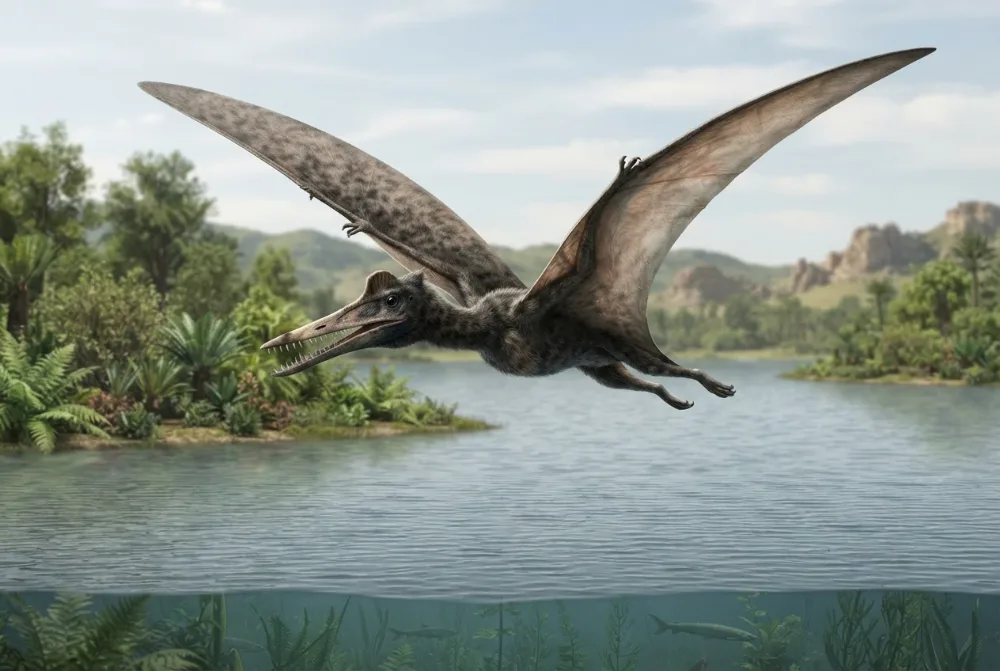
Hamipterus was a flying reptile with a wingspan as wide as a car! It lived in a big lake area in China and ate fish. Hundreds of Hamipterus fossils were found together, including eggs and soft parts like skin.12
Rairarama rini?
Raiva hombe sei?
Mapapiro aro aiva akapamhama zvakadii?
 mapapiro akapamhama semabhasikoro 2 akatevedzana⚽raigona kubhururuka richiyambuka nhandare yose yebhora mumasekonzi 6.4
Hamipterus raiva hombe sei kana richienzaniswa NEWE?
Masvomhu chete mubrowser yako. Hapana chinochengetwa kana kutumirwa kupi zvako.
Raimhanya zvakadii?


Zvinonakidza
Hamipterus fossils were found in huge numbers, probably from a nesting colony that was buried by a storm. Over 40 individuals were collected, and there may have been hundreds.1
Unlike most pterosaurs, Hamipterus bones are three-dimensional and not squashed flat. Scientists even found the horny sheaths that covered its head crests.1
Five uncrushed eggs were found with the Hamipterus fossils. That is very rare for pterosaurs.1
Hamipterus had a hook-shaped bony process on the tip of its lower jaw, which scientists think helped it grab slippery fish.3
Male and female Hamipterus looked different. The paratype skull is thought to be from a male, while the holotype is probably a female.1
The tooth enamel of Hamipterus was very thin, only covering about half of each tooth crown.1
Mibvunzo inonyanya kubvunzwa nezve Hamipterus
?How big was Hamipterus?
Hamipterus had a wingspan of 1.5 to 3.5 metres, which is about as wide as a small car.1
?Did Hamipterus have feathers?
No, Hamipterus was a pterosaur, a flying reptile, not a dinosaur. Pterosaurs did not have feathers; they had a fur-like covering called pycnofibers.1
?What did Hamipterus eat?
Hamipterus ate fish. It had a hook-shaped bony process on the tip of its lower jaw that helped it grab slippery fish.1
Zvevanyanzvi vemadhino
- Zita resainzi
- Hamipterus
- Akaripa zita:
- Wang et al. 20144
- Boka
- Zvinokambaira zvinobhururuka
- Mhuri / boka
- Pteranodontoidea4
- Kurongwa kwemhuka
- Pterosauria > Pterodactyloidea4
- Zera rematombo
- makore mamiriyoni 137 kusvika 133 (Valanginian)4
- Mapoka ematombo
- Shengjinkou4
- Nyika
- China4
- Zvinyorwa zvemafosiri
- 4 mu The Paleobiology Database4
- Kuwanikwa
- Hamipterus was named in 2014 by Wang Xiaolin and a team of scientists. The fossils were found in the Hami region of Xinjiang, China, starting in 2006.1
- Zvichiri kupokanwa
- Scientists are not sure exactly where Hamipterus fits in the pterosaur family tree. It may be close to Istiodactylus, Ludodactylus, or the Anhangueridae.1
Kunobva chokwadi
- Hamipterus (en.wikipedia.org)
- The first dinosaurs from the Early Cretaceous Hami Pterosaur Fauna, China (pmc.ncbi.nlm.nih.gov)
- PBDB Taxon (paleobiodb.org)
- Hamipterus in The Paleobiology Database (CC BY 4.0): zera, nzvimbo, mapoka ematombo, kurongwa kwemhuka.
Chokwadi chega chega papeji ino chine nhamba inoratidza kwachakabva. Kana takakanganisa chimwe chinhu, ruregerero, tiri vanoda madhino, kwete magazini yesainzi. Tiudze pa [email protected] tichazvigadzirisa.
 Rex ane nzara! Dino Wiki ipurojekiti yababa yemwanakomana wavo anoda madhino, mahara, pasina kushambadza uye pasina zvinokutevera. Vakuru vanogona kupa Rex chekudyadya kuti vabatsire kuchengeta saiti iri pamhepo.Fudza Rex
 Pteranodon
 Quetzalcoatlus
 Dorygnathus
 Rhamphorhynchus
 Anhanguera
 Pterodactylus
 Stegosaurus
 Iguanodon
 Archaeopteryx
 Giganotosaurus
 Microraptor
 Deinonychus