 Uri dhino ripi? Kwizi
 Hondo yemadhino
 Mujaho wemadhino
 Mitambo midiki yemadhino
 Arubhamu yemasitika
 Rondedzero dzeTOP dzemadhino
 Ndishamise!
Rairarama rini?

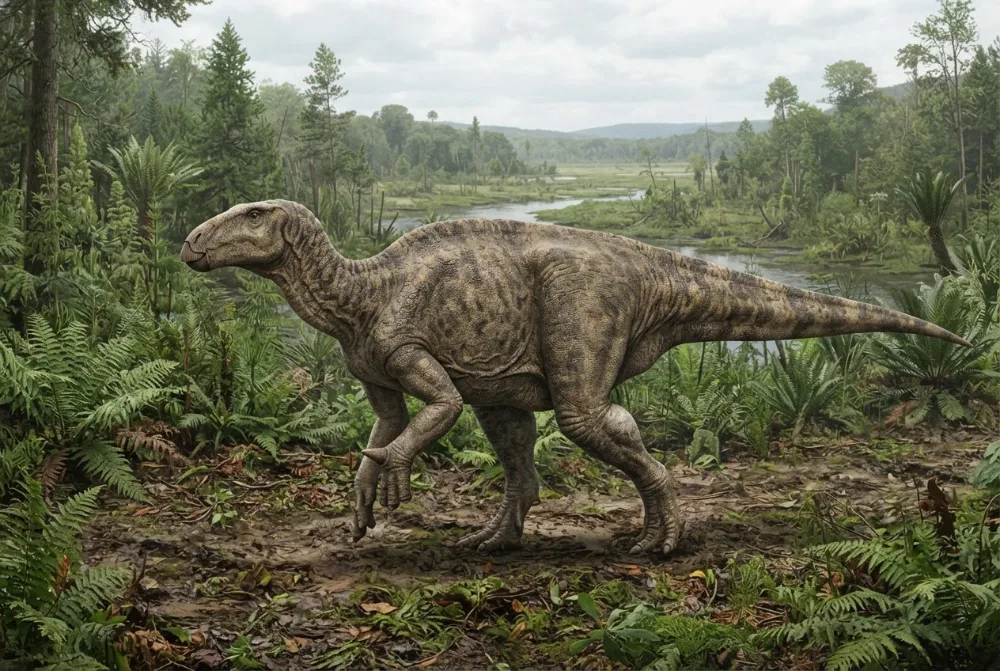
Raiva hombe sei?
Raiva refu zvakadii?
Raiva rakakwirira zvakadii?
Rairema zvakadii?
 kureba semotokari 2.5 dzakamiswa dzakatevedzana🍌kureba semabhanana 61 akatevedzana
 kurema kunenge senzou🍉kurema semanwiwa 1000🎒kurema semakirasi 6 akazara evana vechikoro🐻❄️kurema semabere echando 11🏃raigona kumhanya mamita 100 mumasekonzi 15 (munhu anomhanya kupfuura vose anoda 9.6)
Iguanodon raiva hombe sei kana richienzaniswa NEWE?
Masvomhu chete mubrowser yako. Hapana chinochengetwa kana kutumirwa kupi zvako.
Raimhanya zvakadii?


Zvinonakidza
Iguanodon was named in 1825 by Gideon Mantell after he found teeth that looked like iguana teeth.1
Its thumb had a big, sharp spike that scientists think was used for defense against predators.1
Iguanodon had a flexible little finger that could grasp objects, unlike its other fingers which were more like hooves.1
When Iguanodon closed its mouth, the bones in its upper jaw would bow out, making the teeth grind against each other like a chewing motion.1
The front of Iguanodon's mouth had no teeth, just a bony beak covered with a hard material for cropping plants.1
Iguanodon could reach food from ground level up to 4 to 5 metres (13 to 16 feet) high, so it ate both low plants and tree leaves.1
In 1878, many complete Iguanodon skeletons were found in a coal mine in Bernissart, Belgium, which helped scientists understand the dinosaur much better.1
Mibvunzo inonyanya kubvunzwa nezve Iguanodon
?How big was Iguanodon?
Iguanodon was about 9 to 11 metres (30 to 36 feet) long and weighed around 4.5 metric tons (5 short tons).1
?What did Iguanodon eat?
Iguanodon was a plant-eater. It used its beak to snip leaves and its cheek teeth to grind tough plants like cycads.34
?Did Iguanodon have a thumb spike?
Yes, Iguanodon had a large, sharp spike on each thumb. It may have been used for defense or for breaking into fruits and seeds.35
?Could Iguanodon walk on two legs?
Yes, Iguanodon could walk on two legs or on all fours. It was one of the few dinosaurs that could do both.34
?When did Iguanodon live?
Iguanodon lived during the Early Cretaceous period, about 126 to 122 million years ago.1
?Who discovered Iguanodon?
Iguanodon was named by Gideon Mantell in 1825 after teeth were found in Sussex, England. His wife Mary Ann Mantell is often credited with finding the first teeth.51
?Was Iguanodon a dinosaur?
Yes, Iguanodon was a dinosaur. It was one of the first dinosaurs ever named, after Megalosaurus.1
?How fast could Iguanodon run?
Up to about 24 km/h (15 mph) on two legs, about as fast as a grown-up riding a bike. Most of the time it walked much slower.4
Mubvisi wengano
Ngano: Iguanodon was a slow, clumsy dinosaur that always walked on four legs.
Chokwadi: Iguanodon could walk on two legs or all fours, and it was probably quite agile for its size.2
Zvevanyanzvi vemadhino
- Zita resainzi
- Iguanodon
- Akaripa zita:
- Mantell 18256
- Boka
- Vanodya miriwo vane miromo
- Mhuri / boka
- Ankylopollexia6
- Kurongwa kwemhuka
- Ornithischia > Ornithopoda > Iguanodontia6
- Zera rematombo
- makore mamiriyoni 155 kusvika 66 (Kimmeridgian / Maastrichtian)6
- Mapoka ematombo
- Arcillas de Morella, Weald Clay, Wessex6
- Nyika
- United Kingdom, Spain, Germany, France, Portugal, Belgium6
- Zvinyorwa zvemafosiri
- 133 mu The Paleobiology Database6
- Rinonziwo
- Heterosaurus, Iguanosaurus, Struthopus, Therosaurus (mazita ekare zvino oonekwa semhuka imwe chete)6
- Kuwanikwa
- Iguanodon was first named by Gideon Mantell in 1825 based on fossil teeth found in Sussex, England. Later, in 1878, many complete skeletons were discovered in a Belgian coal mine and studied by Louis Dollo.1
- Zvichiri kupokanwa
- Scientists still debate exactly what plants Iguanodon ate. Some think it ate horsetails, cycads, and conifers, while others link it to the spread of flowering plants.1
Kunobva chokwadi
- Iguanodon (en.wikipedia.org)
- Iguanodon | Diet, Habitat & Extinction (britannica.com)
- Iguanodon | National Geographic Kids (kids.nationalgeographic.com)
- enchantedlearning.com (enchantedlearning.com)
- Iguanodon: the teeth that led to a dinosaur discovery | Natural History Museum (nhm.ac.uk)
- Iguanodon in The Paleobiology Database (CC BY 4.0): zera, nzvimbo, mapoka ematombo, kurongwa kwemhuka.
Chokwadi chega chega papeji ino chine nhamba inoratidza kwachakabva. Kana takakanganisa chimwe chinhu, ruregerero, tiri vanoda madhino, kwete magazini yesainzi. Tiudze pa [email protected] tichazvigadzirisa.
 Rex ane nzara! Dino Wiki ipurojekiti yababa yemwanakomana wavo anoda madhino, mahara, pasina kushambadza uye pasina zvinokutevera. Vakuru vanogona kupa Rex chekudyadya kuti vabatsire kuchengeta saiti iri pamhepo.Fudza Rex
 Tenontosaurus
 Thescelosaurus
 Zalmoxes
 Camptosaurus
 Rhabdodon
 Nanosaurus
 Stegosaurus
 Archaeopteryx
 Giganotosaurus
 Microraptor
 Deinonychus
 Baryonyx