 Uri dhino ripi? Kwizi
 Hondo yemadhino
 Mujaho wemadhino
 Mitambo midiki yemadhino
 Arubhamu yemasitika
 Rondedzero dzeTOP dzemadhino
 Ndishamise!
Lagenanectes
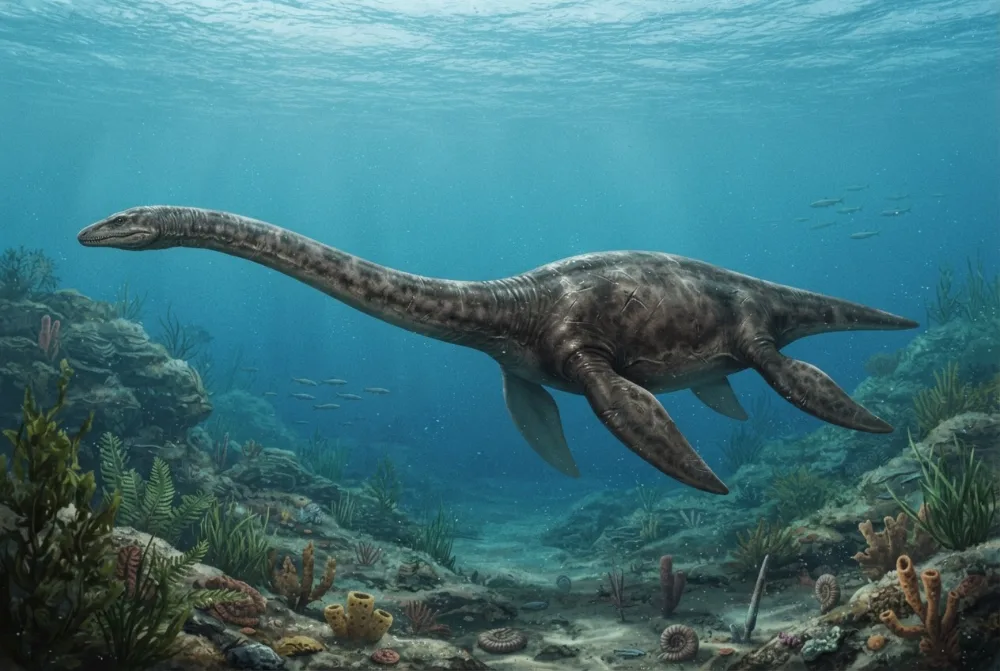
Lagenanectes was a long-necked marine reptile that swam in the seas of what is now Germany. It was not a dinosaur, but a plesiosaur, and it used its four flippers to paddle through the water. This ancient creature grew to about 8 meters long, as long as a school bus!21
Rairarama rini?
Raiva hombe sei?
Raiva refu zvakadii?
 kureba seimbwa 8 kubva pamhino kusvika kumuswe🍌kureba semabhanana 44 akatevedzana🏊raigona kushambira kureba kwedziva guru rekushambira (50 m) mumasekonzi 7.5
Lagenanectes raiva hombe sei kana richienzaniswa NEWE?
Masvomhu chete mubrowser yako. Hapana chinochengetwa kana kutumirwa kupi zvako.
Raimhanya zvakadii?


Zvinonakidza
Lagenanectes is one of the earliest known elasmosaurids, a group of plesiosaurs with very long necks. It lived about 130 million years ago during the Early Cretaceous.21
The front part of its lower jaw had a unique platform with dents, and the tooth sockets pointed sideways. This is different from most other plesiosaurs.1
Grooves on the top of its skull may have held electroreceptors, which helped Lagenanectes detect prey hidden in the dark water.1
The only known fossil of Lagenanectes shows signs of bone disease. The back of the skull and first neck vertebra had bony outgrowths, possibly from a bacterial infection.21
The fossil was discovered in 1964 by a private collector named Kurt Wiedenroth in a clay pit near Sarstedt, Germany. The pit no longer exists.21
Lagenanectes was named in 2017, more than 50 years after its discovery. Scientists finally studied the bones and realized it was a new genus.1
Zvevanyanzvi vemadhino
- Zita resainzi
- Lagenanectes
- Akaripa zita:
- Sachs et al. 20174
- Boka
- Mapresiosauro
- Mhuri / boka
- Elasmosauridae4
- Kurongwa kwemhuka
- Plesiosauria > Elasmosauridae > Sauropterygia4
- Zera rematombo
- makore mamiriyoni 133 kusvika 126 (Hauterivian)4
- Mapoka ematombo
- Stadthagen4
- Nyika
- Germany4
- Zvinyorwa zvemafosiri
- 1 mu The Paleobiology Database4
- Kuwanikwa
- Lagenanectes was discovered in 1964 by fossil collector Kurt Wiedenroth in a clay pit near Sarstedt, Germany. It was named and described as a new genus and species by Sven Sachs, Jahn J. Hornung and Benjamin P. Kear in 2017.21
- Zvichiri kupokanwa
- The exact age of the Lagenanectes fossil is uncertain. It could be from the lower Hauterivian to lower Barremian stages, but scientists think it is most likely upper Hauterivian.21
Kunobva chokwadi
- Lagenanectes (en.wikipedia.org)
- Lagenanectes richterae, an early elasmosaurid from Germany (sachspal.de)
- PBDB Taxon (paleobiodb.org)
- Lagenanectes in The Paleobiology Database (CC BY 4.0): zera, nzvimbo, mapoka ematombo, kurongwa kwemhuka.
Chokwadi chega chega papeji ino chine nhamba inoratidza kwachakabva. Kana takakanganisa chimwe chinhu, ruregerero, tiri vanoda madhino, kwete magazini yesainzi. Tiudze pa [email protected] tichazvigadzirisa.
 Rex ane nzara! Dino Wiki ipurojekiti yababa yemwanakomana wavo anoda madhino, mahara, pasina kushambadza uye pasina zvinokutevera. Vakuru vanogona kupa Rex chekudyadya kuti vabatsire kuchengeta saiti iri pamhepo.Fudza Rex
 Elasmosaurus
 Pliosaurus
 Plesiosaurus
 Cimoliasaurus
 Colymbosaurus
 Trinacromerum
 Stegosaurus
 Iguanodon
 Archaeopteryx
 Giganotosaurus
 Microraptor
 Deinonychus