 Uri dhino ripi? Kwizi
 Hondo yemadhino
 Mujaho wemadhino
 Mitambo midiki yemadhino
 Arubhamu yemasitika
 Rondedzero dzeTOP dzemadhino
 Ndishamise!
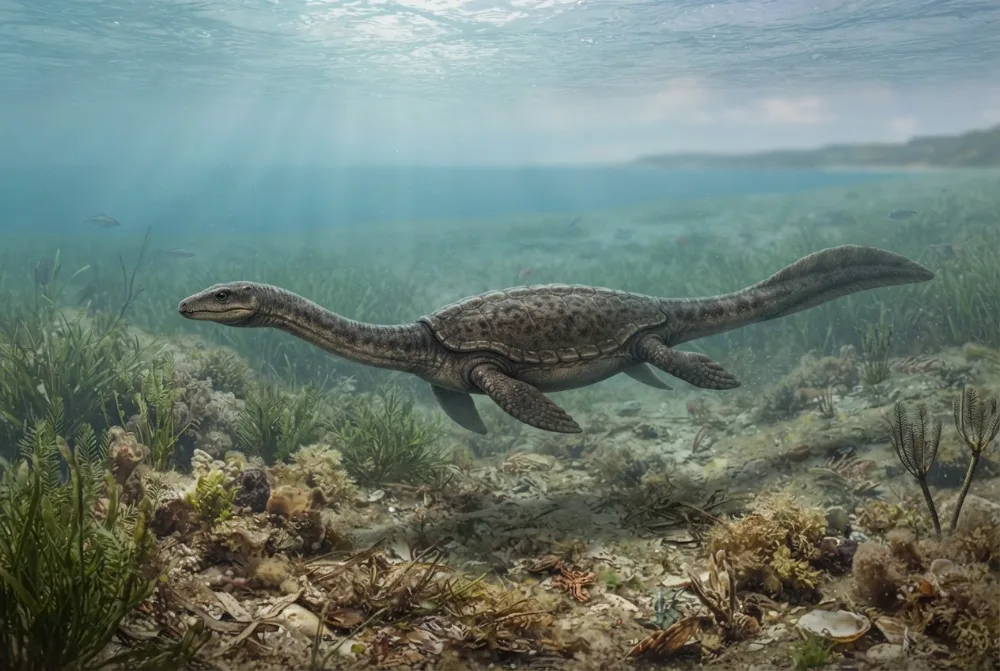
Paludidraco
Paludidraco was a strange marine reptile that lived in shallow seas over 200 million years ago. It had a very heavy, dense skeleton that helped it stay underwater without swimming much, like a manatee. Its jaws were weak and filled with many tiny teeth, so it probably sucked up soft plants or small animals from the seafloor.2
Rairarama rini?
Raiva hombe sei?
Raiva refu zvakadii?
 kureba seimbwa 2.5 kubva pamhino kusvika kumuswe🍌kureba semabhanana 14 akatevedzana🏊raigona kushambira kureba kwedziva guru rekushambira (50 m) mumasekonzi 8.6
Paludidraco raiva hombe sei kana richienzaniswa NEWE?
Masvomhu chete mubrowser yako. Hapana chinochengetwa kana kutumirwa kupi zvako.
Raimhanya zvakadii?


Zvinonakidza
Paludidraco had an extremely heavy, pachyostotic skeleton, meaning its bones were very thick and dense. This helped it float at shallow depths without using much energy, just like modern manatees.2
Its jaws were very slender and weak, and its teeth were small, curved, and set in a groove (pleurodont implantation). This is very different from most other marine reptiles of its time.1
Paludidraco had more than 15 teeth in its premaxilla (the front part of the upper jaw), which is a unique feature among its family, Simosauridae.1
Scientists think Paludidraco was not an active predator. Its weak jaws could not catch struggling prey, and its heavy body made it slow and not very maneuverable.1
The name Paludidraco comes from Latin words meaning 'marshy dragon', because its fossils were found near a reservoir called El Atance in Spain.1
Paludidraco lived during the Late Triassic period, about 237 to 205 million years ago, in what is now central Spain.4
Zvevanyanzvi vemadhino
- Zita resainzi
- Paludidraco
- Akaripa zita:
- de Miguel Chaves et al. 20184
- Boka
- Zvinokambaira zvemugungwa
- Mhuri / boka
- Simosauridae4
- Kurongwa kwemhuka
- Nothosauria > Sauropterygia4
- Zera rematombo
- makore mamiriyoni 237 kusvika 206 (Carnian / Norian)4
- Mapoka ematombo
- Keuper4
- Nyika
- Spain4
- Zvinyorwa zvemafosiri
- 1 mu The Paleobiology Database4
- Kuwanikwa
- Paludidraco multidentatus was named in 2018 by scientists de Miguel Chaves, Ortega, and Pérez-García. They described it from two well-preserved skeletons found at the El Atance site in central Spain.41
- Zvichiri kupokanwa
- Scientists are not sure whether Paludidraco was a true filter feeder like some whales, or if it used its comb-like teeth to scrape soft plants from the seafloor. Its skull lacks some features seen in modern filter feeders.1
Kunobva chokwadi
- New highly pachyostotic nothosauroid interpreted as a filter ... (pmc.ncbi.nlm.nih.gov)
- New highly pachyostotic nothosauroid interpreted as a filter-feeding Triassic (royalsocietypublishing.org)
- Paludidraco (en.wikipedia.org)
- Paludidraco in The Paleobiology Database (CC BY 4.0): zera, nzvimbo, mapoka ematombo, kurongwa kwemhuka.
Chokwadi chega chega papeji ino chine nhamba inoratidza kwachakabva. Kana takakanganisa chimwe chinhu, ruregerero, tiri vanoda madhino, kwete magazini yesainzi. Tiudze pa [email protected] tichazvigadzirisa.
 Rex ane nzara! Dino Wiki ipurojekiti yababa yemwanakomana wavo anoda madhino, mahara, pasina kushambadza uye pasina zvinokutevera. Vakuru vanogona kupa Rex chekudyadya kuti vabatsire kuchengeta saiti iri pamhepo.Fudza Rex
 Nothosaurus
 Placodus
 Lariosaurus
 Cyamodus
 Cymatosaurus
 Proneusticosaurus
 Massospondylus
 Plateosaurus
 Coelophysis
 Podokesaurus
 Thecodontosaurus
 Eudimorphodon