 Uri dhino ripi? Kwizi
 Hondo yemadhino
 Mujaho wemadhino
 Mitambo midiki yemadhino
 Arubhamu yemasitika
 Rondedzero dzeTOP dzemadhino
 Ndishamise!
Peloneustes
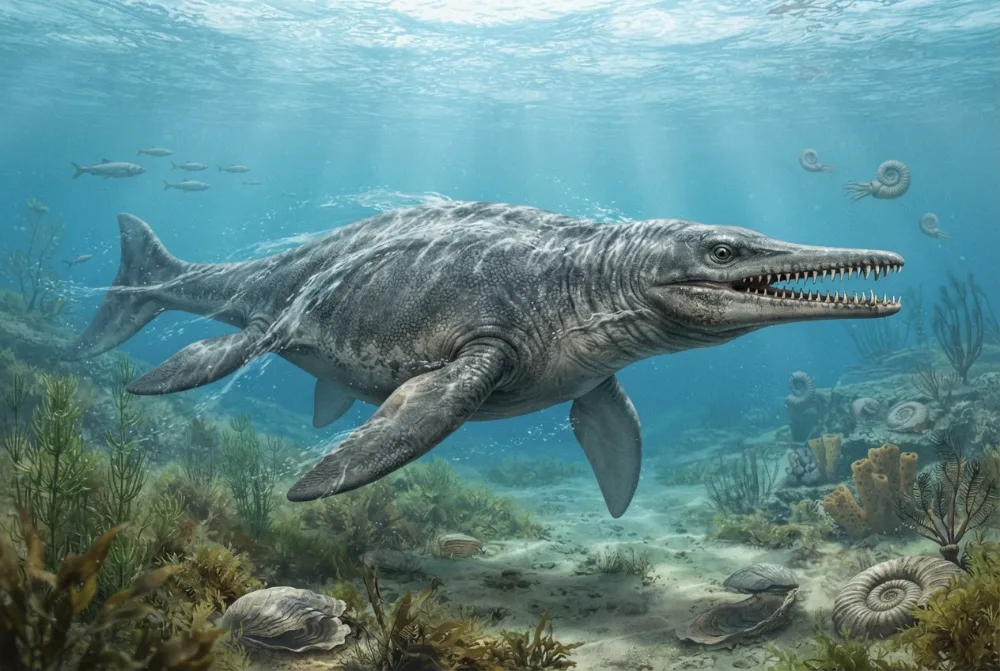
Peloneustes was a pliosaur, a kind of short-necked plesiosaur that lived in a shallow sea. It had a long, narrow snout like a dolphin and many sharp teeth for catching fish. This marine reptile was a fast and fierce hunter in the water.1
Rairarama rini?
Raiva hombe sei?
Raiva refu zvakadii?
Rairema zvakadii?
 kureba seimbwa 4 kubva pamhino kusvika kumuswe🍌kureba semabhanana 24 akatevedzana🍉kurema semanwiwa 200🧸kurema sevana vekireshi 53🎒kurema sevana vechikoro 31🐻❄️kurema semabere echando 2🏊raigona kushambira kureba kwedziva guru rekushambira (50 m) mumasekonzi 6.7
Peloneustes raiva hombe sei kana richienzaniswa NEWE?
Masvomhu chete mubrowser yako. Hapana chinochengetwa kana kutumirwa kupi zvako.
Raimhanya zvakadii?


Zvinonakidza
Peloneustes lived about 165 to 161 million years ago during the Middle Jurassic period.3
Its name means 'mud swimmer' because its fossils were found in mud from an ancient sea.1
Peloneustes had a long, narrow snout that was shaped like a dolphin's beak. This helped it move quickly through the water.1
It had 30 to 31 teeth in its upper jaw and 36 to 44 teeth in its lower jaw. The teeth were sharp and slightly curved for piercing fish.2
Peloneustes shared its sea home with other marine reptiles like ichthyosaurs and other plesiosaurs. At least five different pliosaurids lived in the same area.1
The sea where Peloneustes swam was only about 30 to 50 metres (100 to 160 feet) deep. It was a shallow inland sea.1
Mibvunzo inonyanya kubvunzwa nezve Peloneustes
?How big was Peloneustes?
Peloneustes was about 3.5 to 4 metres (11 to 13 feet) long. This is small for a pliosaurid.1
?What did Peloneustes eat?
Peloneustes ate fish. It had a long, narrow snout and many sharp teeth for piercing fish, and it would swing its head quickly to catch them.1
?When did Peloneustes live?
Peloneustes lived during the Middle Jurassic period, about 165 to 161 million years ago. Its fossils are from the Oxford Clay Formation in England.1
?Was Peloneustes a dinosaur?
No, Peloneustes was a plesiosaur, a marine reptile, not a dinosaur. It lived in the sea and used its flippers to swim.1
Zvevanyanzvi vemadhino
- Zita resainzi
- Peloneustes
- Akaripa zita:
- Lydekker 18893
- Boka
- Mapresiosauro
- Mhuri / boka
- Pliosauridae3
- Kurongwa kwemhuka
- Plesiosauria > Pliosauridae > Sauropterygia3
- Zera rematombo
- makore mamiriyoni 165 kusvika 162 (Callovian)3
- Mapoka ematombo
- Oxford Clay, Ornatenton, Argiles de Montaubert3
- Nyika
- United Kingdom, France, Germany3
- Zvinyorwa zvemafosiri
- 12 mu The Paleobiology Database3
- Kuwanikwa
- Peloneustes was first described as a species of Plesiosaurus by Harry Govier Seeley in 1869. Richard Lydekker gave it its own genus name in 1889.1
- Zvichiri kupokanwa
- Scientists are not sure if Peloneustes was a close relative of Pliosaurus or a more early-diverging pliosaurid. They are still studying its family tree.1
Kunobva chokwadi
- Peloneustes (en.wikipedia.org)
- The cranial anatomy and taxonomy of Peloneustes philarchus (Sauropterygia, Pliosauridae) from the Peterborough Member (Callovian, Middle Jurassic) of the United Kingdom (onlinelibrary.wiley.com)
- Peloneustes in The Paleobiology Database (CC BY 4.0): zera, nzvimbo, mapoka ematombo, kurongwa kwemhuka.
Chokwadi chega chega papeji ino chine nhamba inoratidza kwachakabva. Kana takakanganisa chimwe chinhu, ruregerero, tiri vanoda madhino, kwete magazini yesainzi. Tiudze pa [email protected] tichazvigadzirisa.
 Rex ane nzara! Dino Wiki ipurojekiti yababa yemwanakomana wavo anoda madhino, mahara, pasina kushambadza uye pasina zvinokutevera. Vakuru vanogona kupa Rex chekudyadya kuti vabatsire kuchengeta saiti iri pamhepo.Fudza Rex
 Elasmosaurus
 Pliosaurus
 Plesiosaurus
 Cimoliasaurus
 Colymbosaurus
 Trinacromerum
 Ichthyosaurus
 Khudiakovia
 Ophthalmosaurus
 Pterodactylus
 Rhamphocephalus
 Gongbusaurus