 Uri dhino ripi? Kwizi
 Hondo yemadhino
 Mujaho wemadhino
 Mitambo midiki yemadhino
 Arubhamu yemasitika
 Rondedzero dzeTOP dzemadhino
 Ndishamise!
Tupandactylus
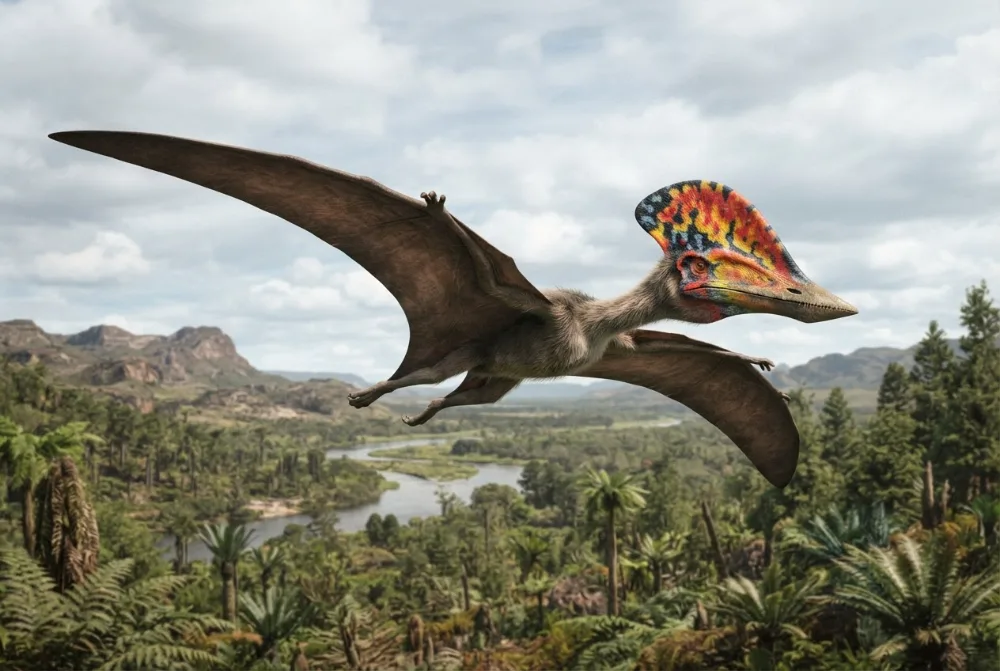
Tupandactylus was a flying reptile with a huge, colorful crest on its head. It lived in what is now Brazil about 115 million years ago and probably ate plants like a flying fruit-lover.12
Rairarama rini?
Raiva hombe sei?
Mapapiro aro aiva akapamhama zvakadii?
Raiva rakakwirira zvakadii?
 mapapiro akapamhama semabhasikoro 2 akatevedzana⚽raigona kubhururuka richiyambuka nhandare yose yebhora mumasekonzi 6
Tupandactylus raiva hombe sei kana richienzaniswa NEWE?
Masvomhu chete mubrowser yako. Hapana chinochengetwa kana kutumirwa kupi zvako.
Raimhanya zvakadii?


Zvinonakidza
Tupandactylus had a giant head crest made of soft tissue and supported by bone spines. In T. imperator the crest was round, while in T. navigans it was tall and vertical.1
Its name comes from Tupã, the Tupi thunder god, and daktylos, the Greek word for finger.1
Tupandactylus probably spent a lot of time on the ground and only flew short distances, because its big crest made flying harder.1
The first fossil of Tupandactylus was a skull and partial lower jaw found in the Crato Formation of Brazil.1
Scientists think Tupandactylus may have been a terrestrial forager, walking around on the ground to find food.1
Tupandactylus had a fifth toe on its foot with a single bone, a feature seen in some other azhdarchoid pterosaurs.3
Mibvunzo inonyanya kubvunzwa nezve Tupandactylus
?How big was Tupandactylus?
Tupandactylus imperator had a wingspan of about 3 to 4 metres (9.8 to 13.1 feet) and stood about 1.5 metres (4.9 feet) tall to the tip of its crest. The smaller species, T. navigans, had a wingspan of about 2.7 metres (8.9 feet).14
?Why did Tupandactylus have a crest?
Scientists think the crest was used for social or sexual display, like a peacock's tail. It was made of soft tissue and bone, and it was so big it may have made flying harder.14
?What did Tupandactylus eat?
Tupandactylus probably ate plants, like fruit, and may have used its long neck to reach food from higher bushes. Some fossils show plant material near its skull, hinting it was a herbivore.14
?Was Tupandactylus a dinosaur?
No, Tupandactylus was a pterosaur, a flying reptile that is not a dinosaur. It is closely related to dinosaurs but belongs to a separate group.1
?When did Tupandactylus live?
Tupandactylus lived about 112 million years ago, during the Early Cretaceous period, in what is now Brazil.1
Mubvisi wengano
Ngano: Some people think Tupandactylus was a dinosaur.
Chokwadi: Tupandactylus was a pterosaur, a flying reptile that is not a dinosaur.1
Zvevanyanzvi vemadhino
- Zita resainzi
- Tupandactylus
- Akaripa zita:
- Kellner and Campos 20075
- Boka
- Zvinokambaira zvinobhururuka
- Mhuri / boka
- Tapejaridae5
- Kurongwa kwemhuka
- Pterosauria > Pterodactyloidea5
- Zera rematombo
- makore mamiriyoni 120 kusvika 113 (Aptian)5
- Mapoka ematombo
- Crato5
- Nyika
- Brazil5
- Zvinyorwa zvemafosiri
- 3 mu The Paleobiology Database5
- Kuwanikwa
- Tupandactylus was first described in 1997 as a species of Tapejara by D. A. Campos and Alexander W. A. Kellner. In 2007, Campos and Kellner gave it its own genus name Tupandactylus.1
- Zvichiri kupokanwa
- Scientists are not sure if Tupandactylus imperator and Tupandactylus navigans are two different species or just males and females of the same species.1
Kunobva chokwadi
- Tupandactylus (en.wikipedia.org)
- PBDB Taxon (paleobiodb.org)
- Redescription of Tupandactylus imperator Campos & Keller, 1997 (Pterosauria, Tapejaridae) based on a new complete specimen from the Crato Formation (Aptian-Albian) of the Araripe Basin, Ceará, Brazil (doi.org)
- Pterosaur had a head crest so tall it may have made it hard to fly | New Scientist (newscientist.com)
- Tupandactylus in The Paleobiology Database (CC BY 4.0): zera, nzvimbo, mapoka ematombo, kurongwa kwemhuka.
Chokwadi chega chega papeji ino chine nhamba inoratidza kwachakabva. Kana takakanganisa chimwe chinhu, ruregerero, tiri vanoda madhino, kwete magazini yesainzi. Tiudze pa [email protected] tichazvigadzirisa.
 Rex ane nzara! Dino Wiki ipurojekiti yababa yemwanakomana wavo anoda madhino, mahara, pasina kushambadza uye pasina zvinokutevera. Vakuru vanogona kupa Rex chekudyadya kuti vabatsire kuchengeta saiti iri pamhepo.Fudza Rex
 Pteranodon
 Quetzalcoatlus
 Dorygnathus
 Rhamphorhynchus
 Anhanguera
 Pterodactylus
 Stegosaurus
 Iguanodon
 Archaeopteryx
 Giganotosaurus
 Microraptor
 Deinonychus