 Kuizi: Çfarë dinozauri je?
 Beteja e dinozaurëve
 Gara e dinozaurëve
 Minilojëra me dinozaurë
 Albumi i stikerave
 Listat TOP të dinozaurëve
 Më surprizo!
Anhanguera
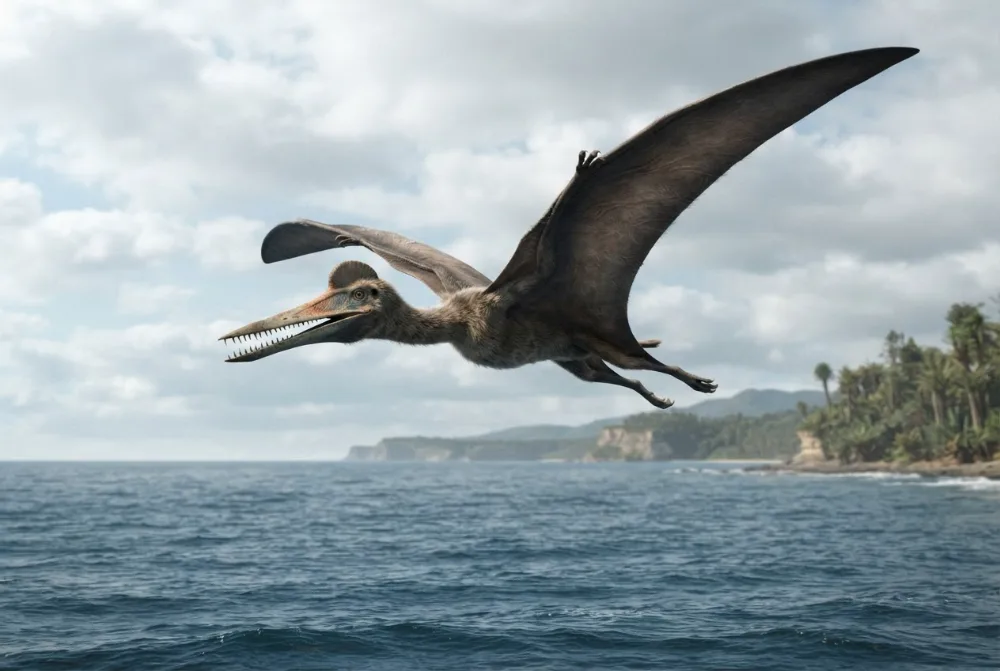
Anhanguera was a flying reptile that soared over ancient seas. It had a long, toothy beak and a wingspan as wide as a car. It was not a dinosaur, but a pterosaur, a close cousin of dinosaurs.1
Kur jetoi?
Sa i madh ishte?
Sa i gjatë ishte?
Sa i rëndë ishte?
 i gjatë sa 4 mace shtëpiake nga hunda te bishti🍌i gjatë sa 11 banane njëra pas tjetrës🍉i rëndë sa 6 shalqinj⚽mund të fluturonte përmes një fushe të tërë futbolli për 5,7 sekonda
Sa i madh ishte Anhanguera krahasuar me TY?
Vetëm matematikë në shfletuesin tënd. Asgjë nuk ruhet dhe asgjë nuk dërgohet askund.
Sa i shpejtë ishte?


Fakte argëtuese
Anhanguera had a crest on the front of its upper jaw, but it was set farther back on the skull than in its close relatives Coloborhynchus and Ornithocheirus.1
Some Anhanguera fossils have a small, blunt crest at the back of the skull, similar to other pteranodontoids.1
A study in 2003 showed that Anhanguera likely held its head at an angle to the ground, based on its inner ear structure, which helped it keep its balance.1
Anhanguera had bony rings in its eye sockets called scleral rings, which may have supported its eyes, similar to modern birds.1
The name Anhanguera comes from the Tupi language and means 'old spirit' or 'spirit protector of the animals'.1
Anhanguera lived during the Early to Late Cretaceous, from about 112 to 93 million years ago.1
Pyetjet më të shpeshta për Anhanguera
?How big was Anhanguera?
Anhanguera had a wingspan of about 4.6 meters (15 ft).1
?What did Anhanguera eat?
Anhanguera ate fish. It had sharp, curved teeth to pierce and grip slippery fish.13
?Why did Anhanguera have a crest?
Scientists aren't sure. It might have been for display to attract mates or show off, or it might have helped the animal eat.3
?Could Anhanguera fly?
Yes, Anhanguera was a flying reptile. It had thin, light bones to save weight and a large brain area for coordinating flight, similar to birds.3
?When did Anhanguera live?
Anhanguera lived during the Early to Late Cretaceous, from about 112 to 93 million years ago.1
Për ekspertët e dinozaurëve
- Emri shkencor
- Anhanguera
- Emërtuar nga
- Campos and Kellner 19854
- Grupi
- Zvarranikët fluturues
- Familja / klada
- Ornithocheiroidea4
- Klasifikimi
- Pterosauria > Pterodactyloidea4
- Mosha e shkëmbinjve
- 137 deri në 94 milionë vjet (Valanginian / Cenomanian)4
- Formacionet shkëmbore
- Romualdo, West Melbury Marly Chalk, Toolebuc4
- Vendet
- Brazili, Mbretëria e Bashkuar, Australia, Maroku, Egjipti, Kolumbia4
- Gjetjet fosile
- 18 në The Paleobiology Database4
- Zbulimi
- Anhanguera was named in 1985 by Brazilian paleontologists Diogenes de Almeida Campos and Alexander Wilhelm Armin Kellner, based on a complete skull found in the Romualdo Formation of Brazil.14
- Ende i diskutueshëm
- Scientists are not sure whether the crests on the jaws were present in all Anhanguera individuals or only in some, possibly depending on age or sex.1
Nga vijnë faktet
- Anhanguera (pterosaur) (en.wikipedia.org)
- _Anhanguera_ (pterosaur) — Grokipedia (grokipedia.com)
- Watch a pterosaur fly | Natural History Museum (nhm.ac.uk)
- Anhanguera in The Paleobiology Database (CC BY 4.0): mosha, vendet, formacionet shkëmbore, klasifikimi.
Çdo fakt në këtë faqe ka një numër që të çon te burimi i tij. Nëse kemi gabuar diçka, na fal, ne jemi fansa dinozaurësh, jo revistë shkencore. Na shkruaj në [email protected] dhe do ta rregullojmë.
 Rexi ka uri! Dino Wiki është projekti i një babai për djalin e tij që i do dinozaurët, falas, pa reklama dhe pa gjurmues. Të rriturit mund t'i japin Rexit një meze për ta mbajtur online.Ushqe Rexin
 Pteranodon
 Quetzalcoatlus
 Dorygnathus
 Rhamphorhynchus
 Pterodactylus
 Eudimorphodon
 Stegosaurus
 Iguanodon
 Archaeopteryx
 Giganotosaurus
 Microraptor
 Deinonychus