 Kuizi: Çfarë dinozauri je?
 Beteja e dinozaurëve
 Gara e dinozaurëve
 Minilojëra me dinozaurë
 Albumi i stikerave
 Listat TOP të dinozaurëve
 Më surprizo!
Dearc
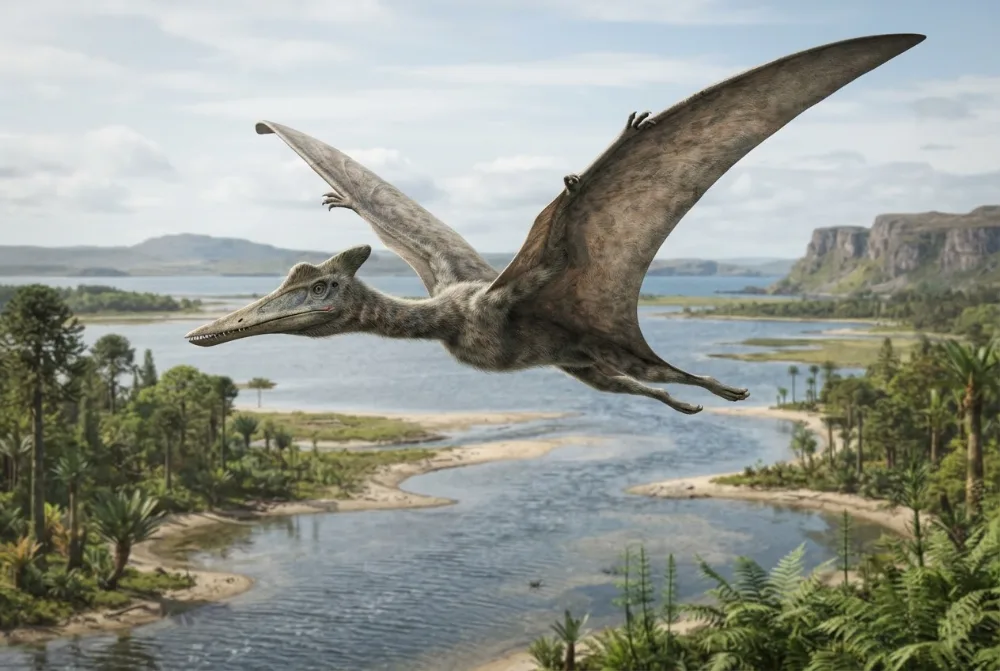
Dearc was a flying reptile that lived in the Middle Jurassic, about 167 million years ago. It was one of the biggest flying animals of its time, with wings as wide as a small car! It soared over the lagoons of what is now Scotland.1
Kur jetoi?
Sa i madh ishte?
Sa të hapur ishin krahët e tij?
 krahë të gjerë sa 1,5 biçikleta në rresht⚽mund të fluturonte përmes një fushe të tërë futbolli për 7,3 sekonda
Sa i madh ishte Dearc krahasuar me TY?
Vetëm matematikë në shfletuesin tënd. Asgjë nuk ruhet dhe asgjë nuk dërgohet askund.
Sa i shpejtë ishte?


Fakte argëtuese
Dearc was not fully grown when it died. It was a juvenile or subadult, still actively growing, so adults might have been even bigger.13
Its wingspan was about 2.5 to 3 metres (8 to 10 feet), as wide as a wandering albatross, the largest flying bird today.1
Before Dearc was discovered, scientists thought pterosaurs stayed small until the Cretaceous period. Dearc shows they got big much earlier.13
The fossil was found at Brothers' Point on the Isle of Skye in 2017, during a National Geographic-funded field trip.1
Its name comes from Scottish Gaelic and means both 'winged reptile' and 'reptile from Skye', because Skye is called the 'winged isle'.1
Dearc had a long, low skull and a slender upper arm bone, which helped it fly.1
Pyetjet më të shpeshta për Dearc
?How big was Dearc?
Dearc had a wingspan of about 2.5 to 3 metres, as wide as a wandering albatross, the largest flying bird today. It was not fully grown when it died, so adults might have been even bigger.34
?When did Dearc live?
Dearc lived in the Middle Jurassic, about 167 million years ago.3
?Where was Dearc found?
The fossil was found at Brothers' Point on the Isle of Skye in Scotland in 2017.3
?What did Dearc eat?
Dearc had two types of teeth: long fangs at the front and peg-like teeth further back, which suggests it ate fish or other small animals.3
?Is Dearc a dinosaur?
No, Dearc is a pterosaur, a flying reptile, not a dinosaur.3
Për ekspertët e dinozaurëve
- Emri shkencor
- Dearc
- Emërtuar nga
- Jagielska et al. 20226
- Grupi
- Zvarranikët fluturues
- Familja / klada
- Rhamphorhynchidae6
- Klasifikimi
- Pterosauria > Rhamphorhynchidae6
- Mosha e shkëmbinjve
- 168 deri në 165 milionë vjet (Bathonian)6
- Formacionet shkëmbore
- Lealt Shale6
- Vendet
- Mbretëria e Bashkuar6
- Gjetjet fosile
- 1 në The Paleobiology Database6
- Zbulimi
- The first Dearc fossil was discovered on May 23, 2017, at Brothers' Point on the Isle of Skye, Scotland, by a team led by Stephen Brusatte. It was named Dearc sgiathanach by Jagielska and colleagues in 2022.1
- Ende i diskutueshëm
- Scientists are not sure exactly how big Dearc could grow, because the only known fossil is from a young animal that was still growing.1
Nga vijnë faktet
- A skeleton from the Middle Jurassic of Scotland illuminates an earlier origin of large pterosaurs: Current Biology (cell.com)
- PBDB Taxon (paleobiodb.org)
- Dearc (en.wikipedia.org)
- Report A skeleton from the Middle Jurassic of Scotland illuminates an earlier origin of large pterosaurs (sciencedirect.com)
- Jurassic Dearc | Nature Ecology & Evolution (nature.com)
- Dearc in The Paleobiology Database (CC BY 4.0): mosha, vendet, formacionet shkëmbore, klasifikimi.
Çdo fakt në këtë faqe ka një numër që të çon te burimi i tij. Nëse kemi gabuar diçka, na fal, ne jemi fansa dinozaurësh, jo revistë shkencore. Na shkruaj në [email protected] dhe do ta rregullojmë.
 Rexi ka uri! Dino Wiki është projekti i një babai për djalin e tij që i do dinozaurët, falas, pa reklama dhe pa gjurmues. Të rriturit mund t'i japin Rexit një meze për ta mbajtur online.Ushqe Rexin
 Pteranodon
 Quetzalcoatlus
 Dorygnathus
 Rhamphorhynchus
 Anhanguera
 Pterodactylus
 Ichthyosaurus
 Khudiakovia
 Ophthalmosaurus
 Peloneustes
 Gongbusaurus
 Shunosaurus