 Kuizi: Çfarë dinozauri je?
 Beteja e dinozaurëve
 Gara e dinozaurëve
 Minilojëra me dinozaurë
 Albumi i stikerave
 Listat TOP të dinozaurëve
 Më surprizo!
Kur jetoi?

Sa i madh ishte?
Sa i gjatë ishte?
Sa i lartë ishte?
vlerësim
Sa i rëndë ishte?
 i gjatë sa 5 qen nga hunda te bishti🍌i gjatë sa 28 banane njëra pas tjetrës🍉i rëndë sa 190 shalqinj🧸i rëndë sa 51 fëmijë kopshti🎒i rëndë sa 30 nxënës🐻❄️i rëndë sa 2 arinj polarë🏃mund të vraponte 100 metra për 12 sekonda (njeriu më i shpejtë do 9,6)
Sa i madh ishte Magyarosaurus krahasuar me TY?
Vetëm matematikë në shfletuesin tënd. Asgjë nuk ruhet dhe asgjë nuk dërgohet askund.
Sa i shpejtë ishte?


Fakte argëtuese
Magyarosaurus is a famous example of island dwarfism, where animals become smaller when living on islands with limited resources.2
It lived during the Late Cretaceous period, about 71 to 66 million years ago.1
The first fossils were described by Baron Franz Nopcsa in 1915, who named it Titanosaurus dacus.2
Magyarosaurus was a titanosaur, a group of sauropods that includes some of the largest dinosaurs ever.1
Scientists have found bones from many individuals, including skull pieces, which is rare for sauropods.2
In 2024, a study suggested that there were actually four different titanosaur species living in the same area, including the giant Uriash kadici.2
Pyetjet më të shpeshta për Magyarosaurus
?How big was Magyarosaurus?
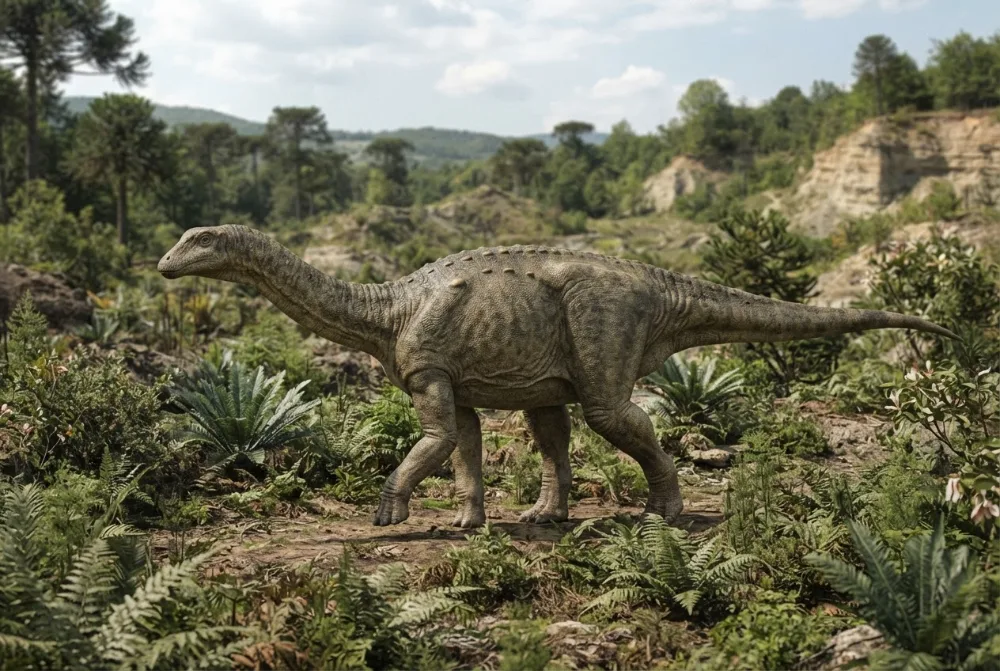
Magyarosaurus was one of the smallest adult sauropods, measuring about 6 metres (20 feet) long and weighing up to 972 kilograms (2,143 pounds).3
?Why was Magyarosaurus so small?
It was a dwarf dinosaur because it lived on an island with limited food, a process called island dwarfism. Scientists confirmed this by studying its bone growth.34
?Did Magyarosaurus have feathers?
No, Magyarosaurus was a sauropod and did not have feathers. It had scaly skin and some bony armour plates called osteoderms.3
?What did Magyarosaurus eat?
Magyarosaurus was a plant-eater, like all sauropods. It ate ferns, cycads and other vegetation that grew on its island home.3
?When did Magyarosaurus live?
Magyarosaurus lived during the Late Cretaceous Period, about 71 to 66 million years ago.3
?Was Magyarosaurus a dinosaur?
Yes, Magyarosaurus was a dinosaur. It was a sauropod, a long-necked plant-eating dinosaur.3
?Could Magyarosaurus swim?
Nobody knows for sure, but like most sauropods it probably lived on land and was not a strong swimmer. It lived on an island, so it may have waded in shallow water.3
?How fast could Magyarosaurus run?
Scientists do not know its exact speed, but as a small sauropod it was likely slower than a modern horse. Its leg bones suggest it was not built for fast running.3
Shkatërruesi i miteve
Miti: Magyarosaurus was a baby or juvenile of a larger sauropod.
E vërteta: Studies of its bones show that Magyarosaurus was a fully grown adult, not a baby. It was a true dwarf species.2
Për ekspertët e dinozaurëve
- Emri shkencor
- Magyarosaurus
- Emërtuar nga
- Huene 19325
- Grupi
- Qafëgjatët
- Familja / klada
- Eutitanosauria5
- Klasifikimi
- Sauropodomorpha > Sauropoda > Titanosauria > Macronaria5
- Mosha e shkëmbinjve
- 72 deri në 66 milionë vjet (Maastrichtian)5
- Formacionet shkëmbore
- Sebeş, Densuș-Ciula, Pui Beds5
- Vendet
- Rumania5
- Gjetjet fosile
- 11 në The Paleobiology Database5
- Zbulimi
- Baron Franz Nopcsa first described the fossils in 1915, calling it Titanosaurus dacus. In 1932, Friedrich von Huene gave it its own genus, Magyarosaurus.2
- Ende i diskutueshëm
- Scientists still debate whether all the small titanosaur fossils from Romania belong to Magyarosaurus or to several different species.2
Nga vijnë faktet
- Magyarosaurus (nhm.ac.uk)
- Full article: Revision of Romanian sauropod dinosaurs reveals high titanosaur diversity and body-size disparity on the latest Cretaceous Haţeg Island, with implications for titanosaurian biogeography (tandfonline.com)
- Magyarosaurus (en.wikipedia.org)
- Small body size and extreme cortical bone remodeling indicate phyletic dwarfism in Magyarosaurus dacus (Sauropoda: Titanosauria) (pubmed.ncbi.nlm.nih.gov)
- Magyarosaurus in The Paleobiology Database (CC BY 4.0): mosha, vendet, formacionet shkëmbore, klasifikimi.
Çdo fakt në këtë faqe ka një numër që të çon te burimi i tij. Nëse kemi gabuar diçka, na fal, ne jemi fansa dinozaurësh, jo revistë shkencore. Na shkruaj në [email protected] dhe do ta rregullojmë.
 Rexi ka uri! Dino Wiki është projekti i një babai për djalin e tij që i do dinozaurët, falas, pa reklama dhe pa gjurmues. Të rriturit mund t'i japin Rexit një meze për ta mbajtur online.Ushqe Rexin
 Brachiosaurus
 Diplodocus
 Brontosaurus
 Argentinosaurus
 Camarasaurus
 Morosaurus
 Tyrannosaurus
 Triceratops
 Velociraptor
 Spinosaurus
 Ankylosaurus
 Parasaurolophus