 Kwisi: O dinosaure efe?
 Ntwa ya didinosaure
 Peiso ya didinosaure
 Dipapadi tse nyane tsa didinosaure
 Albamo ya ditikara
 Manane a TOP a didinosaure
 Nkgethele!
Amanasaurus
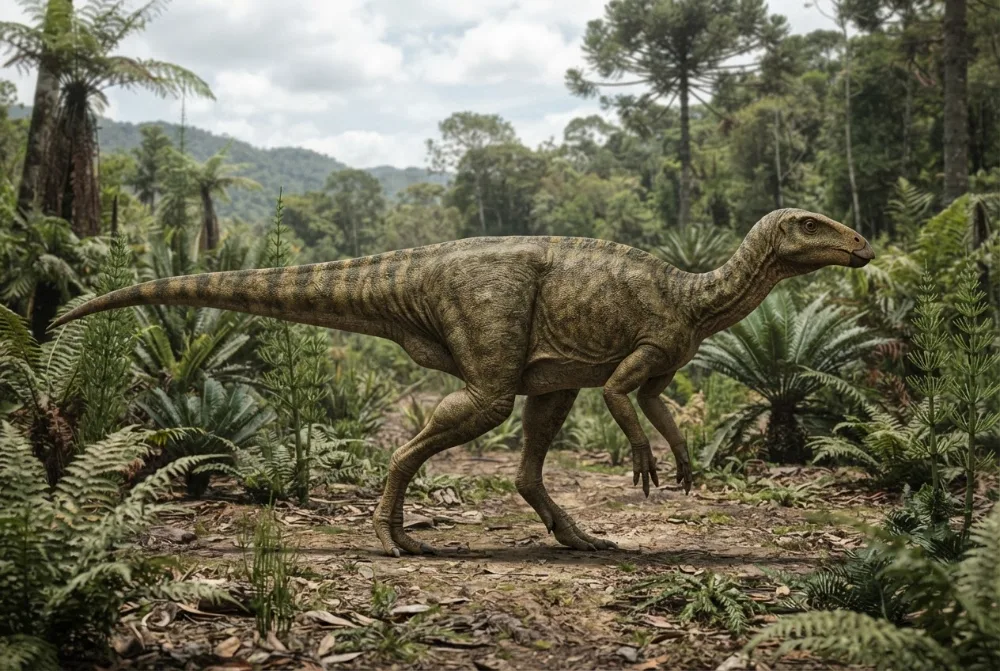
Amanasaurus was a plant-eating dinosaur that lived about 233 million years ago in what is now Brazil. It had a beak-like mouth and walked on four legs, munching on ferns and other plants. This dinosaur was about the size of a large dog, making it one of the bigger plant-eaters of its time.26
E phetse neng?
E ne e le kgolo hakae?
E ne e le telele hakae?
E ne e phahame hakae?
kakanyo
E ne e le boima hakae?
 telele jwaloka dikatse tsa lapeng tse 2.5 ho tloha nkong ho isa mohatleng🍌telele jwaloka dibanana tse 7 di behilwe ka molae batla e le boima jwaloka katse ya lapeng🍌boima jwaloka dibanana tse 29🪑e nyane hoo e ka tsamayang ka tlasa setulo🏃e ne e ka matha dimitara tse 100 ka metsotswana e 14 (motho ya lebelo ka ho fetisisa o hloka 9,6)
Amanasaurus e ne e le kgolo hakae ha e bapiswa le WENA?
Ke dipalo feela ho browser ya hao. Ha ho letho le bolokwang kapa le romelwang kae kapa kae.
E ne e le lebelo hakae?


Dintlha tse monate
Amanasaurus lived during a time called the Carnian pluvial episode, a wet period when it rained a lot. Its name 'rain lizard' comes from that.12
Scientists know Amanasaurus from just two leg bones: a top part of a right thigh bone and a bottom part of a left thigh bone. These bones were found in the same spot.21
Amanasaurus was about the same size as the earliest dinosaurs that lived alongside it. This surprised scientists, who thought silesaurids were always smaller.2
The thigh bone of Amanasaurus had a special groove called a cleft between the top of the anterior trochanter and the shaft. This is the oldest such feature seen in any silesaurid.2
Dipotso tse botswang haholo ka Amanasaurus
?How big was Amanasaurus?
About 1.3 metres (4.3 feet) long, based on the larger leg bone found. That is roughly the size of a large dog.4
?Was Amanasaurus a dinosaur?
Scientists disagree. Some say it was a very early ornithischian dinosaur, while others say it was a close cousin of dinosaurs. Either way, it is a dinosauriform, meaning it is closely related to dinosaurs.51
?What did Amanasaurus eat?
It was a plant-eater. It used its beak-like mouth to munch on ferns and other plants that grew during the rainy Carnian period.4
Bakeng sa ditsebi tsa didinosaure
- Lebitso la saense
- Amanasaurus
- E rehilwe ke
- Müller and Garcia 20236
- Sehlopha
- Dija-dimela tse nang le melomo
- Lelapa / leloko
- Silesauridae6
- Tlhophiso
- Ornithischia6
- Dilemo tsa mafika
- dilemo tse dimilione tse 237 ho isa ho 227 (Carnian)6
- Dinaha
- Brazil6
- Direkoto tsa difosili
- 1 ho The Paleobiology Database6
- Ho sibollwa
- Amanasaurus was named in 2023 by paleontologists Rodrigo T. Müller and Maurício S. Garcia. They studied two fossil leg bones found at the Pivetta site in Brazil.62
- E sa ntse e phehwa kgang
- Scientists are not sure if Amanasaurus was a true dinosaur or a very close relative. Some studies place it inside Ornithischia, while others put it just outside Dinosauria.21
Moo dintlha di tswang teng
- Amanasaurus (en.wikipedia.org)
- A new silesaurid from Carnian beds of Brazil fills a gap in the radiation of avian line archosaurs (nature.com)
- Amanasaurus nesbitti | Dinosaur Database by DinoAnimals.com (dinoanimals.com)
- Paleontólogos da UFSM descobrem nova espécie pré-histórica que preenche lacuna na evolução dos dinossauros – UFSM (ufsm.br)
- A new silesaurid from Carnian beds of Brazil fills a gap in the radiation of avian line archosaurs | Scientific Reports (nature.com)
- Amanasaurus in The Paleobiology Database (CC BY 4.0): dilemo, dibaka, dibopeho tsa mafika, tlhophiso.
Ntlha e nngwe le e nngwe leqepheng lena e na le nomoro e supang mohlodi wa yona. Haeba re fositse ho hong, re kopa tshwarelo, re balatedi ba didinosaure, ha re koranta ya saense. Re bolelle ho [email protected] mme re tla e lokisa.
 Rex o lapile! Dino Wiki ke projeke ya ntate bakeng sa mora wa hae ya ratang didinosaure, ke mahala, ha ho dipapatso, ha ho disebedi. Batho ba baholo ba ka fepa Rex seneke ho thusa hore e dule e le inthaneteng.Fepa Rex
 Iguanodon
 Tenontosaurus
 Thescelosaurus
 Zalmoxes
 Camptosaurus
 Rhabdodon
 Nothosaurus
 Massospondylus
 Plateosaurus
 Coelophysis
 Podokesaurus
 Simosaurus