 Kwisi: O dinosaure efe?
 Ntwa ya didinosaure
 Peiso ya didinosaure
 Dipapadi tse nyane tsa didinosaure
 Albamo ya ditikara
 Manane a TOP a didinosaure
 Nkgethele!
Antarctopelta
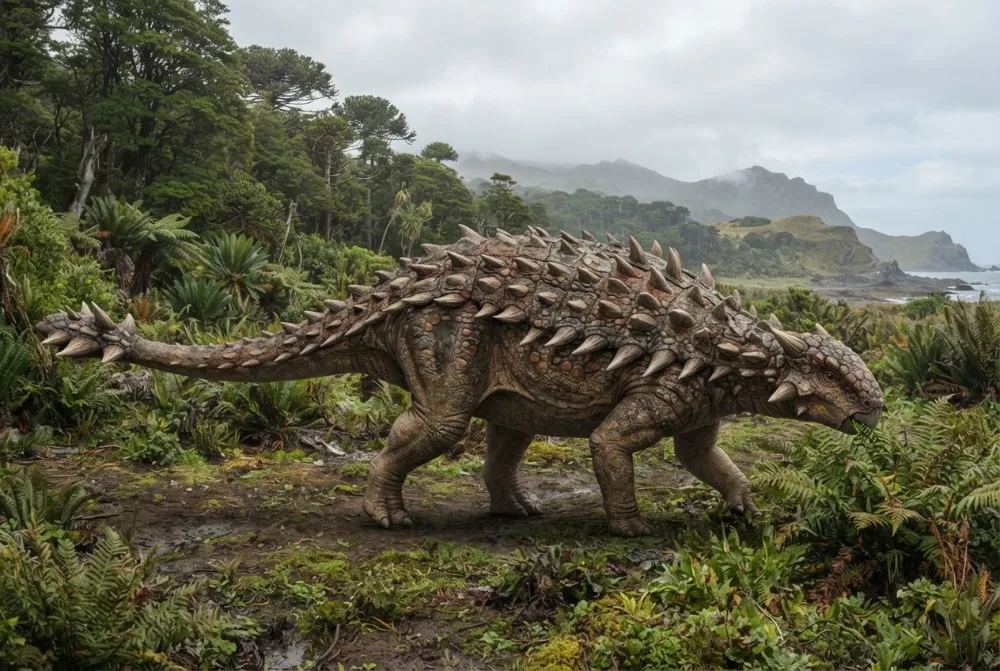
Antarctopelta was an armoured dinosaur that lived in Antarctica during the Late Cretaceous. It was covered in bony plates and spikes, and its tail ended in a weapon made of fused spikes that looked like an Aztec club. It was a slow-moving plant-eater that used its armour for protection.1
E phetse neng?
E ne e le kgolo hakae?
E ne e le telele hakae?
E ne e phahame hakae?
kakanyo
E ne e le boima hakae?
 telele jwaloka dintja tse 6 ho tloha nkong ho isa mohatleng🍌telele jwaloka dibanana tse 33 di behilwe ka mola🍉boima jwaloka mahapu a 70🧸boima jwaloka bana ba kereshe ba 18🎒boima jwaloka bana ba sekolo ba 11🏃e ne e ka matha dimitara tse 100 ka metsotswana e 16 (motho ya lebelo ka ho fetisisa o hloka 9,6)
Antarctopelta e ne e le kgolo hakae ha e bapiswa le WENA?
Ke dipalo feela ho browser ya hao. Ha ho letho le bolokwang kapa le romelwang kae kapa kae.
E ne e le lebelo hakae?


Dintlha tse monate
Antarctopelta was the first dinosaur fossil ever named from Antarctica, even though it was discovered before another Antarctic dinosaur called Cryolophosaurus.1
Its tail had a special weapon called a macuahuitl, made of flat, spiky bones fused together. It looked like an Aztec club and was used for defence.1
Scientists found six different types of armour plates on Antarctopelta, including large flat ones and tall keeled spikes.1
Antarctopelta lived in a warm, ice-free Antarctica with dense forests of conifers, cycads, and ginkgos. It still had to survive long dark winters.1
The only known skeleton was discovered in 1986 by Argentine geologists Eduardo Olivero and Robert Scasso, but it took ten years to dig out because of frozen ground and bad weather.1
Antarctopelta shared its home with the small plant-eater Trinisaura, as well as marine reptiles like mosasaurs and plesiosaurs.1
Dipotso tse botswang haholo ka Antarctopelta
?How big was Antarctopelta?
About 4 meters (13 feet) long from snout to tail tip. One scientist estimated it could have been up to 6 meters (20 feet) long and weighed 350 kilograms (770 pounds).1
?What did Antarctopelta eat?
It was a plant-eater. Its jaws had small, leaf-shaped teeth for chewing plants.1
?Did Antarctopelta have feathers?
No. It was an armoured dinosaur covered in bony plates and spikes, not feathers.1
?When did Antarctopelta live?
It lived during the late Campanian stage of the Late Cretaceous period, about 73.4 million years ago.1
?Was Antarctopelta a dinosaur?
Yes, it was a type of armoured dinosaur called an ankylosaur.1
?Could Antarctopelta swim?
Scientists are not sure, but its body was stocky and built for walking on land, not swimming. Its fossils were found with a shark tooth, suggesting it may have floated out to sea after death.1
Mosenyi wa ditshomo
Tshomo: Some people think Antarctopelta had a tail club like a typical ankylosaur.
Nnete: Antarctopelta actually had a macuahuitl, a flat fan of spikes at the end of its tail, not a round club.1
Bakeng sa ditsebi tsa didinosaure
- Lebitso la saense
- Antarctopelta
- E rehilwe ke
- Salgado and Gasparini 20062
- Sehlopha
- Didinosaure tse nang le sesireletsi
- Lelapa / leloko
- Parankylosauria2
- Tlhophiso
- Ornithischia > Ankylosauria > Thyreophora2
- Dilemo tsa mafika
- dilemo tse dimilione tse 84 ho isa ho 72 (Campanian)2
- Dibopeho tsa mafika
- Snow Hill Island2
- Dinaha
- Antaraktika2
- Direkoto tsa difosili
- 1 ho The Paleobiology Database2
- Ho sibollwa
- Antarctopelta was discovered in January 1986 by Argentine geologists Eduardo Olivero and Robert Scasso on James Ross Island, Antarctica. It was named in 2006 by paleontologists Leonardo Salgado and Zulma Gasparini, who called it Antarctopelta oliveroi after Olivero.1
- E sa ntse e phehwa kgang
- Scientists are still debating whether Antarctopelta was more closely related to nodosaurids or ankylosaurids, because it has features of both groups.1
Moo dintlha di tswang teng
- Antarctopelta (en.wikipedia.org)
- Antarctopelta in The Paleobiology Database (CC BY 4.0): dilemo, dibaka, dibopeho tsa mafika, tlhophiso.
Ntlha e nngwe le e nngwe leqepheng lena e na le nomoro e supang mohlodi wa yona. Haeba re fositse ho hong, re kopa tshwarelo, re balatedi ba didinosaure, ha re koranta ya saense. Re bolelle ho [email protected] mme re tla e lokisa.
 Rex o lapile! Dino Wiki ke projeke ya ntate bakeng sa mora wa hae ya ratang didinosaure, ke mahala, ha ho dipapatso, ha ho disebedi. Batho ba baholo ba ka fepa Rex seneke ho thusa hore e dule e le inthaneteng.Fepa Rex
 Ankylosaurus
 Sauropelta
 Pinacosaurus
 Scutellosaurus
 Struthiosaurus
 Euoplocephalus
 Tyrannosaurus
 Triceratops
 Velociraptor
 Spinosaurus
 Parasaurolophus
 Pteranodon