 Kwisi: O dinosaure efe?
 Ntwa ya didinosaure
 Peiso ya didinosaure
 Dipapadi tse nyane tsa didinosaure
 Albamo ya ditikara
 Manane a TOP a didinosaure
 Nkgethele!
Anurognathus
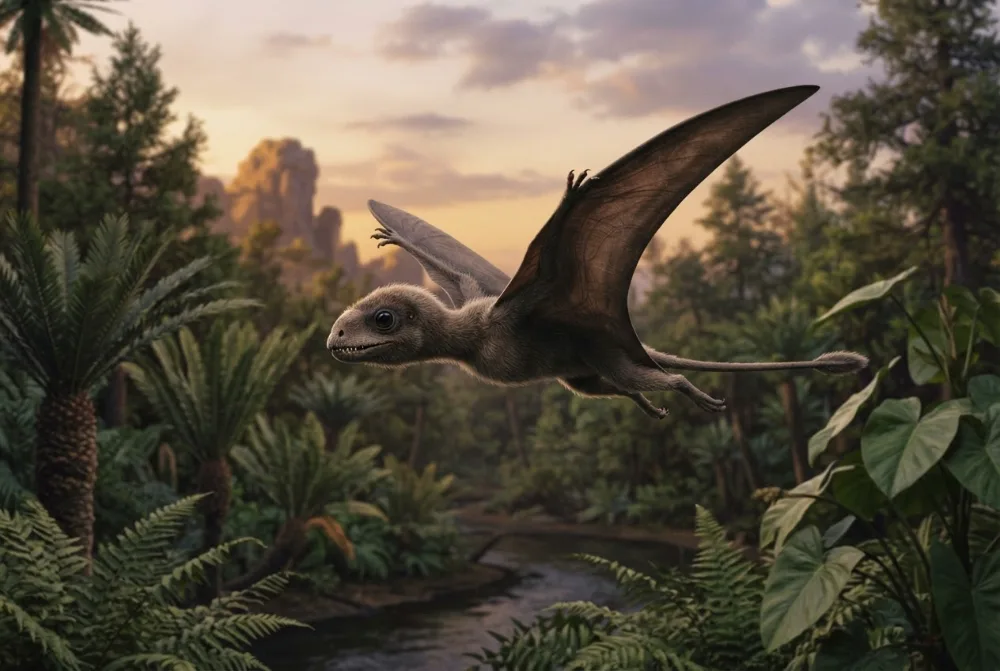
Anurognathus was a tiny pterosaur that lived in the Late Jurassic. It had a very short, wide head and big eyes, like a little flying frog. It probably hunted insects at dusk.12
E phetse neng?
E ne e le kgolo hakae?
E ne e le telele hakae?
E ne e le boima hakae?
Anurognathus e ne e le kgolo hakae ha e bapiswa le WENA?
Ke dipalo feela ho browser ya hao. Ha ho letho le bolokwang kapa le romelwang kae kapa kae.
E ne e le lebelo hakae?


Dintlha tse monate
Anurognathus had a very short tail, unlike most early pterosaurs. This made it more maneuverable when hunting insects.1
Its skull was wider than it was long, and its eyes were huge. This helped it see well in dim light.12
Anurognathus weighed only about 40 grams (1.4 ounces), as light as a small bird.1
Scientists think Anurognathus had bristles around its mouth, like a fringe, to help catch insects.12
Only two fossils of Anurognathus have been found, both in Germany. One is a juvenile.1
Dipotso tse botswang haholo ka Anurognathus
?How big was Anurognathus?
Anurognathus was tiny, with a wingspan of about 35 cm (14 in) and a weight of only 40 grams (1.4 oz), as light as a small bird.1
?What did Anurognathus eat?
It ate insects. Its pin-like teeth and small mouth were perfect for catching tiny bugs about 11 mm long.1
?Could Anurognathus fly?
Yes, it was a pterosaur and could fly. It had short, broad wings and probably flew slowly and maneuvered well to catch insects at dusk.1
?Did Anurognathus have feathers?
No, it did not have feathers. It had a fuzzy coat of hair-like fibers called pycnofibers, and possibly bristles around its mouth.1
?When did Anurognathus live?
Anurognathus lived during the Late Jurassic period, about 150 to 148 million years ago.1
?Why did Anurognathus have big eyes?
Its huge eyes helped it see well in dim light, so it could hunt insects at dusk or in the dark.1
?Is Anurognathus a dinosaur?
No, Anurognathus is a pterosaur, a flying reptile that is not a dinosaur.1
?How many fossils of Anurognathus have been found?
Only two fossils have been found, both in Germany. One is a juvenile, and the other is a subadult.1
Mosenyi wa ditshomo
Tshomo: Some people think Anurognathus was a dinosaur.
Nnete: Anurognathus was a pterosaur, a flying reptile that is not a dinosaur.4
Bakeng sa ditsebi tsa didinosaure
- Lebitso la saense
- Anurognathus
- E rehilwe ke
- Döderlein 19234
- Sehlopha
- Dihahabi tse fofang
- Lelapa / leloko
- Anurognathidae4
- Tlhophiso
- Pterosauria4
- Dilemo tsa mafika
- dilemo tse dimilione tse 149 ho isa ho 145 (Tithonian)4
- Dibopeho tsa mafika
- Solnhofener Plattenkalk4
- Dinaha
- Jeremane4
- Direkoto tsa difosili
- 1 ho The Paleobiology Database4
- Ho sibollwa
- Anurognathus was named by Ludwig Döderlein in 1923. He bought the first fossil from a collector in 1922. It was found in the Solnhofen limestone of Germany.1
- E sa ntse e phehwa kgang
- Scientists still debate whether Anurognathus was a fast flyer that surprised its prey, or a slow, maneuverable hunter like a nightjar.1
Moo dintlha di tswang teng
- Anurognathus (en.wikipedia.org)
- A second specimen of the pterosaurAnurognathus ammoni | PalZ | Springer Nature Link (link.springer.com)
- PaleoCodex :: Anurognathus (paleocodex.com)
- Anurognathus in The Paleobiology Database (CC BY 4.0): dilemo, dibaka, dibopeho tsa mafika, tlhophiso.
Ntlha e nngwe le e nngwe leqepheng lena e na le nomoro e supang mohlodi wa yona. Haeba re fositse ho hong, re kopa tshwarelo, re balatedi ba didinosaure, ha re koranta ya saense. Re bolelle ho [email protected] mme re tla e lokisa.
 Rex o lapile! Dino Wiki ke projeke ya ntate bakeng sa mora wa hae ya ratang didinosaure, ke mahala, ha ho dipapatso, ha ho disebedi. Batho ba baholo ba ka fepa Rex seneke ho thusa hore e dule e le inthaneteng.Fepa Rex
 Pteranodon
 Quetzalcoatlus
 Dorygnathus
 Rhamphorhynchus
 Anhanguera
 Pterodactylus
 Brachiosaurus
 Diplodocus
 Allosaurus
 Brontosaurus
 Compsognathus
 Camarasaurus