 Kwisi: O dinosaure efe?
 Ntwa ya didinosaure
 Peiso ya didinosaure
 Dipapadi tse nyane tsa didinosaure
 Albamo ya ditikara
 Manane a TOP a didinosaure
 Nkgethele!
Aymberedactylus
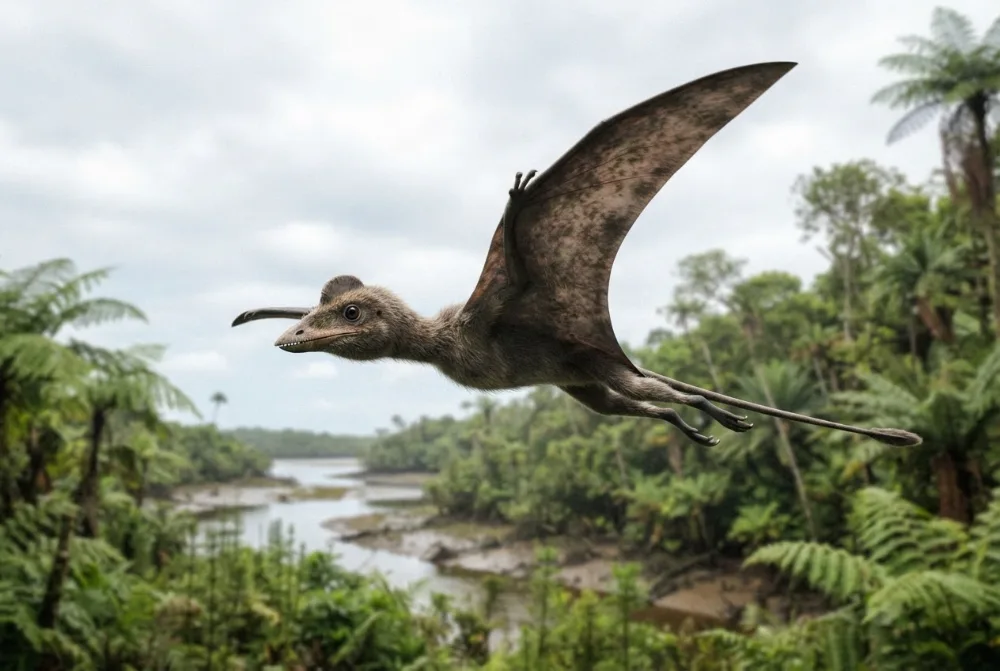
Aymberedactylus was a toothless flying reptile from the Early Cretaceous of Brazil. It had a short, downturned beak and probably ate fruits. Scientists think it was a small to medium-sized pterosaur with a wingspan of about 2 metres.1
E phetse neng?
E ne e le kgolo hakae?
Mapheo a yona a ne a pharaletse hakae?
 telele jwaloka dikatse tsa lapeng tse 4 ho tloha nkong ho isa mohatleng⚽e ne e ka fofa ho tshela lebala lohle la bolo ya maoto ka metsotswana e 7.9
Aymberedactylus e ne e le kgolo hakae ha e bapiswa le WENA?
Ke dipalo feela ho browser ya hao. Ha ho letho le bolokwang kapa le romelwang kae kapa kae.
E ne e le lebelo hakae?


Dintlha tse monate
Aymberedactylus is only known from one almost complete lower jaw (mandible). No other bones have been found.1
Its lower jaw is 27 centimetres long and is completely toothless.1
It had a very long retroarticular process (a part of the jaw joint) that was about 7% of the whole jaw length.1
The jaw had a shallow, rough-textured pit on the splenial bone that is unique to this species.1
Aymberedactylus belongs to the Tapejarinae group, which are toothless pterosaurs that often had big crests on their heads.1
It lived about 119 to 113 million years ago in a coastal lagoon environment.4
Dipotso tse botswang haholo ka Aymberedactylus
?What did Aymberedactylus eat?
It probably ate fruits. Scientists think it was a frugivore, like other tapejarine pterosaurs with downturned beaks.2
?How big was Aymberedactylus?
It had a wingspan of about 2 metres (6.5 feet), which is typical for tapejarid pterosaurs. The only known fossil is a 27 centimetre long lower jaw.32
?Was Aymberedactylus a dinosaur?
No, it was a pterosaur, a flying reptile that lived at the same time as dinosaurs but is not a dinosaur itself.3
Bakeng sa ditsebi tsa didinosaure
- Lebitso la saense
- Aymberedactylus
- E rehilwe ke
- Pegas et al. 20164
- Sehlopha
- Dihahabi tse fofang
- Lelapa / leloko
- Tapejaridae4
- Tlhophiso
- Pterosauria > Pterodactyloidea4
- Dilemo tsa mafika
- dilemo tse dimilione tse 120 ho isa ho 113 (Aptian)4
- Dibopeho tsa mafika
- Crato4
- Dinaha
- Brazil4
- Direkoto tsa difosili
- 1 ho The Paleobiology Database4
- Ho sibollwa
- Aymberedactylus cearensis was named in 2016 by R.V. Pêgas, M.E.C. Leal and A.W.A. Kellner based on a lower jaw found near Nova Olinda, Brazil. Its name means 'small lizard finger' from the Tupi language, referring to its small size and pterosaur features.1
- E sa ntse e phehwa kgang
- Since only a lower jaw has been found, scientists are not sure about the exact shape of its head crest or its full body size.1
Moo dintlha di tswang teng
- A Basal Tapejarine (Pterosauria; Pterodactyloidea; Tapejaridae) from the Crato Formation, Early Cretaceous of Brazil (web.archive.org)
- A Basal Tapejarine (Pterosauria; Pterodactyloidea; Tapejaridae) from the Crato Formation, Early Cretaceous of Brazil | PLOS One (journals.plos.org)
- Aymberedactylus (en.wikipedia.org)
- Aymberedactylus in The Paleobiology Database (CC BY 4.0): dilemo, dibaka, dibopeho tsa mafika, tlhophiso.
Ntlha e nngwe le e nngwe leqepheng lena e na le nomoro e supang mohlodi wa yona. Haeba re fositse ho hong, re kopa tshwarelo, re balatedi ba didinosaure, ha re koranta ya saense. Re bolelle ho [email protected] mme re tla e lokisa.
 Rex o lapile! Dino Wiki ke projeke ya ntate bakeng sa mora wa hae ya ratang didinosaure, ke mahala, ha ho dipapatso, ha ho disebedi. Batho ba baholo ba ka fepa Rex seneke ho thusa hore e dule e le inthaneteng.Fepa Rex
 Pteranodon
 Quetzalcoatlus
 Dorygnathus
 Rhamphorhynchus
 Anhanguera
 Pterodactylus
 Stegosaurus
 Iguanodon
 Archaeopteryx
 Giganotosaurus
 Microraptor
 Deinonychus