 Kwisi: O dinosaure efe?
 Ntwa ya didinosaure
 Peiso ya didinosaure
 Dipapadi tse nyane tsa didinosaure
 Albamo ya ditikara
 Manane a TOP a didinosaure
 Nkgethele!
Bistahieversor
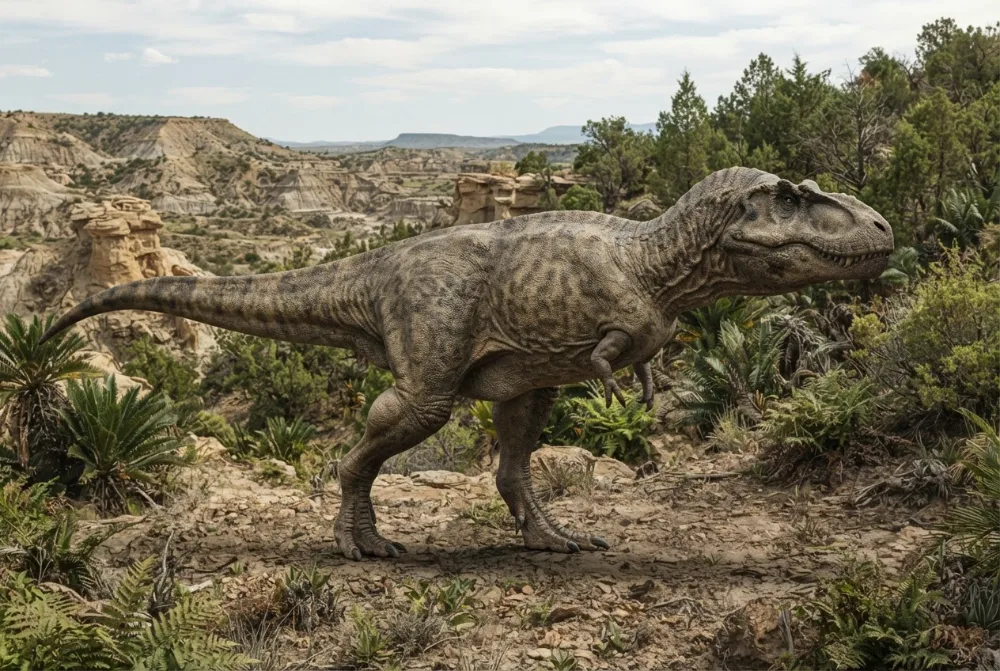
Bistahieversor was a fierce meat-eating dinosaur that lived in what is now New Mexico, USA. It was a close cousin of the famous Tyrannosaurus rex and had a deep, strong snout for biting. Scientists call it the 'Bisti Beast' after the wild area where its bones were found.1
E phetse neng?
E ne e le kgolo hakae?
E ne e le telele hakae?
E ne e phahame hakae?
kakanyo
E ne e le boima hakae?
 telele jwaloka dikoloi tse 2 tse pakilweng ka mola🍌telele jwaloka dibanana tse 50 di behilwe ka mola
 boima jwaloka dintja tse 160🍉boima jwaloka mahapu a 660🎒boima jwaloka ditlelase tse feletseng tse 4 tsa bana ba sekolo🐻❄️boima jwaloka dibere tse tshweu tse 7🏃e ne e ka matha dimitara tse 100 ka metsotswana e 13 (motho ya lebelo ka ho fetisisa o hloka 9,6)
Bistahieversor e ne e le kgolo hakae ha e bapiswa le WENA?
Ke dipalo feela ho browser ya hao. Ha ho letho le bolokwang kapa le romelwang kae kapa kae.
E ne e le lebelo hakae?


Dintlha tse monate
Bistahieversor had 64 teeth, more than many other tyrannosaurs.1
It had an extra opening above its eye, which scientists think held an air sac that made the skull lighter.1
A keel along its lower jaw helped strengthen its bite.1
Bistahieversor lived about 75.5 to 74.5 million years ago, during the Late Cretaceous.1
The first fossils of Bistahieversor were once mistaken for another dinosaur called Aublysodon.2
Both adult and juvenile skeletons have been found, giving scientists a good look at how it grew.2
Dipotso tse botswang haholo ka Bistahieversor
?How big was Bistahieversor?
About 8 to 9 metres (26 to 30 feet) long and weighed between 2.5 and 3.3 metric tons (2.75 to 3.6 short tons).13
?Was Bistahieversor bigger than T. rex?
No, Bistahieversor was much smaller than Tyrannosaurus rex. T. rex could be over 12 metres (40 feet) long and weigh more than 8 metric tons.1
?What did Bistahieversor eat?
It was a meat-eater that hunted other dinosaurs. Its deep snout and strong bite helped it catch and eat prey.13
?Where was Bistahieversor found?
Its fossils were found in the Bisti/De-Na-Zin Wilderness Area in New Mexico, USA. That's why it's called the 'Bisti Beast'.13
?When did Bistahieversor live?
It lived about 75.5 to 74.5 million years ago, during the Late Cretaceous Period.1
?Did Bistahieversor have feathers?
Scientists are not sure. No feathers have been found with Bistahieversor fossils, but some of its close relatives may have had simple feathers.1
Mosenyi wa ditshomo
Tshomo: Bistahieversor is often called a tyrannosaurid like T. rex.
Nnete: Scientists now think Bistahieversor was a close relative of tyrannosaurids, but not a true member of that family. It belongs to a group called Eutyrannosauria.1
Bakeng sa ditsebi tsa didinosaure
- Lebitso la saense
- Bistahieversor
- E rehilwe ke
- Carr and Williamson 20104
- Sehlopha
- Ditiranosaure
- Lelapa / leloko
- Tyrannosauridae4
- Tlhophiso
- Theropoda > Tyrannosauroidea > Tyrannosauridae4
- Dilemo tsa mafika
- dilemo tse dimilione tse 84 ho isa ho 72 (Campanian)4
- Dibopeho tsa mafika
- Fruitland, Kirtland4
- Dinaha
- Amerika4
- Direkoto tsa difosili
- 4 ho The Paleobiology Database4
- Ho sibollwa
- Bistahieversor was named in 2010 by Thomas Carr and Thomas Williamson. The first skeleton was found by Paul Sealey in the Bisti Wilderness Area of New Mexico.2
- E sa ntse e phehwa kgang
- Scientists are still debating exactly how Bistahieversor is related to other tyrannosaurs, and whether its deep snout evolved separately from that of T. rex.2
Moo dintlha di tswang teng
- en.wikipedia.org (en.wikipedia.org)
- Full article: Bistahieversor sealeyi, gen. et sp. nov., a new tyrannosauroid from New Mexico and the origin of deep snouts in Tyrannosauroidea (tandfonline.com)
- The Bisti Beast | New Mexico Museum of Natural History & Science (nmnaturalhistory.org)
- Bistahieversor in The Paleobiology Database (CC BY 4.0): dilemo, dibaka, dibopeho tsa mafika, tlhophiso.
Ntlha e nngwe le e nngwe leqepheng lena e na le nomoro e supang mohlodi wa yona. Haeba re fositse ho hong, re kopa tshwarelo, re balatedi ba didinosaure, ha re koranta ya saense. Re bolelle ho [email protected] mme re tla e lokisa.
 Rex o lapile! Dino Wiki ke projeke ya ntate bakeng sa mora wa hae ya ratang didinosaure, ke mahala, ha ho dipapatso, ha ho disebedi. Batho ba baholo ba ka fepa Rex seneke ho thusa hore e dule e le inthaneteng.Fepa Rex
 Tyrannosaurus
 Tarbosaurus
 Albertosaurus
 Daspletosaurus
 Gorgosaurus
 Alectrosaurus
 Triceratops
 Velociraptor
 Spinosaurus
 Ankylosaurus
 Parasaurolophus
 Pteranodon