 Kwisi: O dinosaure efe?
 Ntwa ya didinosaure
 Peiso ya didinosaure
 Dipapadi tse nyane tsa didinosaure
 Albamo ya ditikara
 Manane a TOP a didinosaure
 Nkgethele!
Boreopterus
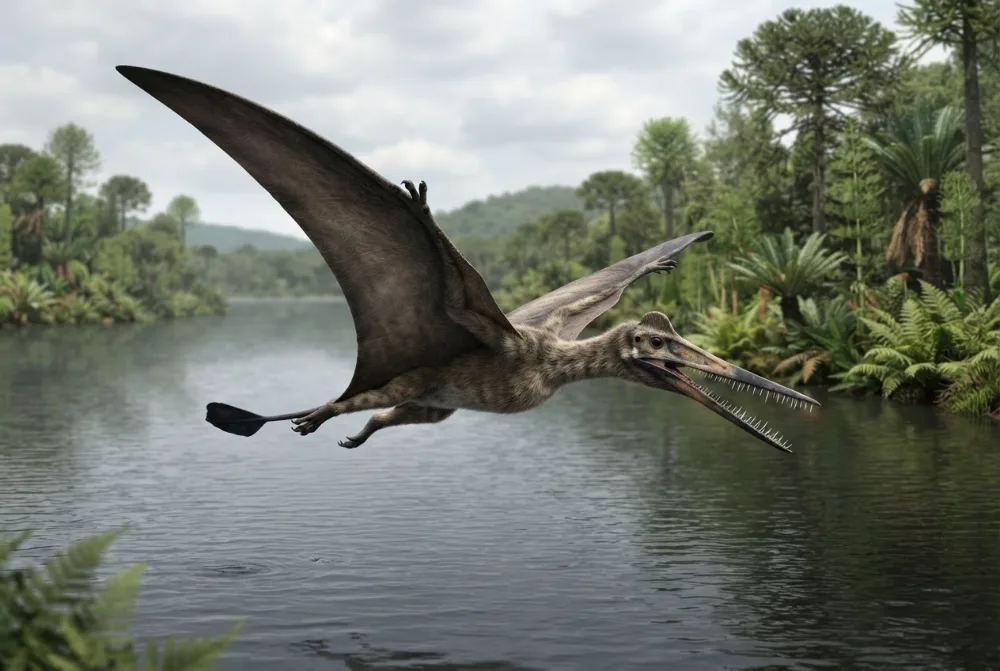
Boreopterus was a flying reptile that lived in China about 124 million years ago. It had a long, low skull packed with lots of sharp teeth, like a fish trap. Scientists think it swam through the water to catch fish, just like some dolphins do today.1
E phetse neng?
E ne e le kgolo hakae?
Mapheo a yona a ne a pharaletse hakae?
 telele jwaloka dikatse tsa lapeng tse 3 ho tloha nkong ho isa mohatleng⚽e ne e ka fofa ho tshela lebala lohle la bolo ya maoto ka metsotswana e 9
Boreopterus e ne e le kgolo hakae ha e bapiswa le WENA?
Ke dipalo feela ho browser ya hao. Ha ho letho le bolokwang kapa le romelwang kae kapa kae.
E ne e le lebelo hakae?


Dintlha tse monate
Boreopterus had at least 27 teeth on each side of both its upper and lower jaws, a huge number for a pterosaur.1
The front nine pairs of teeth were especially large and formed a mesh that helped trap slippery fish.1
Its wingspan was only about 1.45 metres (4.76 feet), making it a small to medium-sized pterosaur.1
It lived during the Early Cretaceous period, around 124.6 million years ago.1
Some scientists think Boreopterus foraged while swimming, using its needle-like teeth to snatch prey, similar to modern Platanista river dolphins.1
The closely related pterosaur Zhenyuanopterus might actually be the adult form of Boreopterus, but scientists are not sure.1
Dipotso tse botswang haholo ka Boreopterus
?Was Boreopterus a dinosaur?
No, Boreopterus was a pterosaur, which is a flying reptile and not a dinosaur.1
?How big was Boreopterus?
Its wingspan was about 1.45 metres (4.76 feet), and its skull was 235 millimetres (9.25 inches) long.1
?What did Boreopterus eat?
It ate fish. It had many sharp teeth that formed a mesh to trap slippery fish, and it may have swum through the water to catch them, like some dolphins do today.1
Mosenyi wa ditshomo
Tshomo: Some people think Boreopterus was a dinosaur.
Nnete: Boreopterus was a pterosaur, a flying reptile that is not a dinosaur.1
Bakeng sa ditsebi tsa didinosaure
- Lebitso la saense
- Boreopterus
- E rehilwe ke
- Lü and Ji 20052
- Sehlopha
- Dihahabi tse fofang
- Lelapa / leloko
- Boreopteridae2
- Tlhophiso
- Pterosauria > Pterodactyloidea2
- Dilemo tsa mafika
- dilemo tse dimilione tse 126 ho isa ho 120 (Barremian / Aptian)2
- Dibopeho tsa mafika
- Yixian2
- Dinaha
- Tjhaena2
- Direkoto tsa difosili
- 2 ho The Paleobiology Database2
- Ho sibollwa
- Lü Junchang and Ji Qiang named Boreopterus in 2005 based on a nearly complete skeleton and skull found in the Yixian Formation of Liaoning, China.1
- E sa ntse e phehwa kgang
- Scientists debate whether the pterosaur Zhenyuanopterus is actually the adult form of Boreopterus.1
Moo dintlha di tswang teng
- Boreopterus (en.wikipedia.org)
- Boreopterus in The Paleobiology Database (CC BY 4.0): dilemo, dibaka, dibopeho tsa mafika, tlhophiso.
Ntlha e nngwe le e nngwe leqepheng lena e na le nomoro e supang mohlodi wa yona. Haeba re fositse ho hong, re kopa tshwarelo, re balatedi ba didinosaure, ha re koranta ya saense. Re bolelle ho [email protected] mme re tla e lokisa.
 Rex o lapile! Dino Wiki ke projeke ya ntate bakeng sa mora wa hae ya ratang didinosaure, ke mahala, ha ho dipapatso, ha ho disebedi. Batho ba baholo ba ka fepa Rex seneke ho thusa hore e dule e le inthaneteng.Fepa Rex
 Pteranodon
 Quetzalcoatlus
 Dorygnathus
 Rhamphorhynchus
 Anhanguera
 Pterodactylus
 Stegosaurus
 Iguanodon
 Archaeopteryx
 Giganotosaurus
 Microraptor
 Deinonychus