 Kwisi: O dinosaure efe?
 Ntwa ya didinosaure
 Peiso ya didinosaure
 Dipapadi tse nyane tsa didinosaure
 Albamo ya ditikara
 Manane a TOP a didinosaure
 Nkgethele!
E phetse neng?

E ne e le kgolo hakae?
E ne e le telele hakae?
E ne e phahame hakae?
E ne e le boima hakae?
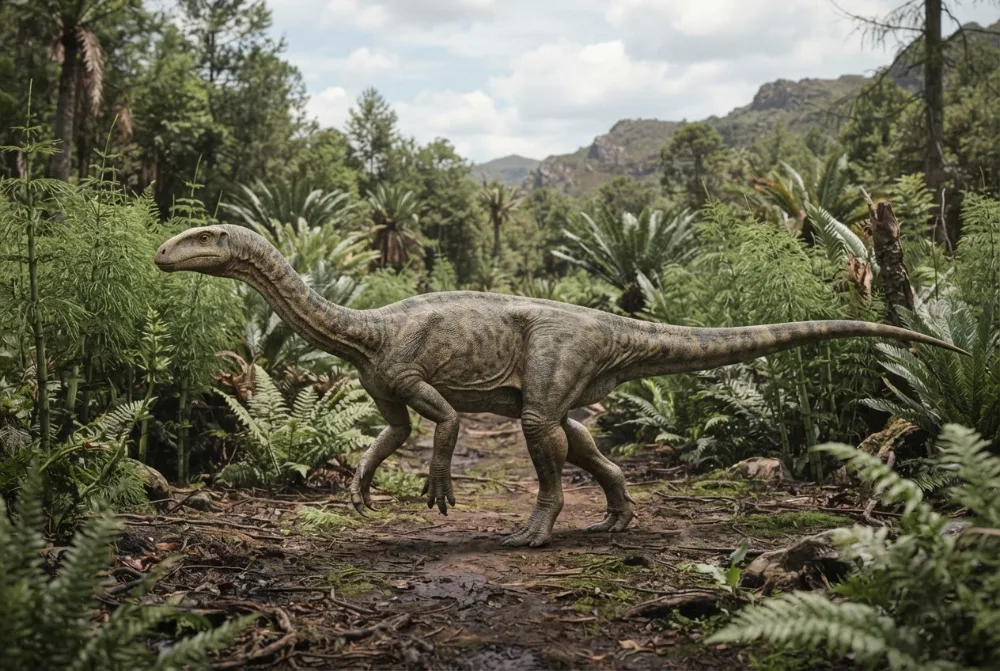
 telele jwaloka dikatse tsa lapeng tse 4 ho tloha nkong ho isa mohatleng🍌telele jwaloka dibanana tse 11 di behilwe ka mola🍌boima jwaloka dibanana tse 120🏃e ne e ka matha dimitara tse 100 ka metsotswana e 12 (motho ya lebelo ka ho fetisisa o hloka 9,6)
Buriolestes e ne e le kgolo hakae ha e bapiswa le WENA?
Ke dipalo feela ho browser ya hao. Ha ho letho le bolokwang kapa le romelwang kae kapa kae.
E ne e le lebelo hakae?


Dintlha tse monate
Buriolestes is one of the oldest known dinosaurs, living about 233 million years ago during the Late Triassic.13
Even though Buriolestes was a meat-eater, it belonged to the sauropodomorph group, which later gave rise to giant plant-eaters like Diplodocus.12
Its fossils were found right next to a lagerpetid called Ixalerpeton, showing that early dinosaurs lived alongside their dinosaur-like cousins.12
Buriolestes had a downturned jaw tip and a long crest on its upper arm bone, traits that later sauropodomorphs also had.1
The name Buriolestes means 'Buriol robber', after the Buriol family who owned the land where it was found.1
Dipotso tse botswang haholo ka Buriolestes
?What did Buriolestes eat?
Buriolestes was a carnivore, likely preying on small vertebrates and soft invertebrates. Its curved, serrated teeth were well-suited for slicing meat.12
?How big was Buriolestes?
Buriolestes was small, with one robust individual weighing over 7 kg (15.4 lb) and others weighing between 6.4 and 7.2 kg (14 to 16 lb). Its femur was about 135 mm long.2
?When did Buriolestes live?
Buriolestes lived about 233 million years ago during the Late Triassic, in the Carnian epoch. It is one of the oldest known dinosaurs.1
?Was Buriolestes a dinosaur?
Yes, Buriolestes was a dinosaur, specifically an early sauropodomorph. It was a meat-eater but belonged to the group that later gave rise to giant plant-eaters like Diplodocus.1
?Where was Buriolestes found?
Buriolestes was found in the Buriol ravine in São João do Polêsine, Brazil, in the Santa Maria Formation. The holotype was discovered in 2009.1
Bakeng sa ditsebi tsa didinosaure
- Lebitso la saense
- Buriolestes
- E rehilwe ke
- Cabreira et al. 20164
- Sehlopha
- Melala e melelele
- Lelapa / leloko
- Sauropodomorpha4
- Tlhophiso
- Sauropodomorpha4
- Dilemo tsa mafika
- dilemo tse dimilione tse 237 ho isa ho 227 (Carnian)4
- Dibopeho tsa mafika
- Santa Maria4
- Dinaha
- Brazil4
- Direkoto tsa difosili
- 1 ho The Paleobiology Database4
- Ho sibollwa
- Buriolestes was discovered in 2009 in a ravine in Brazil and named in 2016 by paleontologist Cabreira and his team. The species name honors paleontologist Cesar Schultz.1
- E sa ntse e phehwa kgang
- Scientists are still debating whether the smaller bones found with the main Buriolestes skeleton belong to a juvenile or a different dinosaur.1
Moo dintlha di tswang teng
- Buriolestes (en.wikipedia.org)
- A Unique Late Triassic Dinosauromorph Assemblage Reveals Dinosaur Ancestral Anatomy and Diet: Current Biology (cell.com)
- PBDB Taxon (paleobiodb.org)
- Buriolestes in The Paleobiology Database (CC BY 4.0): dilemo, dibaka, dibopeho tsa mafika, tlhophiso.
Ntlha e nngwe le e nngwe leqepheng lena e na le nomoro e supang mohlodi wa yona. Haeba re fositse ho hong, re kopa tshwarelo, re balatedi ba didinosaure, ha re koranta ya saense. Re bolelle ho [email protected] mme re tla e lokisa.
 Rex o lapile! Dino Wiki ke projeke ya ntate bakeng sa mora wa hae ya ratang didinosaure, ke mahala, ha ho dipapatso, ha ho disebedi. Batho ba baholo ba ka fepa Rex seneke ho thusa hore e dule e le inthaneteng.Fepa Rex
 Brachiosaurus
 Diplodocus
 Brontosaurus
 Argentinosaurus
 Camarasaurus
 Morosaurus
 Nothosaurus
 Coelophysis
 Podokesaurus
 Simosaurus
 Eudimorphodon
 Herrerasaurus