 Kwisi: O dinosaure efe?
 Ntwa ya didinosaure
 Peiso ya didinosaure
 Dipapadi tse nyane tsa didinosaure
 Albamo ya ditikara
 Manane a TOP a didinosaure
 Nkgethele!
Clidastes
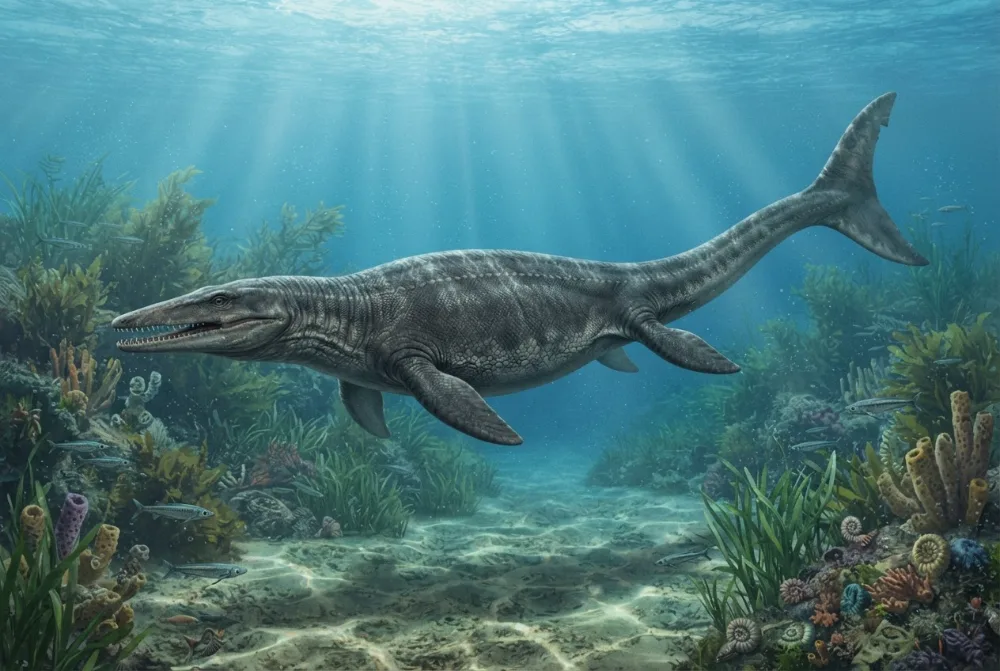
Clidastes was a small, speedy marine lizard that lived in the Late Cretaceous seas. It was one of the smallest mosasaurs, but it was a fast swimmer that chased down fish and squid in shallow waters.1
E phetse neng?
E ne e le kgolo hakae?
E ne e le telele hakae?
E ne e le boima hakae?
 telele jwaloka dintja tse 6 ho tloha nkong ho isa mohatleng🍌telele jwaloka dibanana tse 34 di behilwe ka mola
 boima jwaloka dikatse tsa lapeng tse 14🍉boima jwaloka mahapu a 11🧸boima jwaloka bana ba kereshe ba 3🎒boima jwaloka bana ba sekolo ba 1.5🏊e ne e ka sesa bolelele ba letamo le leholo la ho sesa (50 m) ka metsotswana e 5.5
Clidastes e ne e le kgolo hakae ha e bapiswa le WENA?
Ke dipalo feela ho browser ya hao. Ha ho letho le bolokwang kapa le romelwang kae kapa kae.
E ne e le lebelo hakae?


Dintlha tse monate
Clidastes had special vertebrae that locked together, making its spine strong and stable for fast swimming.1
It was one of the smallest mosasaurs, only 2 to 4 meters long on average, but some grew up to 6.2 meters.1
Isotope studies on its teeth suggest Clidastes sometimes entered freshwater, like modern sea snakes.1
The first Clidastes fossils were found in Alabama in 1869 by E. D. Cope, and they were beautifully preserved.1
Its tail had extra-strong bones and muscles, which helped it chase down the fastest prey.1
Some scientists think that only one species, Clidastes propython, is valid, but others recognize more.1
Dipotso tse botswang haholo ka Clidastes
?Was Clidastes a dinosaur?
No, Clidastes was a marine lizard, not a dinosaur. It belonged to a group called mosasaurs, which are reptiles that lived in the sea.13
?How big was Clidastes?
Clidastes was one of the smallest mosasaurs, averaging 2 to 4 metres (6.6 to 13.1 feet) long. The largest specimens reached about 6.2 metres (20 feet).13
?What did Clidastes eat?
Clidastes likely ate cephalopods (like squid), fish, and other small vertebrates. It hunted in shallow water.13
?Could Clidastes swim in freshwater?
Yes, isotope studies on its teeth suggest Clidastes sometimes entered freshwater, similar to modern sea snakes.1
Bakeng sa ditsebi tsa didinosaure
- Lebitso la saense
- Clidastes
- E rehilwe ke
- Cope 18684
- Sehlopha
- Dimosasaure
- Lelapa / leloko
- Mosasauridae4
- Tlhophiso
- Mosasauroidea4
- Dilemo tsa mafika
- dilemo tse dimilione tse 94 ho isa ho 66 (Turonian / Maastrichtian)4
- Dibopeho tsa mafika
- Mooreville Chalk, Niobrara, Pierre Shale4
- Dinaha
- Amerika, Sweden, Jeremane, Meksiko, Russia, Jordane4
- Direkoto tsa difosili
- 34 ho The Paleobiology Database4
- Ho sibollwa
- E. D. Cope named Clidastes in 1868, and in 1869 he found the first good fossils in the Mooreville Chalk of Alabama.14
- E sa ntse e phehwa kgang
- Scientists debate whether fossils from Europe and Jordan really belong to Clidastes or to other mosasaurs.1
Moo dintlha di tswang teng
- Clidastes (en.wikipedia.org)
- Clidastes - Justapedia (justapedia.org)
- Clidastes Facts for Kids (kids.kiddle.co)
- Clidastes in The Paleobiology Database (CC BY 4.0): dilemo, dibaka, dibopeho tsa mafika, tlhophiso.
Ntlha e nngwe le e nngwe leqepheng lena e na le nomoro e supang mohlodi wa yona. Haeba re fositse ho hong, re kopa tshwarelo, re balatedi ba didinosaure, ha re koranta ya saense. Re bolelle ho [email protected] mme re tla e lokisa.
 Rex o lapile! Dino Wiki ke projeke ya ntate bakeng sa mora wa hae ya ratang didinosaure, ke mahala, ha ho dipapatso, ha ho disebedi. Batho ba baholo ba ka fepa Rex seneke ho thusa hore e dule e le inthaneteng.Fepa Rex
 Mosasaurus
 Prognathodon
 Tylosaurus
 Platecarpus
 Globidens
 Halisaurus
 Tyrannosaurus
 Triceratops
 Velociraptor
 Spinosaurus
 Ankylosaurus
 Parasaurolophus