 Kwisi: O dinosaure efe?
 Ntwa ya didinosaure
 Peiso ya didinosaure
 Dipapadi tse nyane tsa didinosaure
 Albamo ya ditikara
 Manane a TOP a didinosaure
 Nkgethele!
Ekrixinatosaurus
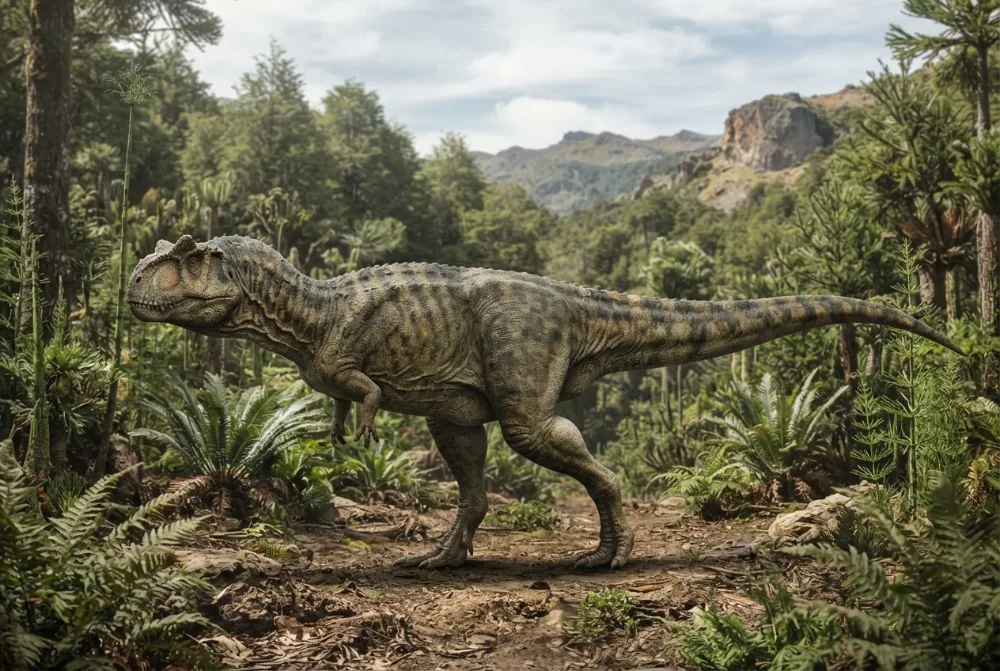
Ekrixinatosaurus was a big, meat-eating dinosaur with a boxy head and strong legs. It lived in what is now Argentina during the Early Cretaceous period. Its fossils were found when workers were building a gas pipeline and used dynamite, which is how it got its name!1
E phetse neng?
E ne e le kgolo hakae?
E ne e le telele hakae?
E ne e phahame hakae?
kakanyo
E ne e le boima hakae?
 telele jwaloka dintja tse 8 ho tloha nkong ho isa mohatleng🍌telele jwaloka dibanana tse 44 di behilwe ka mola🍉boima jwaloka mahapu a 160🧸boima jwaloka bana ba kereshe ba 42🎒boima jwaloka bana ba sekolo ba 25🏃e ne e ka matha dimitara tse 100 ka metsotswana e 9.5 (motho ya lebelo ka ho fetisisa o hloka 9,6)
Ekrixinatosaurus e ne e le kgolo hakae ha e bapiswa le WENA?
Ke dipalo feela ho browser ya hao. Ha ho letho le bolokwang kapa le romelwang kae kapa kae.
E ne e le lebelo hakae?


Dintlha tse monate
Ekrixinatosaurus was an abelisaurid, a family of theropod dinosaurs with short, deep skulls and tiny arms. Its skull was about 83 centimetres long.1
The only known skeleton of Ekrixinatosaurus was found scattered over an area of 15 square metres. It included parts of the skull, backbone, hips, legs and feet.1
Ekrixinatosaurus lived alongside the giant meat-eater Giganotosaurus and the long-necked sauropods Andesaurus and Limaysaurus. Scientists think they may have competed for food.1
The bones of Ekrixinatosaurus were discovered because of a gas pipeline project. Workers used dynamite to blast through the rock, which is why the dinosaur was named 'explosion-born reptile'.1
Ekrixinatosaurus had a boxy skull with a bump above its eye and a jaw that curved upward. Its face bones were covered in small holes and spikes, which may have supported a tough, wrinkly skin.1
Some scientists once thought Ekrixinatosaurus was the largest abelisaurid, bigger than Carnotaurus. But later studies showed that Carnotaurus was actually larger, just with a smaller head.1
Dipotso tse botswang haholo ka Ekrixinatosaurus
?How big was Ekrixinatosaurus?
It was about 6.5 to 8 metres long (21 to 26 feet) and weighed around 800 kilograms (1,800 pounds). Some scientists once thought it was bigger, but later studies showed it was smaller than Carnotaurus.1
?What did Ekrixinatosaurus eat?
It was a meat-eater that probably hunted smaller dinosaurs and animals. It lived alongside giant plant-eaters like Andesaurus and may have competed with the huge predator Giganotosaurus for food.1
?When did Ekrixinatosaurus live?
It lived during the Early Cretaceous period, about 111 to 106 million years ago.1
?Where was Ekrixinatosaurus found?
Its fossils were found in Argentina, in a place called the Candeleros Formation. Workers building a gas pipeline blasted the rock with dynamite, which is how the dinosaur got its name 'explosion-born reptile'.1
?Was Ekrixinatosaurus bigger than Carnotaurus?
No, Carnotaurus was actually larger. Some scientists once thought Ekrixinatosaurus was bigger because of its large skull, but comparing the leg bones shows Carnotaurus was the bigger dinosaur.1
?Did Ekrixinatosaurus have feathers?
The sources do not say whether it had feathers. Its face bones had small holes and spikes that may have supported tough, wrinkly skin, but no information about feathers is given.1
Bakeng sa ditsebi tsa didinosaure
- Lebitso la saense
- Ekrixinatosaurus
- E rehilwe ke
- Calvo et al. 20042
- Sehlopha
- Didinosaure tse jang nama
- Lelapa / leloko
- Abelisauridae2
- Tlhophiso
- Theropoda > Ceratosauria > Abelisauridae2
- Dilemo tsa mafika
- dilemo tse dimilione tse 113 ho isa ho 110 (Albian)2
- Dibopeho tsa mafika
- Candeleros2
- Dinaha
- Argentina2
- Direkoto tsa difosili
- 1 ho The Paleobiology Database2
- Ho sibollwa
- Ekrixinatosaurus was named in 2004 by paleontologists Jorge Calvo, David Rubilar-Rogers and Karen Moreno. The fossils were found in the Candeleros Formation of Argentina during construction of a gas pipeline.12
- E sa ntse e phehwa kgang
- Scientists are not sure exactly how big Ekrixinatosaurus was. Some think it was 6.5 to 8 metres long, while others estimate it could have been 10 to 11 metres based on its skull size.1
Moo dintlha di tswang teng
- Ekrixinatosaurus (en.wikipedia.org)
- Ekrixinatosaurus in The Paleobiology Database (CC BY 4.0): dilemo, dibaka, dibopeho tsa mafika, tlhophiso.
Ntlha e nngwe le e nngwe leqepheng lena e na le nomoro e supang mohlodi wa yona. Haeba re fositse ho hong, re kopa tshwarelo, re balatedi ba didinosaure, ha re koranta ya saense. Re bolelle ho [email protected] mme re tla e lokisa.
 Rex o lapile! Dino Wiki ke projeke ya ntate bakeng sa mora wa hae ya ratang didinosaure, ke mahala, ha ho dipapatso, ha ho disebedi. Batho ba baholo ba ka fepa Rex seneke ho thusa hore e dule e le inthaneteng.Fepa Rex
 Allosaurus
 Carnotaurus
 Dilophosaurus
 Giganotosaurus
 Compsognathus
 Paronychodon
 Stegosaurus
 Iguanodon
 Archaeopteryx
 Microraptor
 Deinonychus
 Baryonyx