 Kwisi: O dinosaure efe?
 Ntwa ya didinosaure
 Peiso ya didinosaure
 Dipapadi tse nyane tsa didinosaure
 Albamo ya ditikara
 Manane a TOP a didinosaure
 Nkgethele!
Dilophosaurus
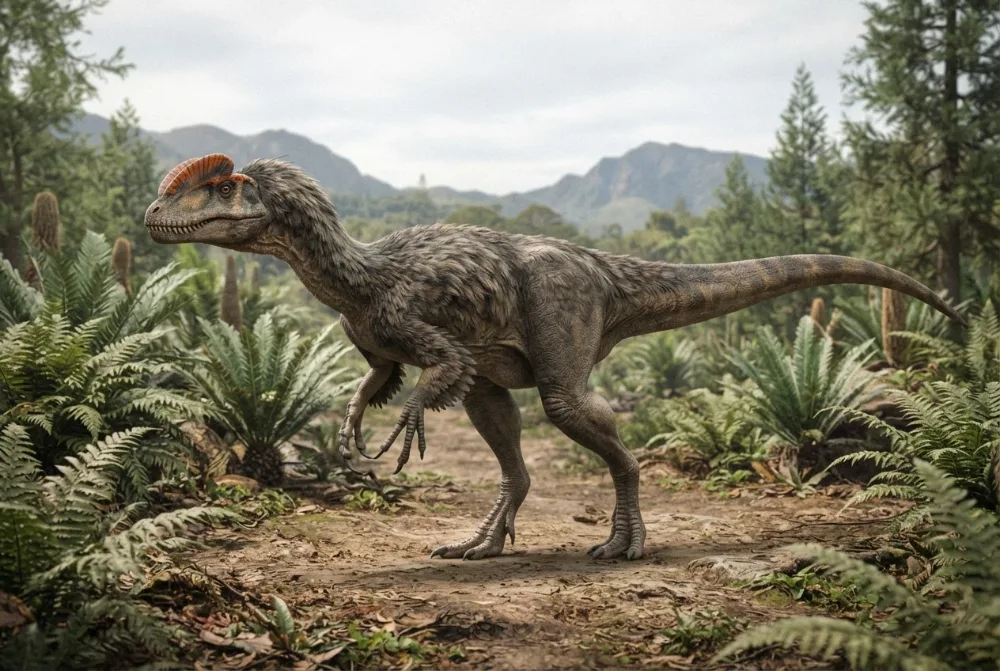
Dilophosaurus was a big, fast meat-eating dinosaur that lived in North America about 186 million years ago. It had two thin crests on its head and strong jaws that could crush bone. It was the biggest land predator in its neighborhood during the Early Jurassic.12
E phetse neng?
E ne e le kgolo hakae?
E ne e le telele hakae?
E ne e phahame hakae?
E ne e le boima hakae?
 telele jwaloka dintja tse 6 ho tloha nkong ho isa mohatleng🍌telele jwaloka dibanana tse 33 di behilwe ka mola🍉boima jwaloka mahapu a 80🧸boima jwaloka bana ba kereshe ba 21🎒boima jwaloka bana ba sekolo ba 12🏃e ne e ka matha dimitara tse 100 ka metsotswana e 9.5 (motho ya lebelo ka ho fetisisa o hloka 9,6)
Dilophosaurus e ne e le kgolo hakae ha e bapiswa le WENA?
Ke dipalo feela ho browser ya hao. Ha ho letho le bolokwang kapa le romelwang kae kapa kae.
E ne e le lebelo hakae?


Dintlha tse monate
Dilophosaurus had two thin crests on its head made from the nasal and lacrimal bones. These crests might have been used for display or to attract mates.12
Its jaws were strong enough to puncture bone, and it may have been the top predator in its ecosystem.1
Some scientists think Dilophosaurus might have eaten fish. Its jaws had a 'rosette' of interlocking teeth like modern fish-eating crocodiles and gharials.1
Dilophosaurus breathed like a bird. Air sacs in its bones allowed unidirectional airflow in its lungs, which gave it more oxygen and made it a fast, active hunter.1
Fossil footprints of Dilophosaurus have been found, including traces where it rested.1
It lived in a seasonally dry environment with rivers and sand dunes, like a river oasis surrounded by a desert.1
Dilophosaurus was the largest land animal in North America during the Early Jurassic, bigger than any other predator at that time.2
Dipotso tse botswang haholo ka Dilophosaurus
?How big was Dilophosaurus?
About 7 metres (23 ft) long and weighed around 400 kg (880 lb). It was one of the earliest large predatory dinosaurs.1
?Did Dilophosaurus have feathers?
The sources do not say whether Dilophosaurus had feathers. No fossil evidence of feathers has been found for this dinosaur.1
?Could Dilophosaurus spit venom?
No. That was made up for the movie Jurassic Park. The real Dilophosaurus did not spit venom.1
?What did Dilophosaurus eat?
It was a meat-eater that probably hunted large animals, smaller animals, and maybe fish. Its strong jaws could even puncture bone.1
?How fast could Dilophosaurus run?
Up to about 38 km/h (24 mph), about as fast as a fast human runner. A computer model of its legs and muscles worked this out. It was a fast, agile hunter.3
?Why did Dilophosaurus have crests?
Nobody knows for sure, but they were probably used for display, like to recognize other Dilophosaurus or attract mates. They were too weak for fighting.1
?Was Dilophosaurus bigger than T. rex?
No. Dilophosaurus was about 7 metres (23 ft) long, much smaller than Tyrannosaurus rex, which could be over 12 metres (39 ft) long.1
?When did Dilophosaurus live?
It lived during the Early Jurassic, about 186 million years ago.1
?Is Dilophosaurus a dinosaur?
Yes, it is a theropod dinosaur, a type of meat-eating dinosaur.1
?Where was Dilophosaurus found?
Its fossils were discovered in northern Arizona, in the Kayenta Formation, on Navajo land.1
Mosenyi wa ditshomo
Tshomo: Dilophosaurus could spit venom like in the movie Jurassic Park.
Nnete: There is no evidence that Dilophosaurus spat venom. It was a large predator with strong jaws and teeth, not a small frilled dinosaur that spits poison.1
Bakeng sa ditsebi tsa didinosaure
- Lebitso la saense
- Dilophosaurus
- E rehilwe ke
- Welles 19704
- Sehlopha
- Didinosaure tse jang nama
- Lelapa / leloko
- Neotheropoda4
- Tlhophiso
- Theropoda4
- Dilemo tsa mafika
- dilemo tse dimilione tse 201 ho isa ho 184 (Hettangian / Pliensbachian)4
- Dibopeho tsa mafika
- Kayenta, Dharmaram4
- Dinaha
- Amerika, India4
- Direkoto tsa difosili
- 14 ho The Paleobiology Database4
- Ho sibollwa
- Three skeletons were found in northern Arizona in 1940 and collected in 1942. Scientist Samuel P. Welles named the first specimen Megalosaurus wetherilli in 1954. After finding a larger skeleton with crests, he renamed it Dilophosaurus wetherilli in 1970.1
- E sa ntse e phehwa kgang
- Scientists still debate whether Dilophosaurus was a fast predator that attacked large prey or a scavenger that ate smaller animals. Most now think it was an active hunter.1
Moo dintlha di tswang teng
- Dilophosaurus (en.wikipedia.org)
- A comprehensive anatomical and phylogenetic evaluation of Dilophosaurus wetherilli (Dinosauria, Theropoda) with descriptions of new specimens from the Kayenta Formation of northern Arizona (bioone.org)
- The Real Dilophosaurus Would Have Eaten the Jurassic Park Version for Breakfast | Scientific American (scientificamerican.com)
- Dilophosaurus in The Paleobiology Database (CC BY 4.0): dilemo, dibaka, dibopeho tsa mafika, tlhophiso.
Ntlha e nngwe le e nngwe leqepheng lena e na le nomoro e supang mohlodi wa yona. Haeba re fositse ho hong, re kopa tshwarelo, re balatedi ba didinosaure, ha re koranta ya saense. Re bolelle ho [email protected] mme re tla e lokisa.
 Rex o lapile! Dino Wiki ke projeke ya ntate bakeng sa mora wa hae ya ratang didinosaure, ke mahala, ha ho dipapatso, ha ho disebedi. Batho ba baholo ba ka fepa Rex seneke ho thusa hore e dule e le inthaneteng.Fepa Rex
 Allosaurus
 Carnotaurus
 Giganotosaurus
 Compsognathus
 Paronychodon
 Megalosaurus
 Stenopterygius
 Dorygnathus
 Lufengosaurus
 Scutellosaurus
 Yunnanosaurus
 Temnodontosaurus