 Kwisi: O dinosaure efe?
 Ntwa ya didinosaure
 Peiso ya didinosaure
 Dipapadi tse nyane tsa didinosaure
 Albamo ya ditikara
 Manane a TOP a didinosaure
 Nkgethele!
Gondwanatitan
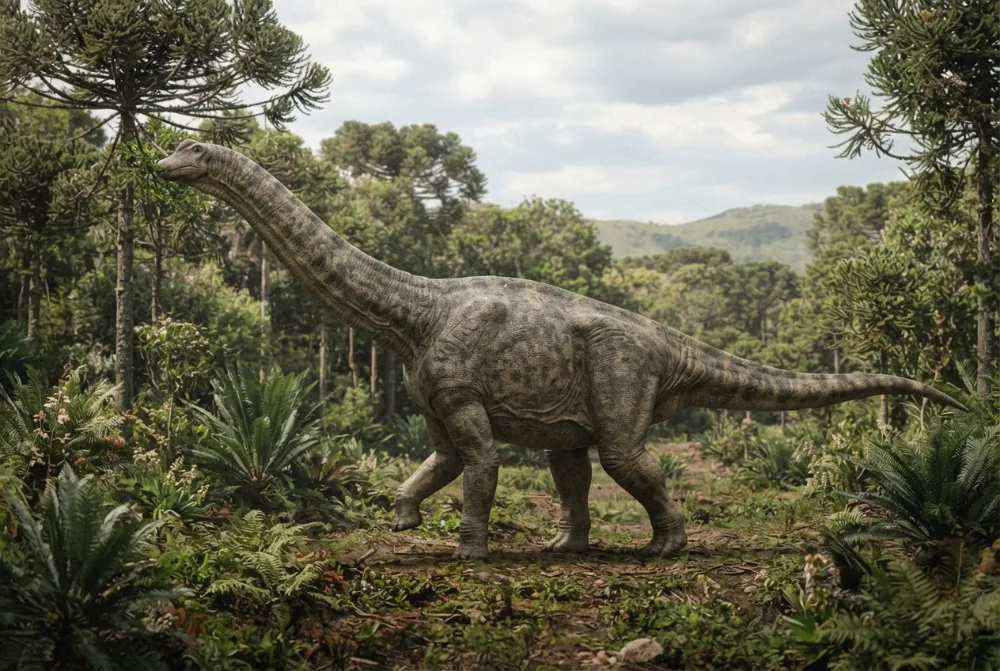
Gondwanatitan was a long-necked plant-eater that stomped around Brazil near the end of the Age of Dinosaurs. It was small for a sauropod, about as long as a school bus, and probably used its tall neck to munch leaves from high trees.1
E phetse neng?
E ne e le kgolo hakae?
E ne e le telele hakae?
E ne e phahame hakae?
kakanyo
E ne e le boima hakae?
 telele jwaloka dintja tse 7 ho tloha nkong ho isa mohatleng🍌telele jwaloka dibanana tse 39 di behilwe ka mola🍉boima jwaloka mahapu a 200🧸boima jwaloka bana ba kereshe ba 53🎒boima jwaloka bana ba sekolo ba 31🐻❄️boima jwaloka dibere tse tshweu tse 2🏃e ne e ka matha dimitara tse 100 ka metsotswana e 12 (motho ya lebelo ka ho fetisisa o hloka 9,6)
Gondwanatitan e ne e le kgolo hakae ha e bapiswa le WENA?
Ke dipalo feela ho browser ya hao. Ha ho letho le bolokwang kapa le romelwang kae kapa kae.
E ne e le lebelo hakae?


Dintlha tse monate
Gondwanatitan's middle tail bones are shaped like hearts, which helps scientists tell it apart from its close relative Aeolosaurus.1
Its limb bones were slender and graceful, not as heavy as those of many other sauropods.1
The shallow depressions on its vertebrae are similar to those seen in Saltasaurus, Alamosaurus, and Malawisaurus.1
The neural spines on its middle tail vertebrae point forward, a feature also seen in Cedarosaurus and Venenosaurus.1
In 2001, some scientists thought Gondwanatitan was the same as Aeolosaurus, but most now treat it as a separate genus.1
The type specimen was found on a farm in 1983, but it took until 1997 before scientists started preparing the bones.1
Dipotso tse botswang haholo ka Gondwanatitan
?How big was Gondwanatitan?
It was about 7 to 8 metres long and weighed around 1 tonne. That is small for a sauropod, about as long as a school bus.12
?What did Gondwanatitan eat?
It was a herbivore, eating tough shoots and leaves from the tops of trees. Its tall neck helped it reach high branches.13
?When did Gondwanatitan live?
It lived during the Late Cretaceous Period, about 70 million years ago.1
Mosenyi wa ditshomo
Tshomo: Gondwanatitan was a giant like other sauropods.
Nnete: Actually, Gondwanatitan was a fairly small sauropod, only about 7 meters long and weighing about 1 tonne.1
Bakeng sa ditsebi tsa didinosaure
- Lebitso la saense
- Gondwanatitan
- E rehilwe ke
- Kellner and Azevedo 19993
- Sehlopha
- Melala e melelele
- Lelapa / leloko
- Aeolosaurini3
- Tlhophiso
- Sauropodomorpha > Sauropoda > Titanosauria > Macronaria3
- Dilemo tsa mafika
- dilemo tse dimilione tse 84 ho isa ho 66 (Campanian / Maastrichtian)3
- Dibopeho tsa mafika
- Adamantina, Cambambe3
- Dinaha
- Brazil3
- Direkoto tsa difosili
- 2 ho The Paleobiology Database3
- Ho sibollwa
- The type specimen was discovered in 1983 on a farm in São Paulo, Brazil, and was formally named Gondwanatitan faustoi by Kellner and de Azevedo in 1999.13
- E sa ntse e phehwa kgang
- Scientists still debate whether Gondwanatitan is really a separate genus from Aeolosaurus, since some bones look very similar.1
Moo dintlha di tswang teng
- Gondwanatitan (en.wikipedia.org)
- Gondwanatitan (prehistoric-wildlife.com)
- Gondwanatitan in The Paleobiology Database (CC BY 4.0): dilemo, dibaka, dibopeho tsa mafika, tlhophiso.
Ntlha e nngwe le e nngwe leqepheng lena e na le nomoro e supang mohlodi wa yona. Haeba re fositse ho hong, re kopa tshwarelo, re balatedi ba didinosaure, ha re koranta ya saense. Re bolelle ho [email protected] mme re tla e lokisa.
 Rex o lapile! Dino Wiki ke projeke ya ntate bakeng sa mora wa hae ya ratang didinosaure, ke mahala, ha ho dipapatso, ha ho disebedi. Batho ba baholo ba ka fepa Rex seneke ho thusa hore e dule e le inthaneteng.Fepa Rex
 Brachiosaurus
 Diplodocus
 Brontosaurus
 Argentinosaurus
 Camarasaurus
 Morosaurus
 Tyrannosaurus
 Triceratops
 Velociraptor
 Spinosaurus
 Ankylosaurus
 Parasaurolophus