 Kwisi: O dinosaure efe?
 Ntwa ya didinosaure
 Peiso ya didinosaure
 Dipapadi tse nyane tsa didinosaure
 Albamo ya ditikara
 Manane a TOP a didinosaure
 Nkgethele!
Ischioceratops
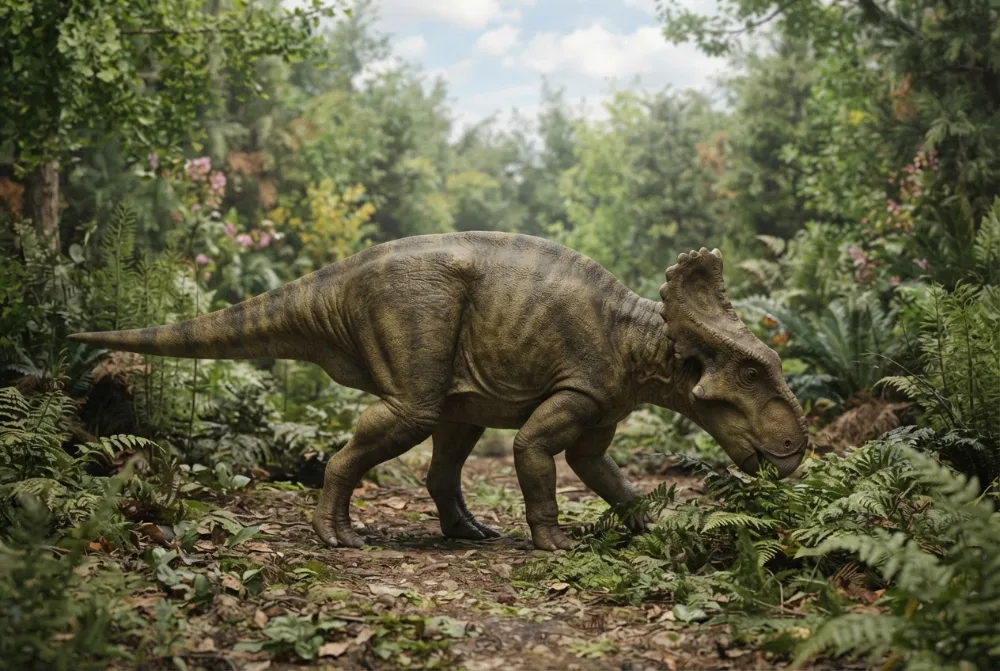
Ischioceratops was a small, plant-eating dinosaur that lived in what is now China. It had a short frill on its head and no horns, unlike its bigger cousin Triceratops. Its most unusual feature was a hip bone shaped like a bow and arrow.1
E phetse neng?
E ne e le kgolo hakae?
E ne e le telele hakae?
E ne e phahame hakae?
kakanyo
 telele jwaloka dikatse tsa lapeng tse 4 ho tloha nkong ho isa mohatleng🍌telele jwaloka dibanana tse 11 di behilwe ka mola🏃e ne e ka matha dimitara tse 100 ka metsotswana e 9.7 (motho ya lebelo ka ho fetisisa o hloka 9,6)
Ischioceratops e ne e le kgolo hakae ha e bapiswa le WENA?
Ke dipalo feela ho browser ya hao. Ha ho letho le bolokwang kapa le romelwang kae kapa kae.
E ne e le lebelo hakae?


Dintlha tse monate
Ischioceratops is known only from a partial skeleton that includes the pelvis, tail bones, and parts of the legs. No skull has been found yet.1
Its ischium (a hip bone) is unlike any other dinosaur's. It flares out in the middle like a recurve bow and has a hole called a fenestra, ending in an axehead-shaped tip.1
Ischioceratops lived during the Campanian stage of the Late Cretaceous, about 83 to 72 million years ago.2
It was a leptoceratopsid, a group of small, hornless, frilled dinosaurs that walked on four legs. Leptoceratopsids are close relatives of the larger horned dinosaurs like Triceratops.1
The fossil was found in the same bonebed as many hadrosaur (duck-billed dinosaur) bones and a tyrannosaur, suggesting a rich ecosystem.1
Ischioceratops had nine sacral vertebrae (hip vertebrae), more than any other known leptoceratopsid.1
Bakeng sa ditsebi tsa didinosaure
- Lebitso la saense
- Ischioceratops
- E rehilwe ke
- He et al. 20154
- Sehlopha
- Didinosaure tse dinaka
- Lelapa / leloko
- Leptoceratopsidae4
- Tlhophiso
- Ornithischia > Ceratopsia4
- Dilemo tsa mafika
- dilemo tse dimilione tse 84 ho isa ho 72 (Campanian)4
- Dibopeho tsa mafika
- Hongtuya4
- Dinaha
- Tjhaena4
- Direkoto tsa difosili
- 1 ho The Paleobiology Database4
- Ho sibollwa
- Ischioceratops was named in 2015 by a team of scientists including He Y., Makovicky P.J., and others. The only specimen was dug up from the Kugou locality in Zhucheng, China, and is stored at the Zhucheng Dinosaur Museum.12
- E sa ntse e phehwa kgang
- Scientists are not sure what the strange shape of its ischium was used for. It might have been for muscle attachment or display, but no one knows for certain.1
Moo dintlha di tswang teng
- A New Leptoceratopsid (Ornithischia, Ceratopsia) with a Unique Ischium from the Upper Cretaceous of Shandong Province, China | PLOS One (journals.plos.org)
- PBDB Taxon (paleobiodb.org)
- Ischioceratops (en.wikipedia.org)
- Ischioceratops in The Paleobiology Database (CC BY 4.0): dilemo, dibaka, dibopeho tsa mafika, tlhophiso.
Ntlha e nngwe le e nngwe leqepheng lena e na le nomoro e supang mohlodi wa yona. Haeba re fositse ho hong, re kopa tshwarelo, re balatedi ba didinosaure, ha re koranta ya saense. Re bolelle ho [email protected] mme re tla e lokisa.
 Rex o lapile! Dino Wiki ke projeke ya ntate bakeng sa mora wa hae ya ratang didinosaure, ke mahala, ha ho dipapatso, ha ho disebedi. Batho ba baholo ba ka fepa Rex seneke ho thusa hore e dule e le inthaneteng.Fepa Rex
 Triceratops
 Protoceratops
 Ojoceratops
 Tatankaceratops
 Psittacosaurus
 Centrosaurus
 Tyrannosaurus
 Velociraptor
 Spinosaurus
 Ankylosaurus
 Parasaurolophus
 Pteranodon