 Kwisi: O dinosaure efe?
 Ntwa ya didinosaure
 Peiso ya didinosaure
 Dipapadi tse nyane tsa didinosaure
 Albamo ya ditikara
 Manane a TOP a didinosaure
 Nkgethele!
Kawanectes
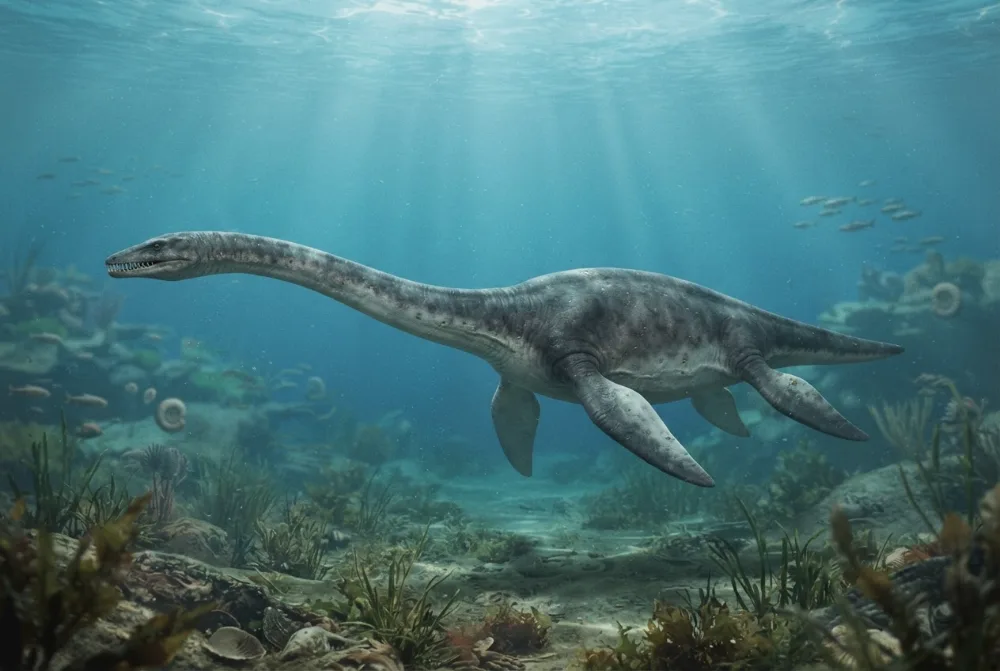
Kawanectes was a small marine reptile with a long neck that lived in the seas of Patagonia near the end of the Age of Dinosaurs. It was an elasmosaurid plesiosaur, but much smaller than its giant relatives, only about as long as a small car.1
E phetse neng?
E ne e le kgolo hakae?
E ne e le telele hakae?
 telele jwaloka dintja tse 4 ho tloha nkong ho isa mohatleng🍌telele jwaloka dibanana tse 23 di behilwe ka mola🏊e ne e ka sesa bolelele ba letamo le leholo la ho sesa (50 m) ka metsotswana e 6.2
Kawanectes e ne e le kgolo hakae ha e bapiswa le WENA?
Ke dipalo feela ho browser ya hao. Ha ho letho le bolokwang kapa le romelwang kae kapa kae.
E ne e le lebelo hakae?


Dintlha tse monate
Kawanectes is one of the smallest elasmosaurids ever found, with an adult body length of only 3.8 to 4.2 metres (12 to 14 feet).1
Its name comes from the Kawas Sea, an ancient ocean that covered Patagonia during the Late Cretaceous.1
One specimen of Kawanectes was found with 389 gastroliths, or stomach stones, which may have helped it digest food or control buoyancy.1
Kawanectes had a high humerus-to-femur length ratio of about 1.2, meaning its upper arm bone was longer than its thigh bone, which is unusual among elasmosaurids.1
Scientists think Kawanectes may have been sexually dimorphic, with females possibly larger than males.1
Kawanectes lived in a marginal marine environment, probably an estuary, not the open ocean, and it was smaller than open-ocean plesiosaurs.1
Dipotso tse botswang haholo ka Kawanectes
?How big was Kawanectes?
Kawanectes was about 3.8 to 4.2 metres (12 to 14 feet) long as an adult, which is small for an elasmosaurid.12
?What did Kawanectes eat?
Kawanectes likely ate small marine animals, and its jaw shape suggests it could snap its jaws shut quickly for fast bites, but not with a strong bite force.2
?Where did Kawanectes live?
Kawanectes lived in the seas of Patagonia, in what is now Argentina, during the Late Cretaceous, in a coastal or estuarine environment.12
?Was Kawanectes a dinosaur?
No, Kawanectes was a plesiosaur, a marine reptile, not a dinosaur.1
Bakeng sa ditsebi tsa didinosaure
- Lebitso la saense
- Kawanectes
- E rehilwe ke
- O'Gorman 20163
- Sehlopha
- Diplesiosaure
- Lelapa / leloko
- Elasmosauridae3
- Tlhophiso
- Plesiosauria > Elasmosauridae > Sauropterygia3
- Dilemo tsa mafika
- dilemo tse dimilione tse 72 ho isa ho 66 (Maastrichtian)3
- Dibopeho tsa mafika
- La Colonia, Allen3
- Dinaha
- Argentina3
- Direkoto tsa difosili
- 8 ho The Paleobiology Database3
- Ho sibollwa
- Kawanectes was first named as a species of Trinacromerum in 1985 by Gasparini and Goñi, but in 2016 José P. O'Gorman gave it its own genus, Kawanectes, based on new fossils.1
- E sa ntse e phehwa kgang
- Scientists are not sure exactly how many neck and tail vertebrae Kawanectes had, because the known fossils are incomplete.1
Moo dintlha di tswang teng
- Kawanectes (en.wikipedia.org)
- First record of Kawanectes lafquenianum (Plesiosauria, Elasmosauridae) from the La Colonia Formation of Argentina, with comments on the mandibular morphology of elasmosaurids: Alcheringa: An Australasian Journal of Palaeontology: Vol 44 , No 1 - Get Access (tandfonline.com)
- Kawanectes in The Paleobiology Database (CC BY 4.0): dilemo, dibaka, dibopeho tsa mafika, tlhophiso.
Ntlha e nngwe le e nngwe leqepheng lena e na le nomoro e supang mohlodi wa yona. Haeba re fositse ho hong, re kopa tshwarelo, re balatedi ba didinosaure, ha re koranta ya saense. Re bolelle ho [email protected] mme re tla e lokisa.
 Rex o lapile! Dino Wiki ke projeke ya ntate bakeng sa mora wa hae ya ratang didinosaure, ke mahala, ha ho dipapatso, ha ho disebedi. Batho ba baholo ba ka fepa Rex seneke ho thusa hore e dule e le inthaneteng.Fepa Rex
 Elasmosaurus
 Pliosaurus
 Plesiosaurus
 Cimoliasaurus
 Colymbosaurus
 Trinacromerum
 Tyrannosaurus
 Triceratops
 Velociraptor
 Spinosaurus
 Ankylosaurus
 Parasaurolophus