 Kwisi: O dinosaure efe?
 Ntwa ya didinosaure
 Peiso ya didinosaure
 Dipapadi tse nyane tsa didinosaure
 Albamo ya ditikara
 Manane a TOP a didinosaure
 Nkgethele!
Kunpengopterus
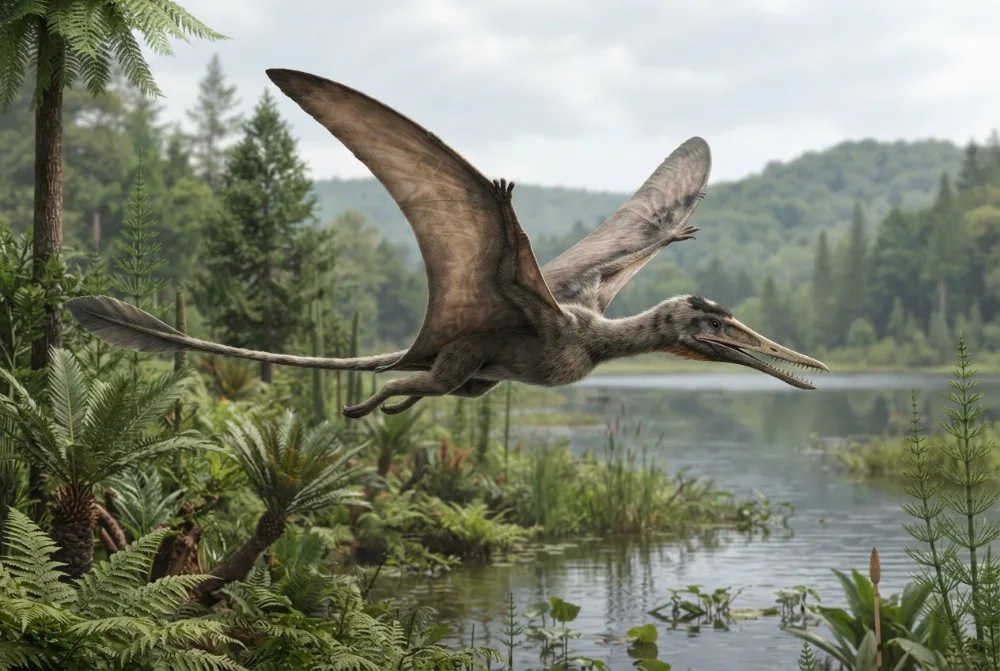
Kunpengopterus was a flying reptile that lived in what is now China during the Jurassic Period. It had a long tail and a head like a bird, and it ate fish.23
E phetse neng?
E ne e le kgolo hakae?
E ne e le boima hakae?
Kunpengopterus e ne e le kgolo hakae ha e bapiswa le WENA?
Ke dipalo feela ho browser ya hao. Ha ho letho le bolokwang kapa le romelwang kae kapa kae.
E ne e le lebelo hakae?


Dintlha tse monate
Kunpengopterus sinensis is known from two nearly complete skeletons, one adult and one juvenile, found with fossilized vomit pellets nearby.3
The vomit pellets contain scales of palaeonisciform fish, proving that Kunpengopterus ate fish and could vomit indigestible parts.3
Both the adult and juvenile Kunpengopterus had similar teeth and could fly soon after hatching, like some other pterosaurs.3
The name Kunpengopterus comes from Chinese mythology: the Kun was a giant fish that could turn into the Peng, a huge bird.1
Kunpengopterus lived between about 168 and 152 million years ago, during the Late Jurassic Period.2
The type specimen of Kunpengopterus sinensis is an almost complete skeleton with a full skull and lower jaws.1
Dipotso tse botswang haholo ka Kunpengopterus
?How big was Kunpengopterus?
Its head was about 10.7 centimetres (4.2 inches) long. The whole body was small, like a modern bird.1
?Did Kunpengopterus have feathers?
No, it did not have feathers. It had pycnofibers, which are thin, hair-like fibers, on its body.4
?What did Kunpengopterus eat?
It ate fish, especially palaeonisciform fish. Scientists know this because fossilized vomit pellets containing fish scales were found with its skeletons.5
?Could Kunpengopterus fly?
Yes, it could fly. Even young Kunpengopterus could fly soon after hatching, just like adults.5
Bakeng sa ditsebi tsa didinosaure
- Lebitso la saense
- Kunpengopterus
- E rehilwe ke
- Wang et al. 20106
- Sehlopha
- Dihahabi tse fofang
- Lelapa / leloko
- Wukongopteridae6
- Tlhophiso
- Pterosauria6
- Dilemo tsa mafika
- dilemo tse dimilione tse 168 ho isa ho 152 (Bathonian / Kimmeridgian)6
- Dibopeho tsa mafika
- Tiaojishan6
- Dinaha
- Tjhaena6
- Direkoto tsa difosili
- 2 ho The Paleobiology Database6
- Ho sibollwa
- Kunpengopterus sinensis was named by Wang Xiaolin and colleagues in 2010, based on a fossil found in the Tiaojishan Formation of Liaoning, China.12
- E sa ntse e phehwa kgang
- Scientists are not sure about the exact age of the rocks that contain Kunpengopterus fossils, which may be from the Middle or Late Jurassic.1
Moo dintlha di tswang teng
- Kunpengopterus (en.wikipedia.org)
- PBDB Taxon (paleobiodb.org)
- Two emetolite-pterosaur associations from the Late Jurassic of China: showing the first evidence for antiperistalsis in (royalsocietypublishing.org)
- New long-tailed pterosaurs (Wukongopteridae) from western Liaoning, China (dinodata.de)
- Two emetolite-pterosaur associations from the Late Jurassic of China: showing the first evidence for antiperistalsis in pterosaurs (pmc.ncbi.nlm.nih.gov)
- Kunpengopterus in The Paleobiology Database (CC BY 4.0): dilemo, dibaka, dibopeho tsa mafika, tlhophiso.
Ntlha e nngwe le e nngwe leqepheng lena e na le nomoro e supang mohlodi wa yona. Haeba re fositse ho hong, re kopa tshwarelo, re balatedi ba didinosaure, ha re koranta ya saense. Re bolelle ho [email protected] mme re tla e lokisa.
 Rex o lapile! Dino Wiki ke projeke ya ntate bakeng sa mora wa hae ya ratang didinosaure, ke mahala, ha ho dipapatso, ha ho disebedi. Batho ba baholo ba ka fepa Rex seneke ho thusa hore e dule e le inthaneteng.Fepa Rex
 Pteranodon
 Quetzalcoatlus
 Dorygnathus
 Rhamphorhynchus
 Anhanguera
 Pterodactylus
 Brachiosaurus
 Diplodocus
 Allosaurus
 Brontosaurus
 Compsognathus
 Camarasaurus