 Kwisi: O dinosaure efe?
 Ntwa ya didinosaure
 Peiso ya didinosaure
 Dipapadi tse nyane tsa didinosaure
 Albamo ya ditikara
 Manane a TOP a didinosaure
 Nkgethele!
Lessemsaurus
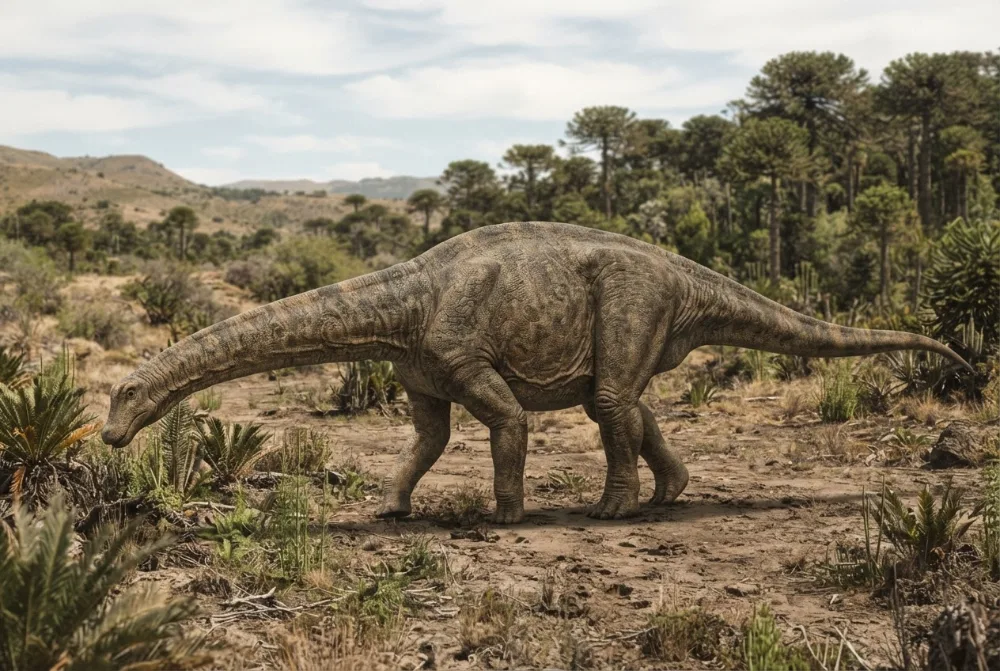
Lessemsaurus was a giant plant-eater that stomped through what is now Argentina about 213 million years ago. It was one of the biggest animals of its time, with a long neck and a huge body. Scientists think it was an early relative of the famous long-necked sauropods like Brachiosaurus.13
E phetse neng?
E ne e le kgolo hakae?
E ne e le telele hakae?
E ne e phahame hakae?
kakanyo
E ne e le boima hakae?
 telele jwaloka dikoloi tse 2.5 tse pakilweng ka mola🍌telele jwaloka dibanana tse 67 di behilwe ka mola
 boima jwaloka ditlou tse 1.5🍉boima jwaloka mahapu a 2000🎒boima jwaloka ditlelase tse feletseng tse 12 tsa bana ba sekolo🐻❄️boima jwaloka dibere tse tshweu tse 22🏃e ne e ka matha dimitara tse 100 ka metsotswana e 22 (motho ya lebelo ka ho fetisisa o hloka 9,6)
Lessemsaurus e ne e le kgolo hakae ha e bapiswa le WENA?
Ke dipalo feela ho browser ya hao. Ha ho letho le bolokwang kapa le romelwang kae kapa kae.
E ne e le lebelo hakae?


Dintlha tse monate
Lessemsaurus had very tall neural arches on its backbones, which made its spine look like a sail and helped support its heavy body.2
It was named after Don Lessem, a science writer who founded The Dinosaur Society, not after a place or a feature.12
Scientists think Lessemsaurus lived in groups, because the fossils of three individuals were found together.32
Its neck bones had a special shape with deep pits and ridges, which may have made its neck stronger and more flexible.2
Lessemsaurus was about as long as a school bus and weighed as much as two elephants.1
Dipotso tse botswang haholo ka Lessemsaurus
?How big was Lessemsaurus?
It was about 10 to 12 metres long and weighed over 7 metric tons, possibly up to 8 to 10 metric tons. That is about as long as a school bus and as heavy as two elephants.1
?What did Lessemsaurus eat?
Lessemsaurus was a plant-eater, just like other sauropodomorph dinosaurs. It ate leaves and other plants.1
?When did Lessemsaurus live?
It lived about 213 million years ago, during the Norian age of the Late Triassic.1
?Where was Lessemsaurus found?
Its fossils were found in the Los Colorados Formation in La Rioja Province, Argentina.1
?Is Lessemsaurus a dinosaur?
Yes, Lessemsaurus is a dinosaur. It is a sauropodiform dinosaur, an early relative of the long-necked sauropods.1
?How fast could Lessemsaurus run?
Scientists do not know exactly how fast it could run, but because it was a large, heavy quadruped, it probably moved slowly, like other big sauropodomorphs.1
Mosenyi wa ditshomo
Tshomo: Some people think Lessemsaurus was a true sauropod like Brachiosaurus.
Nnete: Scientists are not sure. Some studies put it as a very early sauropod, while others say it was a close relative but not a true sauropod.3
Bakeng sa ditsebi tsa didinosaure
- Lebitso la saense
- Lessemsaurus
- E rehilwe ke
- Bonaparte 19994
- Sehlopha
- Melala e melelele
- Lelapa / leloko
- Lessemsauridae4
- Tlhophiso
- Sauropodomorpha > Sauropoda4
- Dilemo tsa mafika
- dilemo tse dimilione tse 227 ho isa ho 206 (Norian)4
- Dibopeho tsa mafika
- Los Colorados4
- Dinaha
- Argentina4
- Direkoto tsa difosili
- 1 ho The Paleobiology Database4
- Ho sibollwa
- Lessemsaurus was named by the famous paleontologist José Bonaparte in 1999. He found the fossils in Argentina and named the species L. sauropoides, which means 'like a sauropod'.12
- E sa ntse e phehwa kgang
- Scientists still debate whether Lessemsaurus was a true sauropod or a more primitive sauropodomorph, because its bones show a mix of features.3
Moo dintlha di tswang teng
- Lessemsaurus (en.wikipedia.org)
- Abstract. EVOLUTION OF THE PRESACRAL VERTEBRAE OF THE SAUROPODOMORPHA. The presacral vertebrae of the pre-dinosaur Marasuchus and the prosauropods Riojasaurus and Plateosaurus are redescribed and discussed. A new genus and species, Lessemsaurus sauropoides, diagnosed by tall neural arches and infrapostzygapophyseal constriction in the posterior cervicals, is described; the vertebral morphology of the cetiosaurid sauropods Volkheimeria, Lapparentosaurus and Patagosaurus is discussed and compared; as well as that of Diplodocus, Apatosaurus, Brachiosaurus brancai, Camarasaurus, Dicraeosaurus, Haplocanthosaurus, the Titanosauridae s. str., Saltasaurus, and a Titanosaurinae indet. from Brazil. Other incompletely known Titanosauria and Opisthocoelicaudia are discussed more briefly. This study demonstrates that the presacral vertebrae represent a rich source of information for understanding the evolution and systematics of sauropodomorphs. In the basal dinosauromorph Marasuchus, three morphological types of vertebrae are recognized, a condition further developed by sauropodomorphs. Within Prosauropoda, the melanorosaurid Riojasaurus shows the most primitive condition in the number and organization of the cervical vertebrae: it has 9 cervicals, the first 5 of which exhibit the cervical morphological type, whereas the last 4 correspond to the dorsal morphological type. Plateosaurus is more derived than Riojasaurus in characters of the neck. The primitive sauropod-type vertebrae is more advanced than the typical prosauropod-type vertebrae, but it shows more primitive characters than the cetiosaurid type. It is considered that the cetiosaurid-type presacrals correspond to an evolutionary stage that might have made gigantism possible, triggering the adaptive radiation recorded in the Upper Jurassic of North America, Africa and Asia. In diplodocids the presacrals show clear relationships to the cetiosaurid type, but there are a high number of cervicals, and opisthocoely of centr (naturalhistory.si.edu)
- PBDB Taxon (paleobiodb.org)
- Lessemsaurus in The Paleobiology Database (CC BY 4.0): dilemo, dibaka, dibopeho tsa mafika, tlhophiso.
Ntlha e nngwe le e nngwe leqepheng lena e na le nomoro e supang mohlodi wa yona. Haeba re fositse ho hong, re kopa tshwarelo, re balatedi ba didinosaure, ha re koranta ya saense. Re bolelle ho [email protected] mme re tla e lokisa.
 Rex o lapile! Dino Wiki ke projeke ya ntate bakeng sa mora wa hae ya ratang didinosaure, ke mahala, ha ho dipapatso, ha ho disebedi. Batho ba baholo ba ka fepa Rex seneke ho thusa hore e dule e le inthaneteng.Fepa Rex
 Brachiosaurus
 Diplodocus
 Brontosaurus
 Argentinosaurus
 Camarasaurus
 Morosaurus
 Nothosaurus
 Coelophysis
 Podokesaurus
 Simosaurus
 Eudimorphodon
 Herrerasaurus