 Kwisi: O dinosaure efe?
 Ntwa ya didinosaure
 Peiso ya didinosaure
 Dipapadi tse nyane tsa didinosaure
 Albamo ya ditikara
 Manane a TOP a didinosaure
 Nkgethele!
Maaradactylus
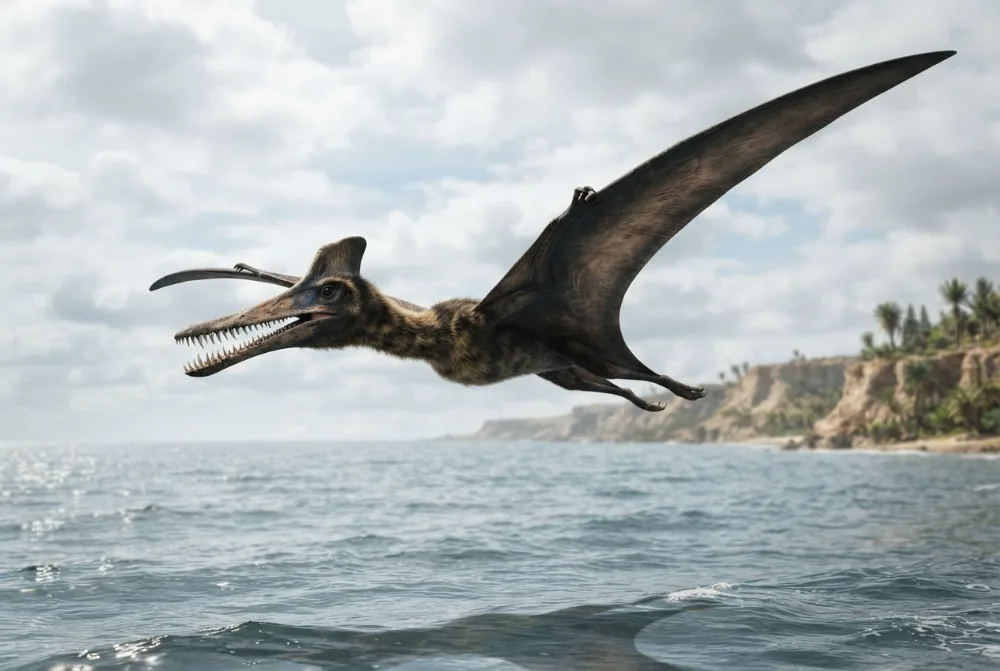
Maaradactylus was a flying reptile with a long, tooth-filled snout and a tall crest on its head. It glided over the ancient sea in what is now Brazil, scooping up fish with its many sharp teeth. Its wings were long and thin, perfect for soaring above the water.1
E phetse neng?
E ne e le kgolo hakae?
Mapheo a yona a ne a pharaletse hakae?
 mapheo a pharaletse jwaloka dibaesekele tse 3 ka mola⚽e ne e ka fofa ho tshela lebala lohle la bolo ya maoto ka metsotswana e 5.1
Maaradactylus e ne e le kgolo hakae ha e bapiswa le WENA?
Ke dipalo feela ho browser ya hao. Ha ho letho le bolokwang kapa le romelwang kae kapa kae.
E ne e le lebelo hakae?


Dintlha tse monate
The skull of Maaradactylus is one of the largest of any anhanguerid pterosaur, measuring 75 centimetres (30 inches) long.1
It had at least 36 pairs of teeth in its upper jaw, more than any other anhanguerid pterosaur.1
The tip of its snout was expanded and rounded, a bit like a spoon, and the front teeth pointed forward while the rest pointed downward.1
Maaradactylus lived during the Early Cretaceous period, about 119 to 113 million years ago.4
The small teeth at the back of its mouth were arranged in triplets, a feature unique to this animal.1
Dipotso tse botswang haholo ka Maaradactylus
?Was Maaradactylus a dinosaur?
No, Maaradactylus was a pterosaur, a flying reptile that lived during the time of dinosaurs. It is not a dinosaur.1
?How big was Maaradactylus?
Its skull was 75 centimetres long, one of the largest of any anhanguerid pterosaur. The rest of its body is not known, but it was a large flying animal.1
?What did Maaradactylus eat?
It likely ate fish, scooping them up with its long, tooth-filled snout as it glided over the sea.1
?When did Maaradactylus live?
It lived during the Early Cretaceous period, about 119 to 113 million years ago, in what is now Brazil.1
Bakeng sa ditsebi tsa didinosaure
- Lebitso la saense
- Maaradactylus
- E rehilwe ke
- Bantim et al. 20144
- Sehlopha
- Dihahabi tse fofang
- Lelapa / leloko
- Anhangueridae4
- Tlhophiso
- Pterosauria > Pterodactyloidea4
- Dilemo tsa mafika
- dilemo tse dimilione tse 120 ho isa ho 113 (Aptian)4
- Dibopeho tsa mafika
- Romualdo4
- Dinaha
- Brazil4
- Direkoto tsa difosili
- 3 ho The Paleobiology Database4
- Ho sibollwa
- The first fossil, a skull with the first two neck bones, was found in 2010 in the Romualdo Formation of Brazil. It was named Maaradactylus kellneri in 2014 by Renan Bantim and colleagues, honoring pterosaur expert Alexander Kellner.12
- E sa ntse e phehwa kgang
- Scientists are not sure if the species once called Coloborhynchus spielbergi really belongs to Maaradactylus or to another genus like Anhanguera.1
Moo dintlha di tswang teng
- Maaradactylus (en.wikipedia.org)
- A new toothed pterosaur (Pterodactyloidea: Anhangueridae) from the Early Cretaceous Romualdo Formation, NE Brazil (mapress.com)
- Maaradactylus kellneri - Atlas Virtual da Pré-História (atlasvirtual.com.br)
- Maaradactylus in The Paleobiology Database (CC BY 4.0): dilemo, dibaka, dibopeho tsa mafika, tlhophiso.
Ntlha e nngwe le e nngwe leqepheng lena e na le nomoro e supang mohlodi wa yona. Haeba re fositse ho hong, re kopa tshwarelo, re balatedi ba didinosaure, ha re koranta ya saense. Re bolelle ho [email protected] mme re tla e lokisa.
 Rex o lapile! Dino Wiki ke projeke ya ntate bakeng sa mora wa hae ya ratang didinosaure, ke mahala, ha ho dipapatso, ha ho disebedi. Batho ba baholo ba ka fepa Rex seneke ho thusa hore e dule e le inthaneteng.Fepa Rex
 Pteranodon
 Quetzalcoatlus
 Dorygnathus
 Rhamphorhynchus
 Anhanguera
 Pterodactylus
 Stegosaurus
 Iguanodon
 Archaeopteryx
 Giganotosaurus
 Microraptor
 Deinonychus