 Kwisi: O dinosaure efe?
 Ntwa ya didinosaure
 Peiso ya didinosaure
 Dipapadi tse nyane tsa didinosaure
 Albamo ya ditikara
 Manane a TOP a didinosaure
 Nkgethele!
Machairoceratops
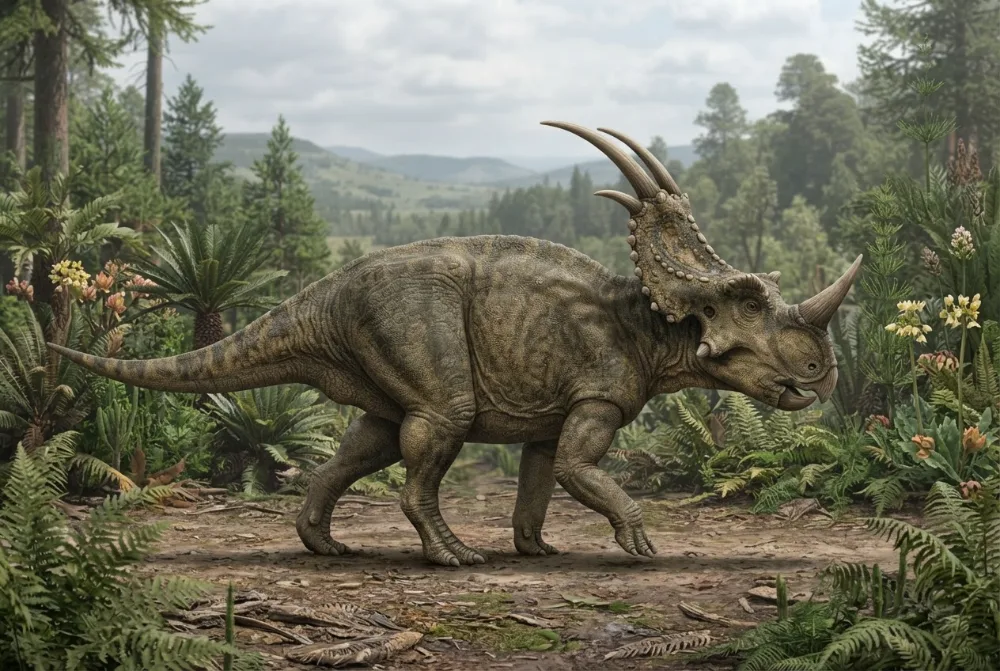
Machairoceratops was a horned dinosaur that lived in what is now Utah, USA, about 80 million years ago. It had two long, forward-curving spikes on the back of its frill, like bent swords. This dinosaur was a plant-eater that walked on four legs.12
E phetse neng?
E ne e le kgolo hakae?
E ne e le telele hakae?
E ne e phahame hakae?
kakanyo
E ne e le boima hakae?

 telele jwaloka dintja tse 8 ho tloha nkong ho isa mohatleng🍌telele jwaloka dibanana tse 44 di behilwe ka molaboima jwaloka dintja tse 100🍉boima jwaloka mahapu a 400🎒boima jwaloka ditlelase tse feletseng tse 2.5 tsa bana ba sekolo🐻❄️boima jwaloka dibere tse tshweu tse 4🏃e ne e ka matha dimitara tse 100 ka metsotswana e 10 (motho ya lebelo ka ho fetisisa o hloka 9,6)
Machairoceratops e ne e le kgolo hakae ha e bapiswa le WENA?
Ke dipalo feela ho browser ya hao. Ha ho letho le bolokwang kapa le romelwang kae kapa kae.
E ne e le lebelo hakae?


Dintlha tse monate
Machairoceratops had two long, forward-curving spikes on the top of its frill, each about 44 cm long. These spikes had a strange groove running from base to tip, and scientists are not sure what it was for.12
Its postorbital horns (above the eyes) were about 27 cm long, but they were found detached from the skull, so their exact angle is unknown.1
This dinosaur lived about 80 million years ago, during the Late Cretaceous. At that time, a huge sea split North America into two landmasses, and Machairoceratops lived on the western part called Laramidia.12
Machairoceratops is known from only one partial skull, found in 2006. The skull includes the braincase, left squamosal, and the unique frill bones.1
It was a centrosaurine ceratopsian, a group of horned dinosaurs that usually had large nose horns and fancy frills. Machairoceratops is one of the few centrosaurines found in the southern part of Laramidia.12
The name 'cronusi' refers to Cronus, a Greek god who used a curved blade. This matches the bent-sword shape of the dinosaur's frill spikes.1
Dipotso tse botswang haholo ka Machairoceratops
?How big was Machairoceratops?
Scientists do not know its exact size, but its skull is very close in size to Diabloceratops, another horned dinosaur. It was a medium-sized ceratopsian, probably similar in length to a small car.1
?What did Machairoceratops eat?
It was a plant-eater (herbivore) that walked on four legs and used its beak to eat plants like ferns and cycads.1
?When did Machairoceratops live?
It lived about 80 million years ago, during the Late Cretaceous Period, in what is now Utah, USA.1
?Why does Machairoceratops have bent spikes?
The two long, forward-curving spikes on its frill looked like bent swords, which is how it got its name. Scientists are not sure exactly what they were used for, but they may have been for display or defense.1
Bakeng sa ditsebi tsa didinosaure
- Lebitso la saense
- Machairoceratops
- E rehilwe ke
- Lund et al. 20164
- Sehlopha
- Didinosaure tse dinaka
- Lelapa / leloko
- Ceratopsidae4
- Tlhophiso
- Ornithischia > Ceratopsia > Ceratopsidae4
- Dilemo tsa mafika
- dilemo tse dimilione tse 84 ho isa ho 72 (Campanian)4
- Dibopeho tsa mafika
- Wahweap4
- Dinaha
- Amerika4
- Direkoto tsa difosili
- 1 ho The Paleobiology Database4
- Ho sibollwa
- Machairoceratops was named in 2016 by Eric K. Lund and colleagues. The only known fossil was found in 2006 in Grand Staircase,Escalante National Monument, Utah, and is stored at the Natural History Museum of Utah.12
- E sa ntse e phehwa kgang
- Scientists are not sure why the frill spikes have a groove along their length. It might have been for display, or something else.2
Moo dintlha di tswang teng
- Machairoceratops (en.wikipedia.org)
- Paleontologists discover new species of horned dinosaur in southern Utah (nhmu.utah.edu)
- PBDB Taxon (paleobiodb.org)
- Machairoceratops in The Paleobiology Database (CC BY 4.0): dilemo, dibaka, dibopeho tsa mafika, tlhophiso.
Ntlha e nngwe le e nngwe leqepheng lena e na le nomoro e supang mohlodi wa yona. Haeba re fositse ho hong, re kopa tshwarelo, re balatedi ba didinosaure, ha re koranta ya saense. Re bolelle ho [email protected] mme re tla e lokisa.
 Rex o lapile! Dino Wiki ke projeke ya ntate bakeng sa mora wa hae ya ratang didinosaure, ke mahala, ha ho dipapatso, ha ho disebedi. Batho ba baholo ba ka fepa Rex seneke ho thusa hore e dule e le inthaneteng.Fepa Rex
 Triceratops
 Protoceratops
 Ojoceratops
 Tatankaceratops
 Psittacosaurus
 Centrosaurus
 Tyrannosaurus
 Velociraptor
 Spinosaurus
 Ankylosaurus
 Parasaurolophus
 Pteranodon