 Kwisi: O dinosaure efe?
 Ntwa ya didinosaure
 Peiso ya didinosaure
 Dipapadi tse nyane tsa didinosaure
 Albamo ya ditikara
 Manane a TOP a didinosaure
 Nkgethele!
E phetse neng?

E ne e le kgolo hakae?
E ne e le telele hakae?
E ne e phahame hakae?
kakanyo
E ne e le boima hakae?
 telele jwaloka dikoloi tse 2 tse pakilweng ka mola🍌telele jwaloka dibanana tse 56 di behilwe ka mola
 e batla e le boima jwaloka tlou🍉boima jwaloka mahapu a 1000🎒boima jwaloka ditlelase tse feletseng tse 6 tsa bana ba sekolo🐻❄️boima jwaloka dibere tse tshweu tse 11🏃e ne e ka matha dimitara tse 100 ka metsotswana e 19 (motho ya lebelo ka ho fetisisa o hloka 9,6)
Mansourasaurus e ne e le kgolo hakae ha e bapiswa le WENA?
Ke dipalo feela ho browser ya hao. Ha ho letho le bolokwang kapa le romelwang kae kapa kae.
E ne e le lebelo hakae?


Dintlha tse monate
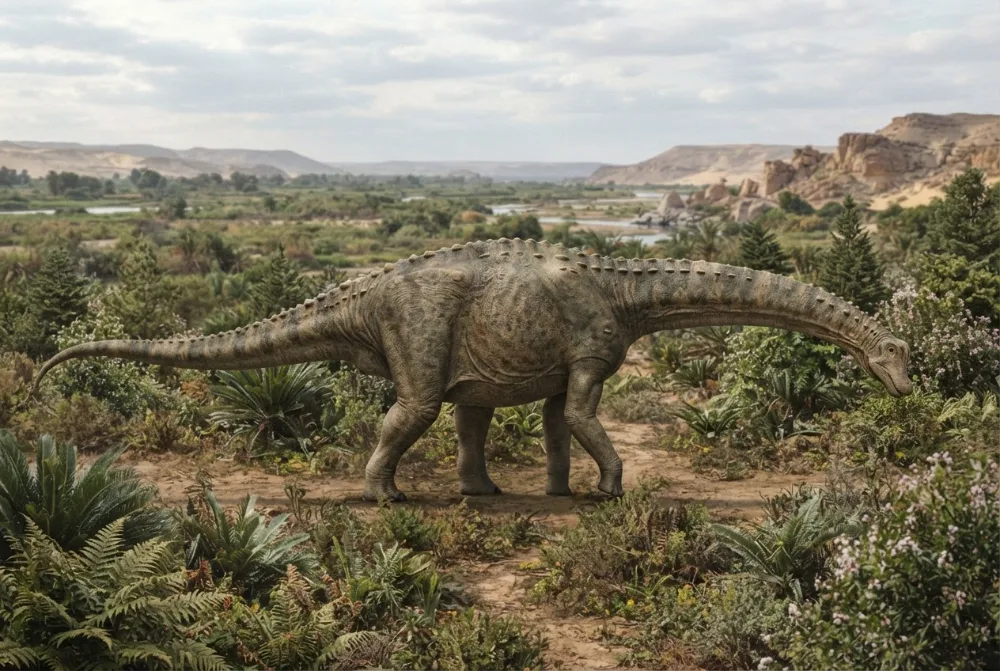
Mansourasaurus is the most complete land-living vertebrate from the last 30 million years of the Age of Dinosaurs in Africa.1
Its skeleton includes parts of the skull, which is very rare for sauropods.1
Mansourasaurus is closely related to titanosaurs from Europe and Asia, showing that dinosaurs could walk between Africa and Europe.1
It lived about 83 to 72 million years ago, during the Campanian age.2
The name honors Mansoura University, where the research team worked.1
Dipotso tse botswang haholo ka Mansourasaurus
?How big was Mansourasaurus?
The not fully-grown holotype was about 8 to 10 metres (26 to 33 feet) long. It probably weighed about 5,000 kilograms, roughly the same as a bull African elephant.3
?What did Mansourasaurus eat?
Mansourasaurus was a herbivore, meaning it ate plants. Each lower jaw bone had ten teeth for chewing plant material.3
?When did Mansourasaurus live?
Mansourasaurus lived during the Late Cretaceous period, about 73 million years ago. Its fossils were found in rocks from the Campanian age.3
?Where was Mansourasaurus found?
Mansourasaurus was discovered in the Dakhla Oasis in Egypt's Western Desert. It was found in the Quseir Formation.3
Mosenyi wa ditshomo
Tshomo: Some people think African dinosaurs were completely isolated from Europe.
Nnete: Mansourasaurus shows that dinosaurs could move between Africa and Europe, so they were not completely isolated.1
Bakeng sa ditsebi tsa didinosaure
- Lebitso la saense
- Mansourasaurus
- E rehilwe ke
- Sallam et al. 20184
- Sehlopha
- Melala e melelele
- Lelapa / leloko
- Diamantinasauria4
- Tlhophiso
- Sauropodomorpha > Sauropoda > Macronaria4
- Dilemo tsa mafika
- dilemo tse dimilione tse 84 ho isa ho 72 (Campanian)4
- Dibopeho tsa mafika
- Quseir4
- Dinaha
- Egepeta4
- Direkoto tsa difosili
- 1 ho The Paleobiology Database4
- Ho sibollwa
- Mansourasaurus was named by Sallam and colleagues in 2018 from fossils found in the Quseir Formation of Egypt.12
- E sa ntse e phehwa kgang
- Scientists still debate exactly where Mansourasaurus fits in the sauropod family tree, with some placing it in a group called Lithostrotia and others in Diamantinasauria.2
Moo dintlha di tswang teng
- New Egyptian sauropod reveals Late Cretaceous dinosaur dispersal between Europe and Africa | Nature Ecology & Evolution (nature.com)
- PBDB Taxon (paleobiodb.org)
- Mansourasaurus (en.wikipedia.org)
- Mansourasaurus in The Paleobiology Database (CC BY 4.0): dilemo, dibaka, dibopeho tsa mafika, tlhophiso.
Ntlha e nngwe le e nngwe leqepheng lena e na le nomoro e supang mohlodi wa yona. Haeba re fositse ho hong, re kopa tshwarelo, re balatedi ba didinosaure, ha re koranta ya saense. Re bolelle ho [email protected] mme re tla e lokisa.
 Rex o lapile! Dino Wiki ke projeke ya ntate bakeng sa mora wa hae ya ratang didinosaure, ke mahala, ha ho dipapatso, ha ho disebedi. Batho ba baholo ba ka fepa Rex seneke ho thusa hore e dule e le inthaneteng.Fepa Rex
 Brachiosaurus
 Diplodocus
 Brontosaurus
 Argentinosaurus
 Camarasaurus
 Morosaurus
 Tyrannosaurus
 Triceratops
 Velociraptor
 Spinosaurus
 Ankylosaurus
 Parasaurolophus