 Kwisi: O dinosaure efe?
 Ntwa ya didinosaure
 Peiso ya didinosaure
 Dipapadi tse nyane tsa didinosaure
 Albamo ya ditikara
 Manane a TOP a didinosaure
 Nkgethele!
Martinectes
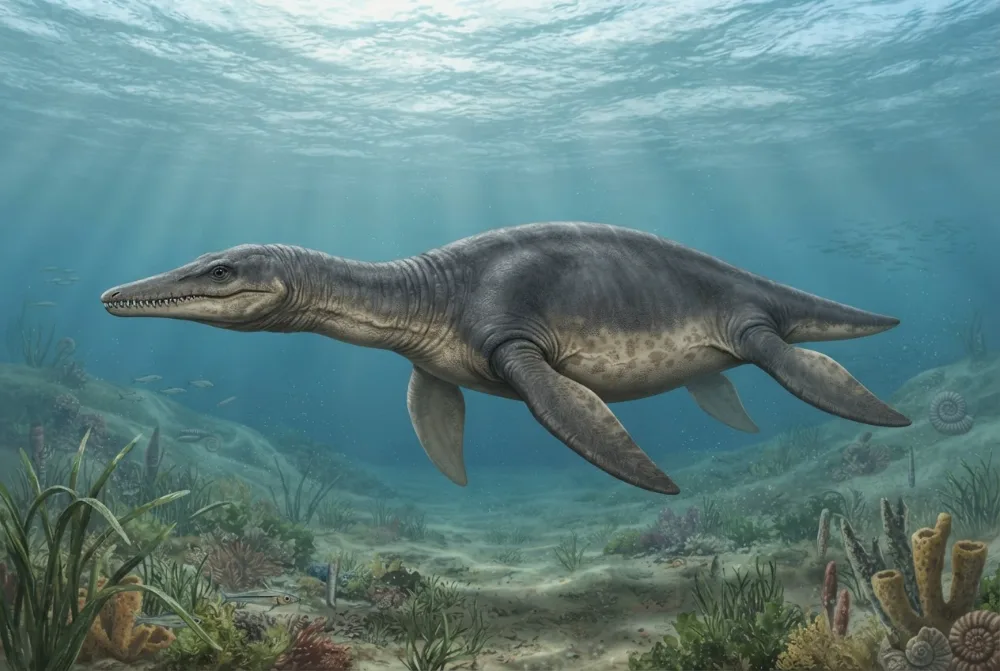
Martinectes was a small, fast-swimming marine reptile that lived in the shallow seas of North America during the time of the dinosaurs. It had a short neck, a long snout, and four big flippers that helped it chase after fish and squid.1
E phetse neng?
E ne e le kgolo hakae?
E ne e le telele hakae?
E ne e le boima hakae?
 telele jwaloka dintja tse 2.5 ho tloha nkong ho isa mohatleng🍌telele jwaloka dibanana tse 14 di behilwe ka mola🍉boima jwaloka mahapu a 250🧸boima jwaloka bana ba kereshe ba 67🎒boima jwaloka bana ba sekolo ba 40🐻❄️boima jwaloka dibere tse tshweu tse 3🏊e ne e ka sesa bolelele ba letamo le leholo la ho sesa (50 m) ka metsotswana e 6.9
Martinectes e ne e le kgolo hakae ha e bapiswa le WENA?
Ke dipalo feela ho browser ya hao. Ha ho letho le bolokwang kapa le romelwang kae kapa kae.
E ne e le lebelo hakae?


Dintlha tse monate
Martinectes was one of the smallest adult polycotylid plesiosaurs ever found, measuring only about 2.3 to 2.6 metres long.1
It had large eyes with a bony ledge above them, which may have shaded its eyes from sunlight while hunting near the water's surface.1
Martinectes lived about 80 million years ago in the Western Interior Seaway, a huge ocean that split North America in two.1
Its name means 'Martin's swimmer', honoring the person who helped discover its fossils.1
Martinectes was originally thought to be a species of Dolichorhynchops, but scientists gave it its own genus in 2024.1
It had unusually wide bones in its spine and a very short back part of its skull, which helped scientists tell it apart from other plesiosaurs.1
Dipotso tse botswang haholo ka Martinectes
?How big was Martinectes?
Martinectes was a large polycotylid plesiosaur, measuring at least around 5 metres (16 ft) long. Some estimates suggest it could reach up to 6 to 7 metres (20 to 23 ft), while a 2026 estimate put it at about 4.95 metres (16.2 ft) long.2
?Was Martinectes a dinosaur?
No, Martinectes was a plesiosaur, a marine reptile that lived in the seas during the time of the dinosaurs. It was not a dinosaur.2
?What did Martinectes eat?
Martinectes likely chased after fish and squid, using its long snout and four big flippers to swim fast. Its small teeth and narrow jaws suggest it ate small, slippery prey.2
Bakeng sa ditsebi tsa didinosaure
- Lebitso la saense
- Martinectes
- E rehilwe ke
- Clark et al. 20243
- Sehlopha
- Diplesiosaure
- Lelapa / leloko
- Polycotylidae3
- Tlhophiso
- Plesiosauria > Sauropterygia3
- Dilemo tsa mafika
- dilemo tse dimilione tse 84 ho isa ho 72 (Campanian)3
- Dibopeho tsa mafika
- Pierre Shale, Taylor Marl3
- Dinaha
- Amerika3
- Direkoto tsa difosili
- 3 ho The Paleobiology Database3
- Ho sibollwa
- Martinectes was named in 2024 by Robert O. Clark, F. Robin O'Keefe, and Sara E. Slack. They studied fossils that had been found in Wyoming and South Dakota, USA, and realized they belonged to a new genus.31
- E sa ntse e phehwa kgang
- Scientists are still debating exactly how Martinectes used its unusual eye ledges and wide skull for hunting.1
Moo dintlha di tswang teng
- A new genus of small polycotylid plesiosaur from the Upper Cretaceous of the Western Interior Seaway and a clarification of the genus Dolichorhynchops (sciencedirect.com)
- Martinectes (en.wikipedia.org)
- Martinectes in The Paleobiology Database (CC BY 4.0): dilemo, dibaka, dibopeho tsa mafika, tlhophiso.
Ntlha e nngwe le e nngwe leqepheng lena e na le nomoro e supang mohlodi wa yona. Haeba re fositse ho hong, re kopa tshwarelo, re balatedi ba didinosaure, ha re koranta ya saense. Re bolelle ho [email protected] mme re tla e lokisa.
 Rex o lapile! Dino Wiki ke projeke ya ntate bakeng sa mora wa hae ya ratang didinosaure, ke mahala, ha ho dipapatso, ha ho disebedi. Batho ba baholo ba ka fepa Rex seneke ho thusa hore e dule e le inthaneteng.Fepa Rex
 Elasmosaurus
 Pliosaurus
 Plesiosaurus
 Cimoliasaurus
 Colymbosaurus
 Trinacromerum
 Tyrannosaurus
 Triceratops
 Velociraptor
 Spinosaurus
 Ankylosaurus
 Parasaurolophus