 Kwisi: O dinosaure efe?
 Ntwa ya didinosaure
 Peiso ya didinosaure
 Dipapadi tse nyane tsa didinosaure
 Albamo ya ditikara
 Manane a TOP a didinosaure
 Nkgethele!
E phetse neng?

E ne e le kgolo hakae?
E ne e le telele hakae?
E ne e phahame hakae?
E ne e le boima hakae?
 telele jwaloka dikatse tsa lapeng tse 3 ho tloha nkong ho isa mohatleng🍌telele jwaloka dibanana tse 8 di behilwe ka mola🍌boima jwaloka dibanana tse 83🏃e ne e ka matha dimitara tse 100 ka metsotswana e 11 (motho ya lebelo ka ho fetisisa o hloka 9,6)
Nhandumirim e ne e le kgolo hakae ha e bapiswa le WENA?
Ke dipalo feela ho browser ya hao. Ha ho letho le bolokwang kapa le romelwang kae kapa kae.
E ne e le lebelo hakae?


Dintlha tse monate
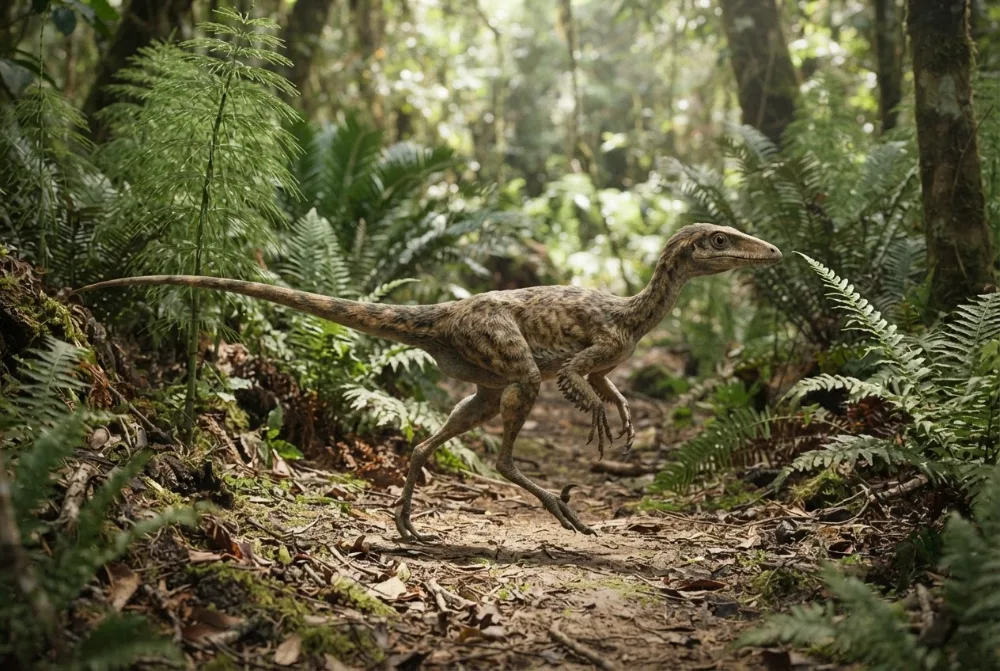
Nhandumirim means 'small rhea' in the Tupi-Guarani language, because it was a speedy little dinosaur like a rhea bird.21
Its fossils were found in a small area, only about 50 centimeters wide, and were semi-articulated, meaning many bones were still in their original positions.2
The tail bones of Nhandumirim have a sharp keel along the bottom, a feature that helps scientists tell it apart from other early dinosaurs.2
Nhandumirim lived in a floodplain environment, alongside other ancient animals like the rhynchosaur Hyperodapedon and the early dinosaur Saturnalia.1
This dinosaur is about 233 million years old, making it one of the oldest known dinosaurs from the Triassic Period.24
Scientists think Nhandumirim could run fast on its long, slender legs, just like the bird it was named after.2
Dipotso tse botswang haholo ka Nhandumirim
?How big was Nhandumirim?
It was a small dinosaur, about the size of a modern rhea bird. Its name means 'small rhea' in the Tupi language.3
?What did Nhandumirim eat?
Scientists are not sure, but because it is an early sauropodomorph, it was probably a plant-eater. Some studies suggest it might have been a meat-eater like early theropods.3
?When did Nhandumirim live?
It lived about 233 million years ago during the Late Triassic Period, in what is now Brazil.3
?Is Nhandumirim a dinosaur?
Yes, it is a dinosaur. It is a basal sauropodomorph, one of the earliest dinosaurs ever discovered.3
Bakeng sa ditsebi tsa didinosaure
- Lebitso la saense
- Nhandumirim
- E rehilwe ke
- Marsola et al. 20194
- Sehlopha
- Didinosaure tsa pele
- Lelapa / leloko
- Saurischia4
- Dilemo tsa mafika
- dilemo tse dimilione tse 227 ho isa ho 206 (Norian)4
- Dibopeho tsa mafika
- Caturrita4
- Dinaha
- Brazil4
- Direkoto tsa difosili
- 1 ho The Paleobiology Database4
- Ho sibollwa
- Nhandumirim was named in 2019 by a team of scientists including J. C. A. Marsola, based on a partial skeleton found at the Waldsanga site in Brazil. The fossils were first collected from the red mudstones of the Santa Maria Formation.42
- E sa ntse e phehwa kgang
- Scientists are not sure if Nhandumirim is a true theropod or just a very close relative, because it has some features that are similar to both theropods and other early dinosaurs.2
Moo dintlha di tswang teng
- A new dinosaur with theropod affinities from the Late Triassic Santa Maria Formation, South Brazil (paleolab.com.br)
- University of Birmingham (pure-oai.bham.ac.uk)
- Nhandumirim (en.wikipedia.org)
- Nhandumirim in The Paleobiology Database (CC BY 4.0): dilemo, dibaka, dibopeho tsa mafika, tlhophiso.
Ntlha e nngwe le e nngwe leqepheng lena e na le nomoro e supang mohlodi wa yona. Haeba re fositse ho hong, re kopa tshwarelo, re balatedi ba didinosaure, ha re koranta ya saense. Re bolelle ho [email protected] mme re tla e lokisa.
 Rex o lapile! Dino Wiki ke projeke ya ntate bakeng sa mora wa hae ya ratang didinosaure, ke mahala, ha ho dipapatso, ha ho disebedi. Batho ba baholo ba ka fepa Rex seneke ho thusa hore e dule e le inthaneteng.Fepa Rex
 Herrerasaurus
 Tawa
Tawa Chindesaurus
 Nyasasaurus
 Staurikosaurus
 Alwalkeria
 Nothosaurus
 Massospondylus
 Plateosaurus
 Coelophysis
 Podokesaurus
 Simosaurus