 Kwisi: O dinosaure efe?
 Ntwa ya didinosaure
 Peiso ya didinosaure
 Dipapadi tse nyane tsa didinosaure
 Albamo ya ditikara
 Manane a TOP a didinosaure
 Nkgethele!
Notohypsilophodon
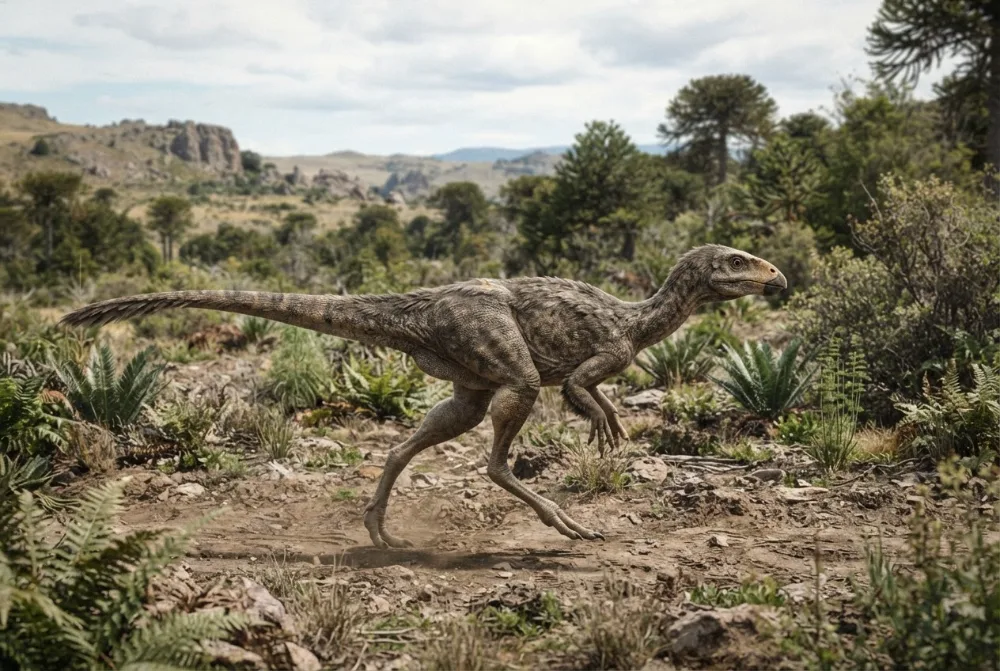
Notohypsilophodon was a small, speedy plant eater that ran on two legs. It lived in what is now Argentina during the Late Cretaceous, about 100 to 90 million years ago. Scientists found a young one, so we are still learning about this little dinosaur.14
E phetse neng?
E ne e le kgolo hakae?
E ne e le telele hakae?
E ne e phahame hakae?
kakanyo
E ne e le boima hakae?
 telele jwaloka dikatse tsa lapeng tse 2.5 ho tloha nkong ho isa mohatleng🍌telele jwaloka dibanana tse 7 di behilwe ka molae batla e le boima jwaloka katse ya lapeng🍌boima jwaloka dibanana tse 50🪑e nyane hoo e ka tsamayang ka tlasa setulo🏃e ne e ka matha dimitara tse 100 ka metsotswana e 12 (motho ya lebelo ka ho fetisisa o hloka 9,6)
Notohypsilophodon e ne e le kgolo hakae ha e bapiswa le WENA?
Ke dipalo feela ho browser ya hao. Ha ho letho le bolokwang kapa le romelwang kae kapa kae.
E ne e le lebelo hakae?


Dintlha tse monate
Notohypsilophodon was the first hypsilophodont dinosaur ever found in South America, which made it very special to scientists.12
The only skeleton we have is from a young dinosaur, because its backbone bones were not fully fused together.12
Its arm bone, the humerus, had no deltopectoral crest, a ridge that many other dinosaurs have for muscle attachment.2
Its shin bone, the tibia, had a bulge on the front and inner side, which is a unique feature of this dinosaur.2
The fibula, a bone in the lower leg, suddenly became narrow near the middle of its shaft, another special trait.2
Its ankle bone, the astragalus, had a top surface with two levels, which is different from many other ornithopods.2
The foot claws, called unguals, had flat undersides, which may have helped it walk or dig.2
Dipotso tse botswang haholo ka Notohypsilophodon
?How big was Notohypsilophodon?
About 1.3 metres (4.3 ft) long and weighed around 6 kilograms (13 lb), roughly the size of a small dog.1
?What did Notohypsilophodon eat?
It was a herbivore, eating plants. It may have swallowed small stones called gastroliths to help grind up food in its stomach.13
?When did Notohypsilophodon live?
It lived during the Late Cretaceous Period, about 100 to 90 million years ago.1
?Is Notohypsilophodon a dinosaur?
Yes, it is a dinosaur. It is a type of ornithopod, a group of plant-eating, bipedal dinosaurs.1
Mosenyi wa ditshomo
Tshomo: Some people think Notohypsilophodon was a true hypsilophodont, like Hypsilophodon.
Nnete: Scientists now think Hypsilophodontidae is not a real family, and Notohypsilophodon is too incomplete to be sure. It is considered a basal ornithopod, possibly part of a group called Elasmaria.1
Bakeng sa ditsebi tsa didinosaure
- Lebitso la saense
- Notohypsilophodon
- E rehilwe ke
- Martínez 19984
- Sehlopha
- Dija-dimela tse nang le melomo
- Lelapa / leloko
- Elasmaria4
- Tlhophiso
- Ornithischia > Ornithopoda > Iguanodontia4
- Dilemo tsa mafika
- dilemo tse dimilione tse 100 ho isa ho 90 (Cenomanian / Turonian)4
- Dibopeho tsa mafika
- Bajo Barreal4
- Dinaha
- Argentina4
- Direkoto tsa difosili
- 1 ho The Paleobiology Database4
- Ho sibollwa
- The skeleton was found in the Bajo Barreal Formation in Argentina during excavations that started in 1985. Rubén D. Martínez named it Notohypsilophodon comodorensis in 1998.12
- E sa ntse e phehwa kgang
- Scientists are not sure exactly where Notohypsilophodon belongs in the dinosaur family tree, because the only skeleton is incomplete and from a young animal.1
Moo dintlha di tswang teng
- Notohypsilophodon (en.wikipedia.org)
- The investigation projects “The vertebrates of the Bajo Barreal Formation, Upper Cretaceous of Chubut” and “The vertebrates of the Chubut Group: characteristics and evolution-first stage” have been developed successively by the Laboratorio de Paleovertebrados of the UNPSJB in Comodoro Rivadavia since the year 1985. During their course a rich fauna of vertebrates from the Bajo Barreal Formation has been documented that includes holostean fish, chelonians, crocodiles, abelisaurian and tetanuran theropod dinosaurs, and titanosaur and diplodociform sauropods. To this fauna is added the ornithopod that is the subject of this work. The record of ornithischian dinosaurs in South America has been scarce until recent times, and it includes Pisanosaurus mertii (Casamiquela, 1967) from the Triassic of La Rioja and the Upper Cretaceous hadrosaurs of Patagonia, such as the Chubutian Secernosaurus koerneri (Brett-Surman, 1979) that probably comes from the Bajo Barreal Formation. Recent and important ornithischian discoveries in the region of Comahue, in the north of Patagonia, include the basal iguanodont Gasparinisaura cincosaltensis (Coria and Salgado, 1996) and other ornithopods now in study. Recently, Salgado and Coria (1996) have studied a proximal piece of femur originally classified as belonging to a theropod, Loncosaurus argentinus (Ameghino, 1898) and have considered it an indeterminate ornithopod. This work describes Notohypsilophodon comodorensis, new genus and species, considered (naturalhistory.si.edu)
- A reappraisal of Notohypshilophodon comodorensis (Ornithischia: Ornithopoda) from the Late Cretaceous of Patagonia, Argentina (mapress.com)
- Notohypsilophodon in The Paleobiology Database (CC BY 4.0): dilemo, dibaka, dibopeho tsa mafika, tlhophiso.
Ntlha e nngwe le e nngwe leqepheng lena e na le nomoro e supang mohlodi wa yona. Haeba re fositse ho hong, re kopa tshwarelo, re balatedi ba didinosaure, ha re koranta ya saense. Re bolelle ho [email protected] mme re tla e lokisa.
 Rex o lapile! Dino Wiki ke projeke ya ntate bakeng sa mora wa hae ya ratang didinosaure, ke mahala, ha ho dipapatso, ha ho disebedi. Batho ba baholo ba ka fepa Rex seneke ho thusa hore e dule e le inthaneteng.Fepa Rex
 Iguanodon
 Tenontosaurus
 Thescelosaurus
 Zalmoxes
 Camptosaurus
 Rhabdodon
 Tyrannosaurus
 Triceratops
 Velociraptor
 Spinosaurus
 Ankylosaurus
 Parasaurolophus