 Kwisi: O dinosaure efe?
 Ntwa ya didinosaure
 Peiso ya didinosaure
 Dipapadi tse nyane tsa didinosaure
 Albamo ya ditikara
 Manane a TOP a didinosaure
 Nkgethele!
Opisthocoelicaudia
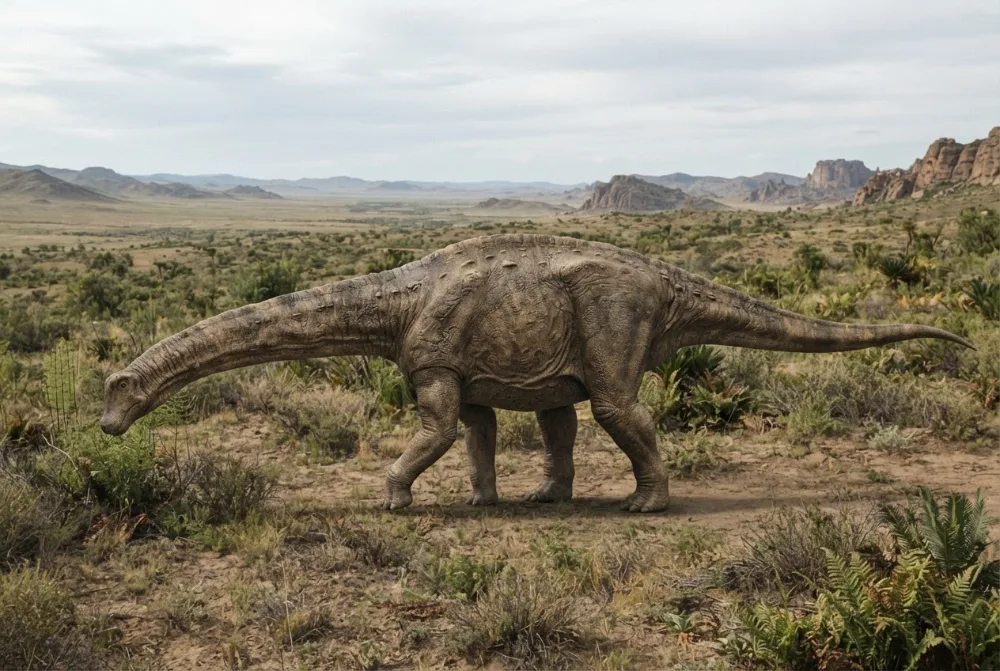
Opisthocoelicaudia was a big, long-necked plant eater that lived in the Late Cretaceous. It had a barrel-shaped body and four thick legs, like an elephant. Scientists found a nearly complete skeleton without the head and neck, so they know a lot about its body.1
E phetse neng?
E ne e le kgolo hakae?
E ne e le telele hakae?
E ne e phahame hakae?
E ne e le boima hakae?

 telele jwaloka dikoloi tse 3 tse pakilweng ka mola🍌telele jwaloka dibanana tse 72 di behilwe ka molaboima jwaloka dikoloi tse 17🍉boima jwaloka mahapu a 5100🎒boima jwaloka ditlelase tse feletseng tse 32 tsa bana ba sekolo🐻❄️boima jwaloka dibere tse tshweu tse 56🏃e ne e ka matha dimitara tse 100 ka metsotswana e 28 (motho ya lebelo ka ho fetisisa o hloka 9,6)
Opisthocoelicaudia e ne e le kgolo hakae ha e bapiswa le WENA?
Ke dipalo feela ho browser ya hao. Ha ho letho le bolokwang kapa le romelwang kae kapa kae.
E ne e le lebelo hakae?


Dintlha tse monate
Its tail vertebrae were shaped like ball-and-socket joints, which is unusual and gives it the name 'posterior cavity tail'.1
The skeleton had tooth marks from big meat-eating dinosaurs, which probably ate the carcass and carried away the head and neck.1
It could probably rear up on its hind legs to reach higher food, because its tail was strong and could act like a tripod.12
Its back vertebrae had split spines, creating a double row of bumps along its spine, a feature also seen in Diplodocus.1
It had six hip vertebrae, one more than most sauropods, which made its hips extra strong.1
The neck was about 5 meters (16 feet) long, which is medium for a sauropod.1
Dipotso tse botswang haholo ka Opisthocoelicaudia
?How big was Opisthocoelicaudia?
It was a relatively small sauropod, measuring about 11.4 to 13 metres (37 to 43 feet) long. Its body mass has been estimated at between 8.4 and 25.4 tonnes in different studies.1
?What did Opisthocoelicaudia eat?
Like other sauropods, it was a herbivore that ate plants. It probably fed on a variety of vegetation in its floodplain and riverine environment.3
?When did Opisthocoelicaudia live?
It lived during the Late Cretaceous Period, specifically in the ?Upper Campanian or Lower Maastrichtian, about 72 to 66 million years ago.12
?Where was Opisthocoelicaudia found?
Its fossils were discovered in the Gobi Desert of Mongolia, in the Nemegt Formation. The type specimen was found at Altan Uul in Ömnögovi Province.1
?Could Opisthocoelicaudia rear up on its hind legs?
Yes, scientists think it could rear up on its hind legs to reach higher food. Its strong tail could act like a tripod to support its weight.1
?Is Opisthocoelicaudia a dinosaur?
Yes, it is a sauropod dinosaur. It belongs to the group Titanosauria and lived during the Late Cretaceous.1
Mosenyi wa ditshomo
Tshomo: Some people think Opisthocoelicaudia was a kind of camarasaur, but scientists now know it was a titanosaur.
Nnete: It was first classified as a camarasaurid, but later studies placed it in Titanosauria, a group of sauropods.1
Bakeng sa ditsebi tsa didinosaure
- Lebitso la saense
- Opisthocoelicaudia
- E rehilwe ke
- Borsuk-Bialynicka 19774
- Sehlopha
- Melala e melelele
- Lelapa / leloko
- Saltasauridae4
- Tlhophiso
- Sauropodomorpha > Sauropoda > Titanosauria > Macronaria4
- Dilemo tsa mafika
- dilemo tse dimilione tse 72 ho isa ho 66 (Maastrichtian)4
- Dibopeho tsa mafika
- Nemegt4
- Dinaha
- Mongolia4
- Direkoto tsa difosili
- 1 ho The Paleobiology Database4
- Ho sibollwa
- It was discovered in 1965 by a Polish-Mongolian expedition in the Gobi Desert. Polish paleontologist Maria Magdalena Borsuk-Białynicka named it in 1977.12
- E sa ntse e phehwa kgang
- Scientists debate whether Opisthocoelicaudia and Nemegtosaurus are actually the same species, because only the skull of Nemegtosaurus is known and Opisthocoelicaudia lacks a skull.1
Moo dintlha di tswang teng
- Opisthocoelicaudia (en.wikipedia.org)
- A NEW CAMARASAURID SAUROPOD OPISTHOCOELICAUDIA SKARZYNSKII GEN. N., SP. N. FROM THE UPPER CRETACEOUS OF MONGOLIA (palaeontologia.pan.pl)
- Opisthocoelicaudia: a Late Cretaceous Mongolian titanosaur (en.alegsaonline.com)
- Opisthocoelicaudia in The Paleobiology Database (CC BY 4.0): dilemo, dibaka, dibopeho tsa mafika, tlhophiso.
Ntlha e nngwe le e nngwe leqepheng lena e na le nomoro e supang mohlodi wa yona. Haeba re fositse ho hong, re kopa tshwarelo, re balatedi ba didinosaure, ha re koranta ya saense. Re bolelle ho [email protected] mme re tla e lokisa.
 Rex o lapile! Dino Wiki ke projeke ya ntate bakeng sa mora wa hae ya ratang didinosaure, ke mahala, ha ho dipapatso, ha ho disebedi. Batho ba baholo ba ka fepa Rex seneke ho thusa hore e dule e le inthaneteng.Fepa Rex
 Brachiosaurus
 Diplodocus
 Brontosaurus
 Argentinosaurus
 Camarasaurus
 Morosaurus
 Tyrannosaurus
 Triceratops
 Velociraptor
 Spinosaurus
 Ankylosaurus
 Parasaurolophus