 Kwisi: O dinosaure efe?
 Ntwa ya didinosaure
 Peiso ya didinosaure
 Dipapadi tse nyane tsa didinosaure
 Albamo ya ditikara
 Manane a TOP a didinosaure
 Nkgethele!
Oryctodromeus
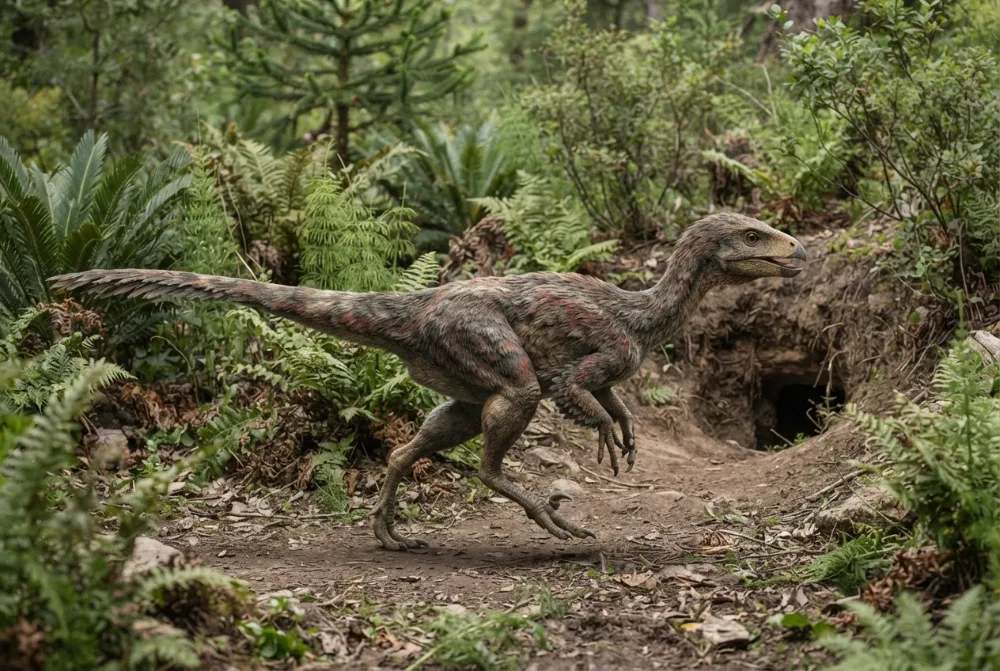
Oryctodromeus was a small, fast dinosaur that dug burrows to live in. It is the first non-bird dinosaur ever found with proof that it lived underground. An adult, two babies, and their burrow were all fossilized together.1
E phetse neng?
E ne e le kgolo hakae?
E ne e le telele hakae?
E ne e phahame hakae?
kakanyo
E ne e le boima hakae?
 telele jwaloka dikatse tsa lapeng tse 4 ho tloha nkong ho isa mohatleng🍌telele jwaloka dibanana tse 12 di behilwe ka mola🍉boima jwaloka mahapu a 6🏃e ne e ka matha dimitara tse 100 ka metsotswana e 8.8 (motho ya lebelo ka ho fetisisa o hloka 9,6)
Oryctodromeus e ne e le kgolo hakae ha e bapiswa le WENA?
Ke dipalo feela ho browser ya hao. Ha ho letho le bolokwang kapa le romelwang kae kapa kae.
E ne e le lebelo hakae?


Dintlha tse monate
Oryctodromeus means 'digging runner' because it could both dig burrows and run fast on two legs.1
Its burrow was about 2 meters (6.6 feet) long and 70 centimeters (2.3 feet) wide, with two turns.1
The adult Oryctodromeus was about 2.1 meters (6.9 feet) long and weighed between 22 and 32 kilograms (50 to 70 pounds).1
Two baby Oryctodromeus were found with the adult, showing that parents cared for their young in the burrow.1
Its strong shoulders and arms helped it dig, but it was not as specialized for digging as a mole or wombat.1
Oryctodromeus was named the state dinosaur of Idaho in 2023.1
The burrow was filled with sand and turned into sandstone, which preserved the bones inside.1
Dipotso tse botswang haholo ka Oryctodromeus
?How did Oryctodromeus dig?
It used its strong shoulders, arms, and broad snout to scratch and move soil. It was not as specialized for digging as a mole or wombat, but more like a rabbit or hyena.13
?What did Oryctodromeus eat?
It was a plant-eater, or herbivore.2
?When did Oryctodromeus live?
It lived during the mid-Cretaceous Period, about 105 to 96 million years ago.1
Bakeng sa ditsebi tsa didinosaure
- Lebitso la saense
- Oryctodromeus
- E rehilwe ke
- Varricchio et al. 20074
- Sehlopha
- Dija-dimela tse nang le melomo
- Lelapa / leloko
- Thescelosauridae4
- Tlhophiso
- Ornithischia4
- Dilemo tsa mafika
- dilemo tse dimilione tse 106 ho isa ho 94 (Albian / Cenomanian)4
- Dibopeho tsa mafika
- Wayan, Blackleaf4
- Dinaha
- Amerika4
- Direkoto tsa difosili
- 9 ho The Paleobiology Database4
- Ho sibollwa
- Oryctodromeus was named in 2007 by David Varricchio, Anthony Martin, and Yoshihiro Katsura. They found an adult and two juveniles inside a fossilized burrow in Montana.14
- E sa ntse e phehwa kgang
- Scientists are not sure if its close relatives Orodromeus and Zephyrosaurus also dug burrows, though they have similar features.1
Moo dintlha di tswang teng
- Oryctodromeus (en.wikipedia.org)
- Oryctodromeus | Natural History Museum (nhm.ac.uk)
- First trace and body fossil evidence of a burrowing, denning dinosaur (pmc.ncbi.nlm.nih.gov)
- Oryctodromeus in The Paleobiology Database (CC BY 4.0): dilemo, dibaka, dibopeho tsa mafika, tlhophiso.
Ntlha e nngwe le e nngwe leqepheng lena e na le nomoro e supang mohlodi wa yona. Haeba re fositse ho hong, re kopa tshwarelo, re balatedi ba didinosaure, ha re koranta ya saense. Re bolelle ho [email protected] mme re tla e lokisa.
 Rex o lapile! Dino Wiki ke projeke ya ntate bakeng sa mora wa hae ya ratang didinosaure, ke mahala, ha ho dipapatso, ha ho disebedi. Batho ba baholo ba ka fepa Rex seneke ho thusa hore e dule e le inthaneteng.Fepa Rex
 Iguanodon
 Tenontosaurus
 Thescelosaurus
 Zalmoxes
 Camptosaurus
 Rhabdodon
 Tyrannosaurus
 Triceratops
 Velociraptor
 Spinosaurus
 Ankylosaurus
 Parasaurolophus