 Kwisi: O dinosaure efe?
 Ntwa ya didinosaure
 Peiso ya didinosaure
 Dipapadi tse nyane tsa didinosaure
 Albamo ya ditikara
 Manane a TOP a didinosaure
 Nkgethele!
Pachycostasaurus
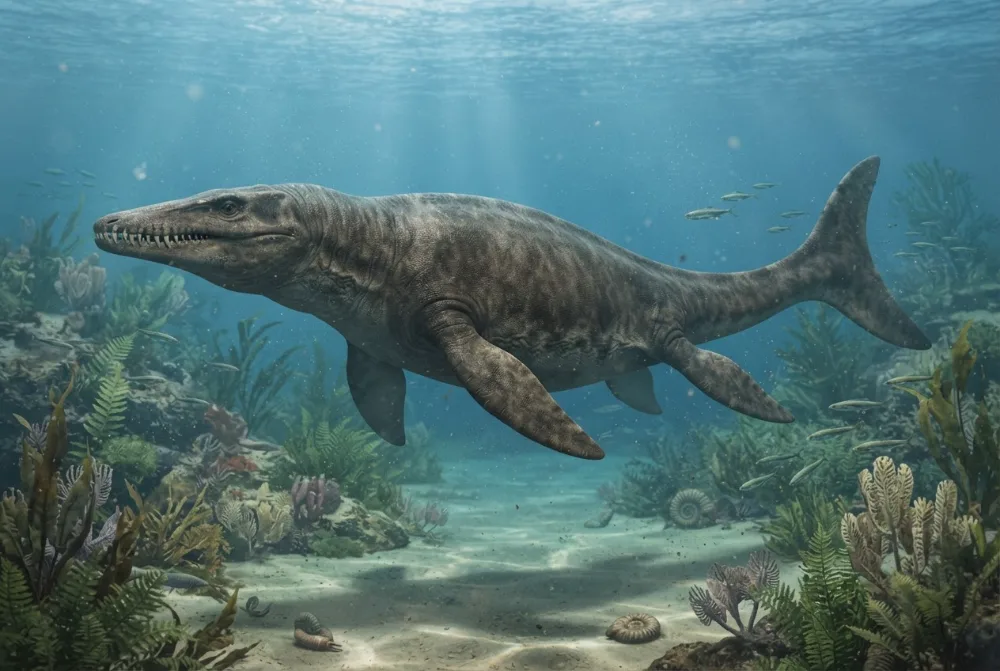
Pachycostasaurus was a pliosaur, a kind of short-necked plesiosaur that lived in the sea. It had very thick, heavy ribs that made its body barrel-shaped, like a fat sausage. This marine reptile was not a fast swimmer, but it used its heavy bones to stay stable underwater.1
E phetse neng?
E ne e le kgolo hakae?
E ne e le telele hakae?
 telele jwaloka dintja tse 3 ho tloha nkong ho isa mohatleng🍌telele jwaloka dibanana tse 17 di behilwe ka mola🏊e ne e ka sesa bolelele ba letamo le leholo la ho sesa (50 m) ka metsotswana e 6.4
Pachycostasaurus e ne e le kgolo hakae ha e bapiswa le WENA?
Ke dipalo feela ho browser ya hao. Ha ho letho le bolokwang kapa le romelwang kae kapa kae.
E ne e le lebelo hakae?


Dintlha tse monate
Pachycostasaurus had ribs and belly bones that were so thick they looked like sausages. This condition is called pachyostosis, and it also happens in modern dugongs and manatees.1
Its flippers were small compared to its body, and its neck was short. This made it a slow swimmer, unlike many other pliosaurs.1
The only known fossil of Pachycostasaurus was found by Alan Dawn, an amateur geologist and museum volunteer, in a quarry in Peterborough, England.1
Its head was about 20% of its total body length, which is typical for pliosaurs of its time.1
Pachycostasaurus lived about 165 to 161 million years ago, during the Middle Jurassic period.2
The bones of its backbone had a large canal for the spinal cord, and some parts were not fully hardened, suggesting the animal might not have been fully grown when it died.1
Mosenyi wa ditshomo
Tshomo: Pachycostasaurus was a fast, powerful predator like other pliosaurs.
Nnete: Its heavy ribs, small flippers, and short neck show it was a slow swimmer that probably stayed near the seafloor, hunting soft prey.1
Bakeng sa ditsebi tsa didinosaure
- Lebitso la saense
- Pachycostasaurus
- E rehilwe ke
- Cruickshank et al. 19962
- Sehlopha
- Diplesiosaure
- Lelapa / leloko
- Pliosauridae2
- Tlhophiso
- Plesiosauria > Pliosauridae > Sauropterygia2
- Dilemo tsa mafika
- dilemo tse dimilione tse 165 ho isa ho 162 (Callovian)2
- Dibopeho tsa mafika
- Oxford Clay2
- Dinaha
- United Kingdom2
- Direkoto tsa difosili
- 1 ho The Paleobiology Database2
- Ho sibollwa
- The fossil was discovered by amateur geologist Alan Dawn in a quarry near Peterborough, England. Scientists Arthur Cruickshank, David Martill and Leslie Noè described and named it in 1996.1
- E sa ntse e phehwa kgang
- Scientists are not sure whether Pachycostasaurus lived in freshwater rivers and estuaries and was washed into the sea, or if it lived in the deep ocean and drifted to shallow waters.1
Moo dintlha di tswang teng
- Pachycostasaurus (en.wikipedia.org)
- Pachycostasaurus in The Paleobiology Database (CC BY 4.0): dilemo, dibaka, dibopeho tsa mafika, tlhophiso.
Ntlha e nngwe le e nngwe leqepheng lena e na le nomoro e supang mohlodi wa yona. Haeba re fositse ho hong, re kopa tshwarelo, re balatedi ba didinosaure, ha re koranta ya saense. Re bolelle ho [email protected] mme re tla e lokisa.
 Rex o lapile! Dino Wiki ke projeke ya ntate bakeng sa mora wa hae ya ratang didinosaure, ke mahala, ha ho dipapatso, ha ho disebedi. Batho ba baholo ba ka fepa Rex seneke ho thusa hore e dule e le inthaneteng.Fepa Rex
 Elasmosaurus
 Pliosaurus
 Plesiosaurus
 Cimoliasaurus
 Colymbosaurus
 Trinacromerum
 Ichthyosaurus
 Khudiakovia
 Ophthalmosaurus
 Pterodactylus
 Rhamphocephalus
 Gongbusaurus