 Kwisi: O dinosaure efe?
 Ntwa ya didinosaure
 Peiso ya didinosaure
 Dipapadi tse nyane tsa didinosaure
 Albamo ya ditikara
 Manane a TOP a didinosaure
 Nkgethele!
Ophthalmosaurus
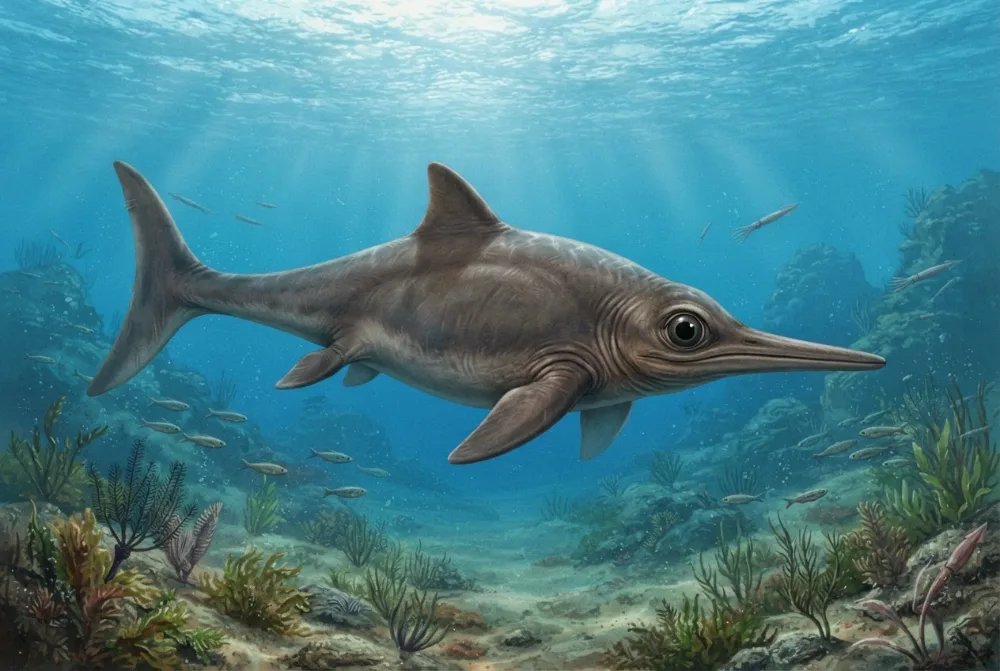
Ophthalmosaurus was a sleek, fast-swimming marine reptile with enormous eyes, almost as big as dinner plates. It lived in the warm seas of the Jurassic period and hunted small fish and squid. Even though it looked like a dolphin, it was actually an ichthyosaur, not a dinosaur.1
E phetse neng?
E ne e le kgolo hakae?
E ne e le telele hakae?
E ne e le boima hakae?
 telele jwaloka dintja tse 4 ho tloha nkong ho isa mohatleng🍌telele jwaloka dibanana tse 22 di behilwe ka mola🍉boima jwaloka mahapu a 190🧸boima jwaloka bana ba kereshe ba 50🎒boima jwaloka bana ba sekolo ba 30🐻❄️boima jwaloka dibere tse tshweu tse 2🏊e ne e ka sesa bolelele ba letamo le leholo la ho sesa (50 m) ka metsotswana e 4
Ophthalmosaurus e ne e le kgolo hakae ha e bapiswa le WENA?
Ke dipalo feela ho browser ya hao. Ha ho letho le bolokwang kapa le romelwang kae kapa kae.
E ne e le lebelo hakae?


Dintlha tse monate
Ophthalmosaurus had eyes that measured about 22 to 23 centimetres (8.7 to 9.1 inches) across, which is bigger than a human head.1
It could dive to depths of 600 metres (2,000 feet) or more, reaching the twilight zone of the ocean, and stay underwater for about 20 minutes.1
Its tail ended in a two-lobed fin, with the lower half supported by the backbone and the upper half made only of soft tissue, helping it swim fast.1
Ophthalmosaurus had short, rounded limbs, with the front ones bigger than the back ones, which it used for steering rather than paddling.1
Fossils show it lived in shallow seas, like the Oxford Clay in England, which was only about 50 metres (160 feet) deep at the time.1
Some scientists think Ophthalmosaurus could swim at about 2 metres per second (6.6 feet per second) when chasing prey.1
Mosenyi wa ditshomo
Tshomo: Ophthalmosaurus was a dinosaur that lived in the water.
Nnete: Ophthalmosaurus was an ichthyosaur, a marine reptile, not a dinosaur. Ichthyosaurs were a different group of reptiles that lived in the oceans.1
Bakeng sa ditsebi tsa didinosaure
- Lebitso la saense
- Ophthalmosaurus
- E rehilwe ke
- Seeley 18742
- Sehlopha
- Diikhthiosaure
- Lelapa / leloko
- Ophthalmosauridae2
- Tlhophiso
- Ichthyosauria > Ichthyosauromorpha2
- Dilemo tsa mafika
- dilemo tse dimilione tse 201 ho isa ho 133 (Hettangian / Valanginian)2
- Dibopeho tsa mafika
- Oxford Clay, Sundance, Vaca Muerta2
- Dinaha
- United Kingdom, Argentina, Amerika, Russia, Fora, Greenland2
- Direkoto tsa difosili
- 27 ho The Paleobiology Database2
- E boetse e tsejwa e le
- Ancanamunia, Yasykovia (mabitso a kgale jwale a balwa e le phoofolo e le nngwe)2
- Ho sibollwa
- Ophthalmosaurus was first described by Harry Seeley in 1874, based on fossils from the Oxford Clay in England. He focused on the shape of the collarbone bones.12
- E sa ntse e phehwa kgang
- Scientists still debate whether some species, like Ophthalmosaurus natans from North America, are really separate species or just close relatives.1
Moo dintlha di tswang teng
- Ophthalmosaurus (en.wikipedia.org)
- Ophthalmosaurus in The Paleobiology Database (CC BY 4.0): dilemo, dibaka, dibopeho tsa mafika, tlhophiso.
Ntlha e nngwe le e nngwe leqepheng lena e na le nomoro e supang mohlodi wa yona. Haeba re fositse ho hong, re kopa tshwarelo, re balatedi ba didinosaure, ha re koranta ya saense. Re bolelle ho [email protected] mme re tla e lokisa.
 Rex o lapile! Dino Wiki ke projeke ya ntate bakeng sa mora wa hae ya ratang didinosaure, ke mahala, ha ho dipapatso, ha ho disebedi. Batho ba baholo ba ka fepa Rex seneke ho thusa hore e dule e le inthaneteng.Fepa Rex
 Ichthyosaurus
 Platypterygius
 Stenopterygius
 Khudiakovia
 Chonespondylus
 Cymbospondylus
 Pterodactylus
 Peloneustes
 Rhamphocephalus
 Gongbusaurus
 Shunosaurus
 Bishanopliosaurus