 Kwisi: O dinosaure efe?
 Ntwa ya didinosaure
 Peiso ya didinosaure
 Dipapadi tse nyane tsa didinosaure
 Albamo ya ditikara
 Manane a TOP a didinosaure
 Nkgethele!
Pampadromaeus
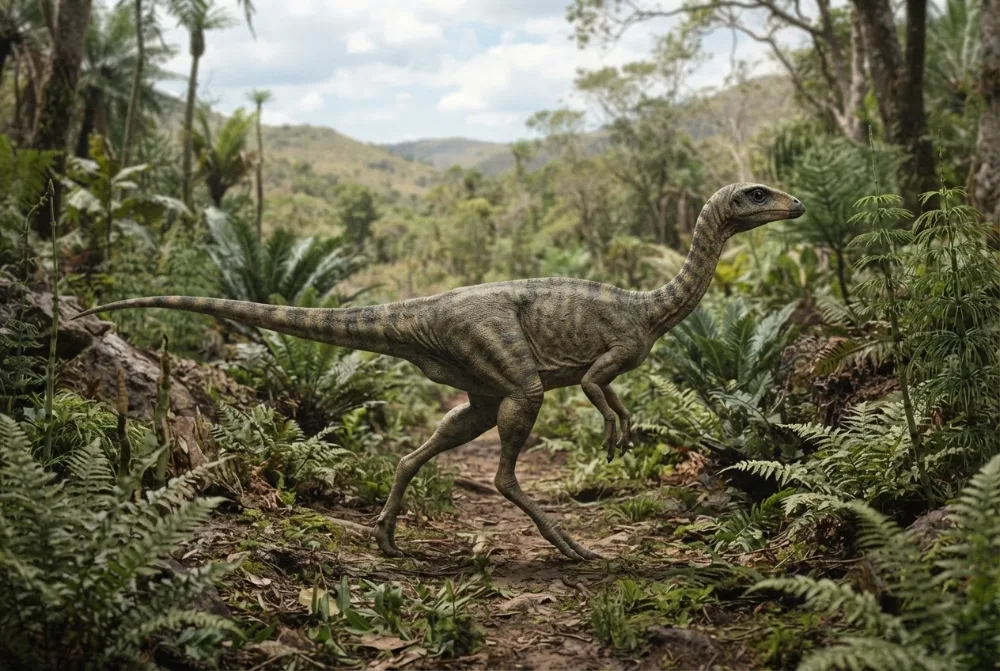
Pampadromaeus was a small, fast runner that lived in Brazil during the Late Triassic, about 233 million years ago. It was an early relative of the huge long-necked sauropods, but it was much smaller and could run on two legs.12
E phetse neng?
E ne e le kgolo hakae?
E ne e le telele hakae?
E ne e phahame hakae?
kakanyo
 telele jwaloka dikatse tsa lapeng tse 3 ho tloha nkong ho isa mohatleng🍌telele jwaloka dibanana tse 8 di behilwe ka mola🏃e ne e ka matha dimitara tse 100 ka metsotswana e 12 (motho ya lebelo ka ho fetisisa o hloka 9,6)
Pampadromaeus e ne e le kgolo hakae ha e bapiswa le WENA?
Ke dipalo feela ho browser ya hao. Ha ho letho le bolokwang kapa le romelwang kae kapa kae.
E ne e le lebelo hakae?


Dintlha tse monate
Pampadromaeus had 88 teeth in total, with 4 in each premaxilla and about 20 in each upper jaw and lower jaw.1
Its lower leg was much longer than its thighbone, which shows it was a fast runner.1
The name Pampadromaeus comes from the Quechua word for 'plain' and the Greek word for 'runner', because it lived in an open landscape and could run quickly.1
Pampadromaeus had some traits similar to theropod dinosaurs, like a gap between the premaxilla and maxilla bones, and front teeth without serrations.1
Dipotso tse botswang haholo ka Pampadromaeus
?How big was Pampadromaeus?
Pampadromaeus was a small dinosaur, about 1.5 metres (5 feet) long.2
?What did Pampadromaeus eat?
Its teeth were large, pointed and serrated, which suggests it ate meat or plants. Scientists are not completely sure, but it is an early relative of long-necked sauropods.1
?When did Pampadromaeus live?
It lived during the Late Triassic, about 233 million years ago, in what is now Brazil.12
?Was Pampadromaeus a dinosaur?
Yes, it was a small, bipedal dinosaur and an early relative of the long-necked sauropods.1
Bakeng sa ditsebi tsa didinosaure
- Lebitso la saense
- Pampadromaeus
- E rehilwe ke
- Cabreira et al. 20113
- Sehlopha
- Melala e melelele
- Lelapa / leloko
- Saturnaliidae3
- Tlhophiso
- Sauropodomorpha3
- Dilemo tsa mafika
- dilemo tse dimilione tse 237 ho isa ho 227 (Carnian)3
- Dibopeho tsa mafika
- Santa Maria3
- Dinaha
- Brazil3
- Direkoto tsa difosili
- 3 ho The Paleobiology Database3
- Ho sibollwa
- Pampadromaeus was named in 2011 by Sergio F. Cabreira and a team of paleontologists. The skeleton was found at the Janner site in Agudo, Brazil.12
- E sa ntse e phehwa kgang
- Scientists are not sure how Pampadromaeus is related to other early sauropodomorphs; it might belong to the family Saturnaliidae.2
Moo dintlha di tswang teng
- Pampadromaeus (en.wikipedia.org)
- Anatomy of the dinosaur Pampadromaeus barberenai (Saurischia, Sauropodomorpha) from the Late Triassic Santa Maria Formation of southern Brazil | PLOS One (journals.plos.org)
- Pampadromaeus in The Paleobiology Database (CC BY 4.0): dilemo, dibaka, dibopeho tsa mafika, tlhophiso.
Ntlha e nngwe le e nngwe leqepheng lena e na le nomoro e supang mohlodi wa yona. Haeba re fositse ho hong, re kopa tshwarelo, re balatedi ba didinosaure, ha re koranta ya saense. Re bolelle ho [email protected] mme re tla e lokisa.
 Rex o lapile! Dino Wiki ke projeke ya ntate bakeng sa mora wa hae ya ratang didinosaure, ke mahala, ha ho dipapatso, ha ho disebedi. Batho ba baholo ba ka fepa Rex seneke ho thusa hore e dule e le inthaneteng.Fepa Rex
 Brachiosaurus
 Diplodocus
 Brontosaurus
 Argentinosaurus
 Camarasaurus
 Morosaurus
 Nothosaurus
 Coelophysis
 Podokesaurus
 Simosaurus
 Eudimorphodon
 Herrerasaurus