 Kwisi: O dinosaure efe?
 Ntwa ya didinosaure
 Peiso ya didinosaure
 Dipapadi tse nyane tsa didinosaure
 Albamo ya ditikara
 Manane a TOP a didinosaure
 Nkgethele!
Peloneustes
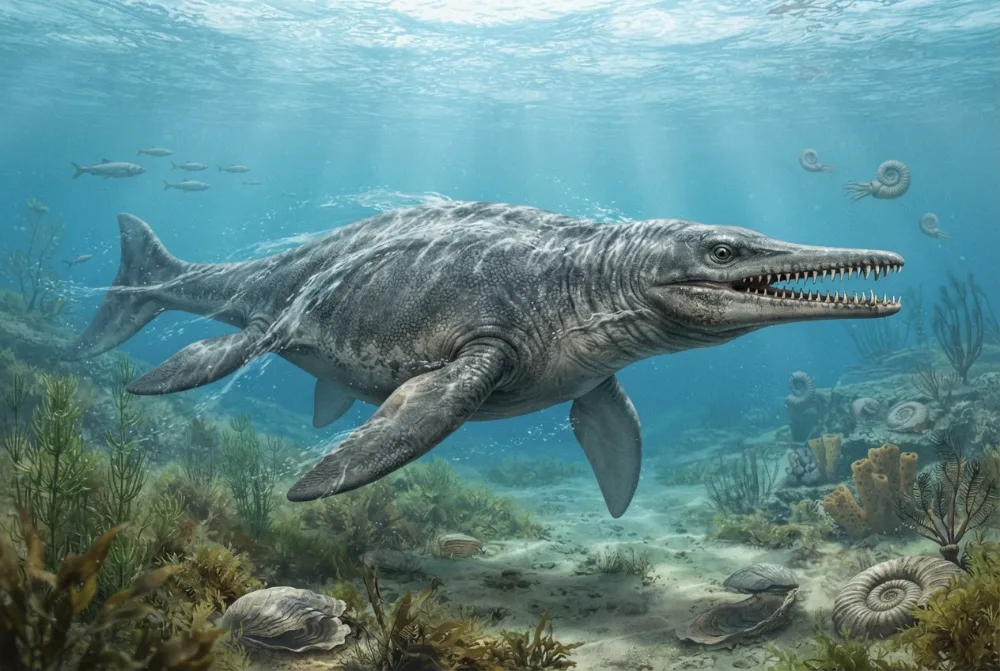
Peloneustes was a pliosaur, a kind of short-necked plesiosaur that lived in a shallow sea. It had a long, narrow snout like a dolphin and many sharp teeth for catching fish. This marine reptile was a fast and fierce hunter in the water.1
E phetse neng?
E ne e le kgolo hakae?
E ne e le telele hakae?
E ne e le boima hakae?
 telele jwaloka dintja tse 4 ho tloha nkong ho isa mohatleng🍌telele jwaloka dibanana tse 24 di behilwe ka mola🍉boima jwaloka mahapu a 200🧸boima jwaloka bana ba kereshe ba 53🎒boima jwaloka bana ba sekolo ba 31🐻❄️boima jwaloka dibere tse tshweu tse 2🏊e ne e ka sesa bolelele ba letamo le leholo la ho sesa (50 m) ka metsotswana e 6.7
Peloneustes e ne e le kgolo hakae ha e bapiswa le WENA?
Ke dipalo feela ho browser ya hao. Ha ho letho le bolokwang kapa le romelwang kae kapa kae.
E ne e le lebelo hakae?


Dintlha tse monate
Peloneustes lived about 165 to 161 million years ago during the Middle Jurassic period.3
Its name means 'mud swimmer' because its fossils were found in mud from an ancient sea.1
Peloneustes had a long, narrow snout that was shaped like a dolphin's beak. This helped it move quickly through the water.1
It had 30 to 31 teeth in its upper jaw and 36 to 44 teeth in its lower jaw. The teeth were sharp and slightly curved for piercing fish.2
Peloneustes shared its sea home with other marine reptiles like ichthyosaurs and other plesiosaurs. At least five different pliosaurids lived in the same area.1
The sea where Peloneustes swam was only about 30 to 50 metres (100 to 160 feet) deep. It was a shallow inland sea.1
Dipotso tse botswang haholo ka Peloneustes
?How big was Peloneustes?
Peloneustes was about 3.5 to 4 metres (11 to 13 feet) long. This is small for a pliosaurid.1
?What did Peloneustes eat?
Peloneustes ate fish. It had a long, narrow snout and many sharp teeth for piercing fish, and it would swing its head quickly to catch them.1
?When did Peloneustes live?
Peloneustes lived during the Middle Jurassic period, about 165 to 161 million years ago. Its fossils are from the Oxford Clay Formation in England.1
?Was Peloneustes a dinosaur?
No, Peloneustes was a plesiosaur, a marine reptile, not a dinosaur. It lived in the sea and used its flippers to swim.1
Bakeng sa ditsebi tsa didinosaure
- Lebitso la saense
- Peloneustes
- E rehilwe ke
- Lydekker 18893
- Sehlopha
- Diplesiosaure
- Lelapa / leloko
- Pliosauridae3
- Tlhophiso
- Plesiosauria > Pliosauridae > Sauropterygia3
- Dilemo tsa mafika
- dilemo tse dimilione tse 165 ho isa ho 162 (Callovian)3
- Dibopeho tsa mafika
- Oxford Clay, Ornatenton, Argiles de Montaubert3
- Dinaha
- United Kingdom, Fora, Jeremane3
- Direkoto tsa difosili
- 12 ho The Paleobiology Database3
- Ho sibollwa
- Peloneustes was first described as a species of Plesiosaurus by Harry Govier Seeley in 1869. Richard Lydekker gave it its own genus name in 1889.1
- E sa ntse e phehwa kgang
- Scientists are not sure if Peloneustes was a close relative of Pliosaurus or a more early-diverging pliosaurid. They are still studying its family tree.1
Moo dintlha di tswang teng
- Peloneustes (en.wikipedia.org)
- The cranial anatomy and taxonomy of Peloneustes philarchus (Sauropterygia, Pliosauridae) from the Peterborough Member (Callovian, Middle Jurassic) of the United Kingdom (onlinelibrary.wiley.com)
- Peloneustes in The Paleobiology Database (CC BY 4.0): dilemo, dibaka, dibopeho tsa mafika, tlhophiso.
Ntlha e nngwe le e nngwe leqepheng lena e na le nomoro e supang mohlodi wa yona. Haeba re fositse ho hong, re kopa tshwarelo, re balatedi ba didinosaure, ha re koranta ya saense. Re bolelle ho [email protected] mme re tla e lokisa.
 Rex o lapile! Dino Wiki ke projeke ya ntate bakeng sa mora wa hae ya ratang didinosaure, ke mahala, ha ho dipapatso, ha ho disebedi. Batho ba baholo ba ka fepa Rex seneke ho thusa hore e dule e le inthaneteng.Fepa Rex
 Elasmosaurus
 Pliosaurus
 Plesiosaurus
 Cimoliasaurus
 Colymbosaurus
 Trinacromerum
 Ichthyosaurus
 Khudiakovia
 Ophthalmosaurus
 Pterodactylus
 Rhamphocephalus
 Gongbusaurus