 Kwisi: O dinosaure efe?
 Ntwa ya didinosaure
 Peiso ya didinosaure
 Dipapadi tse nyane tsa didinosaure
 Albamo ya ditikara
 Manane a TOP a didinosaure
 Nkgethele!
Prosaurolophus
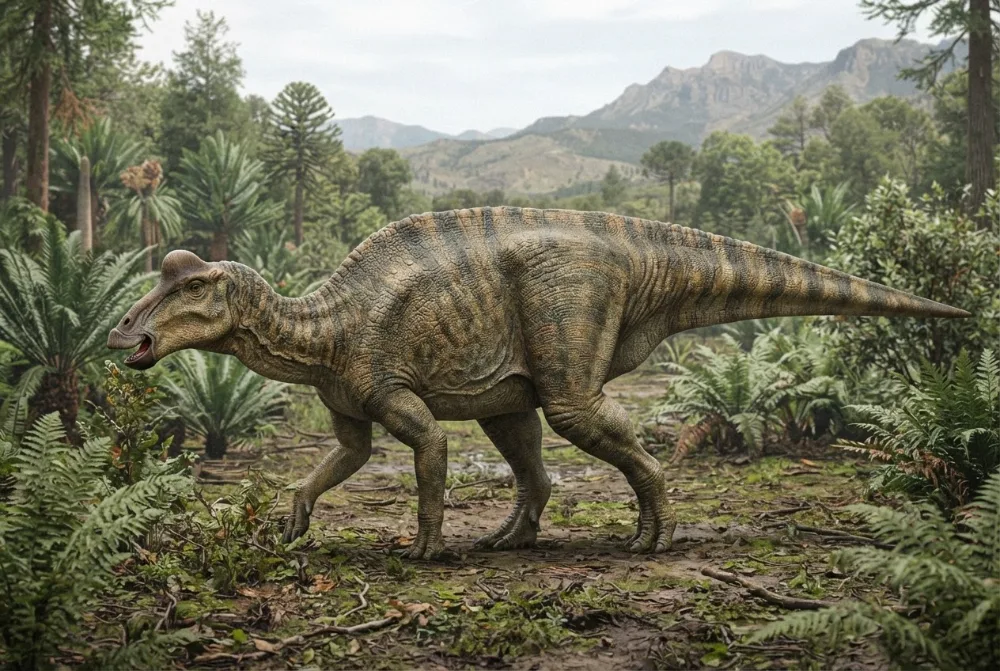
Prosaurolophus was a duck-billed dinosaur that lived in North America about 75 million years ago. It had a small, solid bump on its nose that looked like a little hat. This gentle giant munched on plants and could walk on two legs or all fours.1
E phetse neng?
E ne e le kgolo hakae?
E ne e le telele hakae?
E ne e phahame hakae?
kakanyo
E ne e le boima hakae?

 telele jwaloka dintja tse 8 ho tloha nkong ho isa mohatleng🍌telele jwaloka dibanana tse 47 di behilwe ka molaboima jwaloka dintja tse 150🍉boima jwaloka mahapu a 600🎒boima jwaloka ditlelase tse feletseng tse 4 tsa bana ba sekolo🐻❄️boima jwaloka dibere tse tshweu tse 7🏃e ne e ka matha dimitara tse 100 ka metsotswana e 15 (motho ya lebelo ka ho fetisisa o hloka 9,6)
Prosaurolophus e ne e le kgolo hakae ha e bapiswa le WENA?
Ke dipalo feela ho browser ya hao. Ha ho letho le bolokwang kapa le romelwang kae kapa kae.
E ne e le lebelo hakae?


Dintlha tse monate
Prosaurolophus had a small, triangular crest on its head made of bone, but scientists think it might have had inflatable nose sacs for display.1
Fossils of at least 25 individuals have been found, including some in a bonebed that suggests they lived together in groups near water.1
Its teeth were packed into dental batteries with hundreds of teeth, and they were replaced throughout its life.1
Prosaurolophus could probably walk on two legs or all fours, and it could reach plants up to 4 metres (13 feet) high.1
It lived in a warm, swampy environment with rivers and floodplains, alongside horned dinosaurs like Centrosaurus and the tyrannosaur Gorgosaurus.1
Dipotso tse botswang haholo ka Prosaurolophus
?How big was Prosaurolophus?
About 8.5 metres (28 feet) long and weighed around 3 tonnes (3.3 tons). Its skull was about 0.9 metres (3 feet) long.1
?What did Prosaurolophus eat?
It was a herbivore that ate plants like conifer trees and tree bark, using its broad beak to crop food and hundreds of teeth to grind it.1
?Did Prosaurolophus have a crest?
Yes, it had a small, triangular crest on its forehead made of bone. Scientists think it might also have had inflatable nose sacs for display.13
?When did Prosaurolophus live?
It lived during the Late Cretaceous period, about 75.7 to 74.1 million years ago.1
?Where was Prosaurolophus found?
Fossils have been found in Alberta, Canada, and Montana, USA, in the Dinosaur Park Formation and Two Medicine Formation.12
?Did Prosaurolophus live in groups?
Yes, a bonebed of several individuals suggests they lived together in groups, possibly gathering near water during droughts.1
Bakeng sa ditsebi tsa didinosaure
- Lebitso la saense
- Prosaurolophus
- E rehilwe ke
- Brown 19164
- Sehlopha
- Melomo ya letata
- Lelapa / leloko
- Hadrosauridae4
- Tlhophiso
- Ornithischia > Ornithopoda > Iguanodontia > Hadrosauridae4
- Dilemo tsa mafika
- dilemo tse dimilione tse 84 ho isa ho 66 (Campanian / Maastrichtian)4
- Dibopeho tsa mafika
- Dinosaur Park, Two Medicine, Bearpaw Shale4
- Dinaha
- Kanada, Amerika4
- Direkoto tsa difosili
- 15 ho The Paleobiology Database4
- Ho sibollwa
- American paleontologist Barnum Brown found a skull in Alberta, Canada in 1915 and named Prosaurolophus maximus in 1916.1
- E sa ntse e phehwa kgang
- Scientists are not sure if the small crest was used for display or if it supported soft tissue like inflatable nose sacs.1
Moo dintlha di tswang teng
- Prosaurolophus (en.wikipedia.org)
- Prosaurolophus | Natural History Museum (nhm.ac.uk)
- Local juvenile duck-billed dinosaur fossil discovery reveals new details about its appearance | News | University of Calgary (news.ucalgary.ca)
- Prosaurolophus in The Paleobiology Database (CC BY 4.0): dilemo, dibaka, dibopeho tsa mafika, tlhophiso.
Ntlha e nngwe le e nngwe leqepheng lena e na le nomoro e supang mohlodi wa yona. Haeba re fositse ho hong, re kopa tshwarelo, re balatedi ba didinosaure, ha re koranta ya saense. Re bolelle ho [email protected] mme re tla e lokisa.
 Rex o lapile! Dino Wiki ke projeke ya ntate bakeng sa mora wa hae ya ratang didinosaure, ke mahala, ha ho dipapatso, ha ho disebedi. Batho ba baholo ba ka fepa Rex seneke ho thusa hore e dule e le inthaneteng.Fepa Rex
 Parasaurolophus
 Edmontosaurus
 Saurolophus
 Hypacrosaurus
 Corythosaurus
 Kritosaurus
 Tyrannosaurus
 Triceratops
 Velociraptor
 Spinosaurus
 Ankylosaurus
 Pteranodon