 Kwisi: O dinosaure efe?
 Ntwa ya didinosaure
 Peiso ya didinosaure
 Dipapadi tse nyane tsa didinosaure
 Albamo ya ditikara
 Manane a TOP a didinosaure
 Nkgethele!
Psephoderma
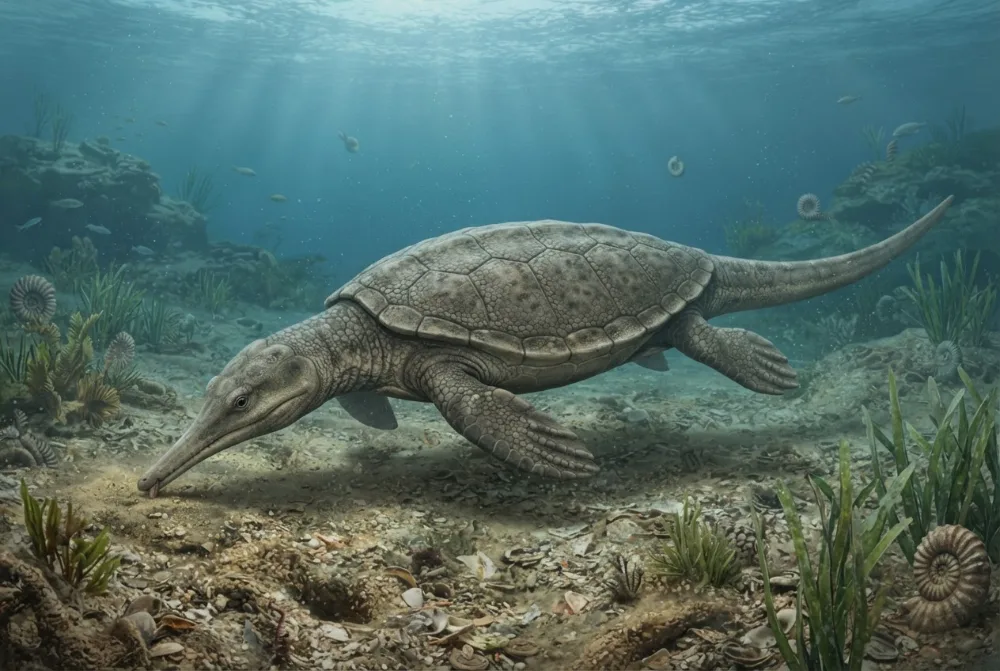
Psephoderma was a marine reptile that lived in the Late Triassic, about 210 million years ago. It had a flat skull and a shell made of two parts, like a turtle, and used its long snout to dig up shellfish from the seafloor.1
E phetse neng?
E ne e le kgolo hakae?
E ne e le telele hakae?
 telele jwaloka dikatse tsa lapeng tse 4 ho tloha nkong ho isa mohatleng🍌telele jwaloka dibanana tse 10 di behilwe ka mola🏊e ne e ka sesa bolelele ba letamo le leholo la ho sesa (50 m) ka metsotswana e 16
Psephoderma e ne e le kgolo hakae ha e bapiswa le WENA?
Ke dipalo feela ho browser ya hao. Ha ho letho le bolokwang kapa le romelwang kae kapa kae.
E ne e le lebelo hakae?


Dintlha tse monate
Psephoderma had a long tail, up to about 80 cm (31 inches), covered in bony scutes.1
Its shell was split into two pieces: one over the ribs and another over the pelvis.1
The largest known Psephoderma fossil is 180 cm (5.9 feet) long.3
Its skull had a narrow, straight snout with grooves that led to the nostrils.1
Psephoderma had no teeth at the front of its mouth, only four large crushing teeth on each side of the palate.1
It lived in shallow, oxygen-rich waters near tidal channels, where it fed on shellfish like Modiolus and Isognomon.3
Dipotso tse botswang haholo ka Psephoderma
?Was Psephoderma a dinosaur?
No, Psephoderma was not a dinosaur. It was a marine reptile called a placodont, which is a type of sauropterygian.1
?How big was Psephoderma?
Psephoderma grew up to 180 centimetres (5.9 feet) long, which is about as long as a bathtub.1
?What did Psephoderma eat?
Psephoderma ate shellfish like Modiolus and Isognomon. It used its long snout to dig them up and crushed them with its large, flat teeth.3
?Could Psephoderma swim?
Yes, Psephoderma could swim. Its shell was streamlined for swimming, and it used its paddle-like limbs to move through the water.3
Bakeng sa ditsebi tsa didinosaure
- Lebitso la saense
- Psephoderma
- E rehilwe ke
- von Meyer 18584
- Sehlopha
- Dihahabi tsa lewatle
- Lelapa / leloko
- Placochelyida4
- Tlhophiso
- Placodontia > Sauropterygia4
- Dilemo tsa mafika
- dilemo tse dimilione tse 243 ho isa ho 201 ()4
- Dibopeho tsa mafika
- Calcare di Zu, Kössener Schichten, Zorzino Limestone4
- Dinaha
- Itali, Austria, Iseraele, United Kingdom4
- Direkoto tsa difosili
- 10 ho The Paleobiology Database4
- E boetse e tsejwa e le
- Placochelyanus (mabitso a kgale jwale a balwa e le phoofolo e le nngwe)4
- Ho sibollwa
- Psephoderma was named by German paleontologist Hermann von Meyer in 1858. Fossils have been found in the Alps and England.12
- E sa ntse e phehwa kgang
- Scientists are not sure if Psephoderma used its shell mainly for defense or for swimming, but some think it was shaped to help it glide through water.3
Moo dintlha di tswang teng
- Psephoderma (en.wikipedia.org)
- PBDB Taxon (paleobiodb.org)
- FUNCTIONAL MORPHOLOGY AND MODE OF LIFE OF THE LATE TRIASSIC PLACODONT PSEPHODERMA ALPINUM MEYER FROM THE CALCARE DI ZORZINO (LOMBARDY, N ITALY) | RIVISTA ITALIANA DI PALEONTOLOGIA E STRATIGRAFIA (riviste.unimi.it)
- Psephoderma in The Paleobiology Database (CC BY 4.0): dilemo, dibaka, dibopeho tsa mafika, tlhophiso.
Ntlha e nngwe le e nngwe leqepheng lena e na le nomoro e supang mohlodi wa yona. Haeba re fositse ho hong, re kopa tshwarelo, re balatedi ba didinosaure, ha re koranta ya saense. Re bolelle ho [email protected] mme re tla e lokisa.
 Rex o lapile! Dino Wiki ke projeke ya ntate bakeng sa mora wa hae ya ratang didinosaure, ke mahala, ha ho dipapatso, ha ho disebedi. Batho ba baholo ba ka fepa Rex seneke ho thusa hore e dule e le inthaneteng.Fepa Rex
 Nothosaurus
 Placodus
 Lariosaurus
 Cyamodus
 Cymatosaurus
 Proneusticosaurus
 Massospondylus
 Plateosaurus
 Coelophysis
 Podokesaurus
 Thecodontosaurus
 Eudimorphodon