 Kwisi: O dinosaure efe?
 Ntwa ya didinosaure
 Peiso ya didinosaure
 Dipapadi tse nyane tsa didinosaure
 Albamo ya ditikara
 Manane a TOP a didinosaure
 Nkgethele!
Saraikimasoom
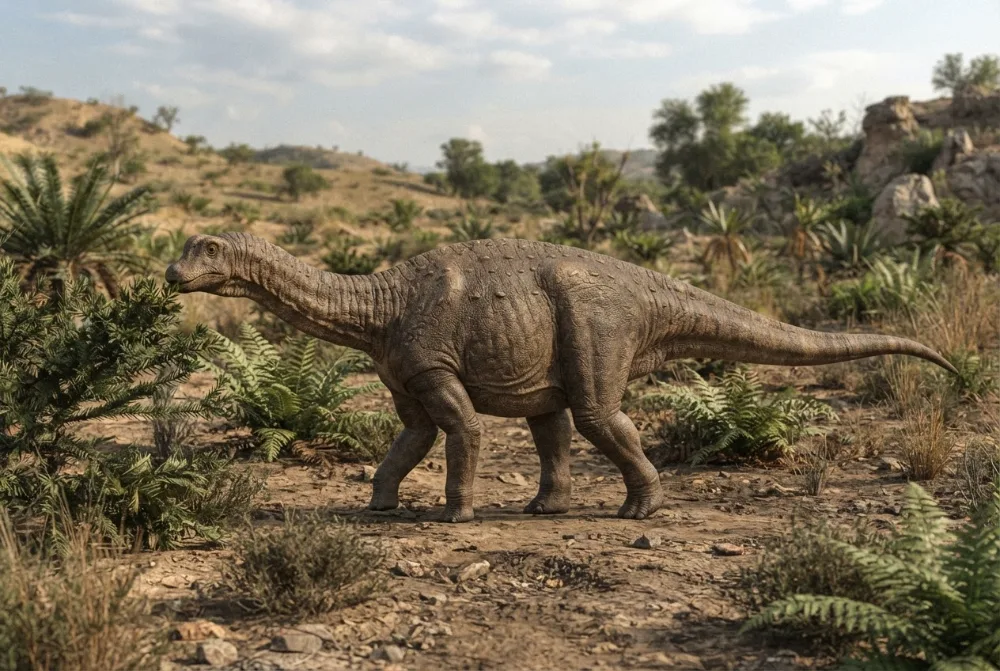
Saraikimasoom was a small, stocky long-necked dinosaur that lived about 72 to 66 million years ago in what is now Pakistan. It had a small skull, a long neck, a round body, and short legs, making it one of the smallest titanosaurs ever found in the Indo-Pakistan region.21
E phetse neng?
E ne e le kgolo hakae?
E ne e le telele hakae?
E ne e phahame hakae?
E ne e le boima hakae?
 telele jwaloka dikoloi tse 2 tse pakilweng ka mola🍌telele jwaloka dibanana tse 56 di behilwe ka mola
 e batla e le boima jwaloka tlou🍉boima jwaloka mahapu a 1000🎒boima jwaloka ditlelase tse feletseng tse 6 tsa bana ba sekolo🐻❄️boima jwaloka dibere tse tshweu tse 11🏃e ne e ka matha dimitara tse 100 ka metsotswana e 19 (motho ya lebelo ka ho fetisisa o hloka 9,6)
Saraikimasoom e ne e le kgolo hakae ha e bapiswa le WENA?
Ke dipalo feela ho browser ya hao. Ha ho letho le bolokwang kapa le romelwang kae kapa kae.
E ne e le lebelo hakae?


Dintlha tse monate
Saraikimasoom had a very small skull, only about 15 to 18 centimeters long and 7 to 9 centimeters high, which is tiny for a dinosaur of its size.1
Its teeth were small, circular, and slightly curved, and they tapered gradually from base to tip, unlike some other titanosaurs whose teeth were more uniform.1
The skull's upper and lower tooth rows were U-shaped, which is a feature shared with its close relative Gspsaurus, but unlike Gspsaurus, the lower tooth row was also U-shaped.1
It had a dental formula of 4, 13/9 to 13, meaning it had 4 premaxillary teeth, 13 maxillary teeth, and 9 to 13 dentary teeth on each side.1
Saraikimasoom is the smallest titanosaur known from the Indo-Pakistan subcontinent, and it was a stocky animal with a round body and short legs.1
Its tail vertebrae were procoelous (hollow in front), except for the first one which was biconvex, a feature that helps scientists classify it as a titanosaur.1
The name Saraikimasoom comes from the Saraiki language, where 'masoom' means innocent, and the species name 'vitakri' honors the Vitakri Formation where it was found.1
Dipotso tse botswang haholo ka Saraikimasoom
?How big was Saraikimasoom?
About 8 to 10 metres long, 2 metres tall at the hip, and weighed around 5 tonnes. That is roughly the length of a school bus.1
?Was Saraikimasoom a dinosaur?
Yes, it was a small, stocky sauropod dinosaur from the Late Cretaceous.13
?What did Saraikimasoom eat?
It was a plant-eater. Its small, conical teeth were good for stripping leaves and soft plants.1
?When did Saraikimasoom live?
It lived about 72 to 66 million years ago, during the very end of the Cretaceous Period.3
?Where was Saraikimasoom found?
Its fossils were discovered in the Vitakri Formation of Balochistan, Pakistan.13
?Is Saraikimasoom the smallest titanosaur?
It is the smallest titanosaur known from the Indo-Pakistan subcontinent, but scientists are not sure if it is the smallest of all titanosaurs.1
?Why is it called Saraikimasoom?
The name comes from the Saraiki language of Pakistan, where 'masoom' means innocent. The species name 'vitakri' honors the Vitakri Formation where it was found.1
?Did Saraikimasoom have feathers?
No, it did not have feathers. It was a sauropod dinosaur, and sauropods are not known to have had feathers.1
Mosenyi wa ditshomo
Tshomo: Some people think all titanosaurs were giant, but Saraikimasoom was actually quite small for a titanosaur.
Nnete: Saraikimasoom was about 8 to 10 meters long and weighed about 5 tons, which is small compared to giants like Argentinosaurus, but still big compared to a car.1
Bakeng sa ditsebi tsa didinosaure
- Lebitso la saense
- Saraikimasoom
- E rehilwe ke
- Malkani 20143
- Sehlopha
- Melala e melelele
- Lelapa / leloko
- Gspsauridae3
- Tlhophiso
- Sauropodomorpha > Sauropoda > Titanosauria > Macronaria3
- Dilemo tsa mafika
- dilemo tse dimilione tse 72 ho isa ho 66 (Maastrichtian)3
- Dibopeho tsa mafika
- Vitakri3
- Dinaha
- Pakistan3
- Direkoto tsa difosili
- 12 ho The Paleobiology Database3
- Ho sibollwa
- Saraikimasoom was first described by M. S. Malkani in 2014, based on a partial skull and other bones found in the Vitakri Formation of Balochistan, Pakistan. The type specimen is stored in the museum of the Geological Survey of Pakistan in Quetta.21
- E sa ntse e phehwa kgang
- Scientists still debate whether Saraikimasoom belongs in its own family, Gspsauridae, or if it is a more primitive titanosaur, and some details of its skull and teeth are still being studied.21
Moo dintlha di tswang teng
- Smallest Titanosaur from Indo-Pakistan Landmass (scirp.org)
- PBDB Taxon (paleobiodb.org)
- Saraikimasoom in The Paleobiology Database (CC BY 4.0): dilemo, dibaka, dibopeho tsa mafika, tlhophiso.
Ntlha e nngwe le e nngwe leqepheng lena e na le nomoro e supang mohlodi wa yona. Haeba re fositse ho hong, re kopa tshwarelo, re balatedi ba didinosaure, ha re koranta ya saense. Re bolelle ho [email protected] mme re tla e lokisa.
 Rex o lapile! Dino Wiki ke projeke ya ntate bakeng sa mora wa hae ya ratang didinosaure, ke mahala, ha ho dipapatso, ha ho disebedi. Batho ba baholo ba ka fepa Rex seneke ho thusa hore e dule e le inthaneteng.Fepa Rex
 Brachiosaurus
 Diplodocus
 Brontosaurus
 Argentinosaurus
 Camarasaurus
 Morosaurus
 Tyrannosaurus
 Triceratops
 Velociraptor
 Spinosaurus
 Ankylosaurus
 Parasaurolophus