 Kwisi: O dinosaure efe?
 Ntwa ya didinosaure
 Peiso ya didinosaure
 Dipapadi tse nyane tsa didinosaure
 Albamo ya ditikara
 Manane a TOP a didinosaure
 Nkgethele!
Sciurumimus
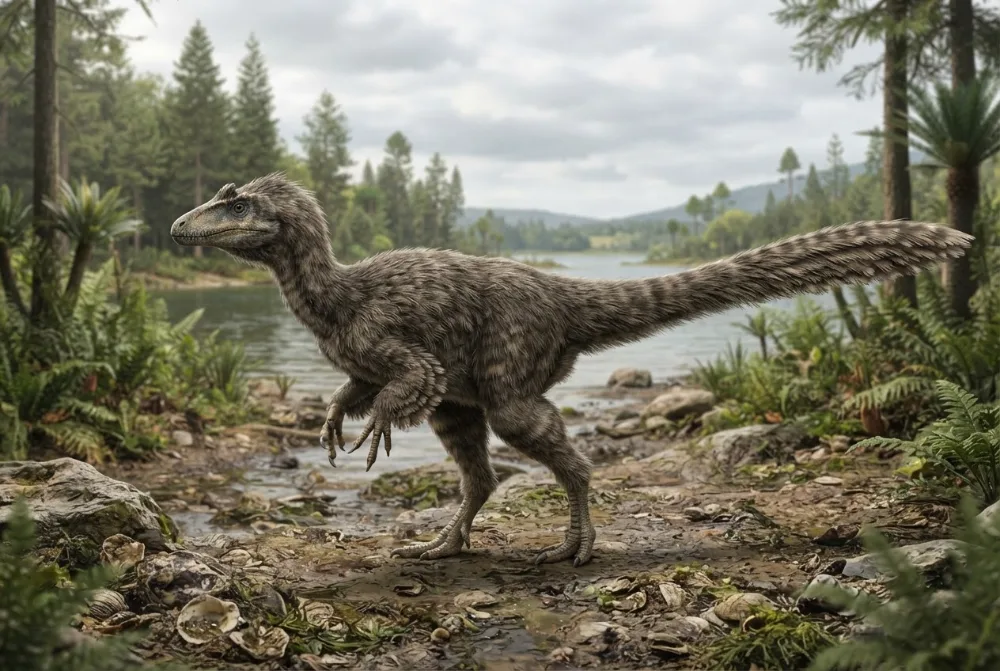
Sciurumimus was a small meat-eating dinosaur that lived in what is now Germany. It looked a bit like a tiny squirrel because it had a long, fluffy tail. Even though it was a young dinosaur, it was already a fast hunter.1
E phetse neng?
E ne e le kgolo hakae?
E ne e le telele hakae?
E ne e phahame hakae?
kakanyo
Sciurumimus e ne e le kgolo hakae ha e bapiswa le WENA?
Ke dipalo feela ho browser ya hao. Ha ho letho le bolokwang kapa le romelwang kae kapa kae.
E ne e le lebelo hakae?


Dintlha tse monate
Sciurumimus is known from just one beautifully preserved baby skeleton.1
Its tail had long, fuzzy filaments that looked like a squirrel's tail, which is how it got its name.1
The fossil even shows some muscle tissue along the back of its leg.1
Sciurumimus had big eyes and a large head compared to its body, like a baby animal.1
Scientists are not sure where Sciurumimus belongs on the dinosaur family tree. Some say it is a megalosauroid, others think it is a coelurosaur.1
Dipotso tse botswang haholo ka Sciurumimus
?How big was Sciurumimus?
The only known fossil is a baby about 70 cm (2.3 ft) long. Adults probably reached 6 metres (19.7 ft) or more.2
?Did Sciurumimus have feathers?
Yes. The fossil shows long, hair-like filaments on the tail and body that are identical to stage 1 feathers found in other dinosaurs.13
?What did Sciurumimus eat?
The baby probably ate insects and other small prey, based on its slender, pointed teeth. Adults likely hunted larger dinosaurs.2
?Is Sciurumimus a dinosaur?
Yes, it is a theropod dinosaur, a meat-eater that lived about 150 million years ago in what is now Germany.1
?Why is it called Sciurumimus?
Its name means 'squirrel mimic' because its fluffy tail looks like a tree squirrel's tail.1
?How fast could Sciurumimus run?
Scientists do not know its exact speed, but as a small, fast hunter it was probably quick on its feet.1
Mosenyi wa ditshomo
Tshomo: Because it had feathery filaments, Sciurumimus was a bird-like dinosaur.
Nnete: Sciurumimus was a meat-eating theropod dinosaur, not a bird, and its filaments were simple stage 1 feathers similar to those found in some ornithischian dinosaurs and early tyrannosaurs.1
Bakeng sa ditsebi tsa didinosaure
- Lebitso la saense
- Sciurumimus
- E rehilwe ke
- Rauhut et al. 20124
- Sehlopha
- Didinosaure tse jang nama
- Lelapa / leloko
- Megalosauroidea4
- Tlhophiso
- Theropoda4
- Dilemo tsa mafika
- dilemo tse dimilione tse 152 ho isa ho 149 (Kimmeridgian)4
- Dibopeho tsa mafika
- Torleite4
- Dinaha
- Jeremane4
- Direkoto tsa difosili
- 1 ho The Paleobiology Database4
- Ho sibollwa
- The first and only Sciurumimus fossil was found in a limestone quarry near Painten, Germany, and named by scientists Rauhut, Foth, Tischlinger, and Norell in 2012.14
- E sa ntse e phehwa kgang
- Scientists still debate whether Sciurumimus is a basal megalosauroid or a coelurosaur, because its only known skeleton is from a very young animal, making its adult features hard to guess.1
Moo dintlha di tswang teng
- Sciurumimus (en.wikipedia.org)
- A new, juvenile predatory dinosaur from Bavaria (snsb.de)
- Exceptionally preserved juvenile megalosauroid theropod ... (pubmed.ncbi.nlm.nih.gov)
- Sciurumimus in The Paleobiology Database (CC BY 4.0): dilemo, dibaka, dibopeho tsa mafika, tlhophiso.
Ntlha e nngwe le e nngwe leqepheng lena e na le nomoro e supang mohlodi wa yona. Haeba re fositse ho hong, re kopa tshwarelo, re balatedi ba didinosaure, ha re koranta ya saense. Re bolelle ho [email protected] mme re tla e lokisa.
 Rex o lapile! Dino Wiki ke projeke ya ntate bakeng sa mora wa hae ya ratang didinosaure, ke mahala, ha ho dipapatso, ha ho disebedi. Batho ba baholo ba ka fepa Rex seneke ho thusa hore e dule e le inthaneteng.Fepa Rex
 Allosaurus
 Carnotaurus
 Dilophosaurus
 Giganotosaurus
 Compsognathus
 Paronychodon
 Brachiosaurus
 Diplodocus
 Brontosaurus
 Camarasaurus
 Morosaurus
 Apatosaurus