 Kwisi: O dinosaure efe?
 Ntwa ya didinosaure
 Peiso ya didinosaure
 Dipapadi tse nyane tsa didinosaure
 Albamo ya ditikara
 Manane a TOP a didinosaure
 Nkgethele!
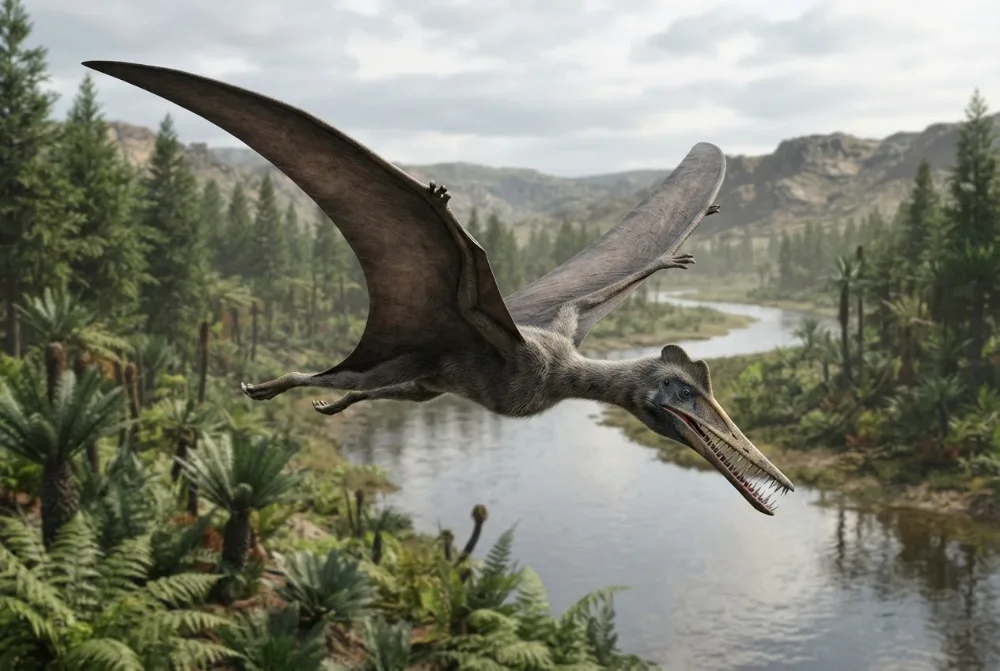
Sericipterus
Sericipterus was a flying reptile that lived about 160 million years ago in what is now China. It had a wingspan of at least 1.73 meters (5.7 feet), making it one of the largest pterosaurs of its time. It probably soared over lakes and rivers, catching fish with its long, sharp teeth.12
E phetse neng?
E ne e le kgolo hakae?
Mapheo a yona a ne a pharaletse hakae?
 telele jwaloka dikatse tsa lapeng tse 3 ho tloha nkong ho isa mohatleng⚽e ne e ka fofa ho tshela lebala lohle la bolo ya maoto ka metsotswana e 8.4
Sericipterus e ne e le kgolo hakae ha e bapiswa le WENA?
Ke dipalo feela ho browser ya hao. Ha ho letho le bolokwang kapa le romelwang kae kapa kae.
E ne e le lebelo hakae?


Dintlha tse monate
Sericipterus had three bony crests on its head: one on the snout, one on top of the skull, and a short crest at the front of the skull.1
It was one of the largest non-pterodactyloid pterosaurs, meaning it belonged to an early group of pterosaurs that did not have the short tails and long heads of later forms.2
The name Sericipterus comes from the Silk Road, the ancient trade route that passed through the region where it was found.1
Its teeth were curved, sharply pointed, and had two keels (sharp edges) for cutting, like steak knives.1
The holotype specimen (IVPP V14725) includes a disarticulated skull, partial lower jaw, many teeth, parts of the spine, wing bones, and other fragments.2
Sericipterus lived in a terrestrial (land) environment, unlike many pterosaurs that lived near the sea.2
Dipotso tse botswang haholo ka Sericipterus
?How big was Sericipterus?
Sericipterus had a wingspan of at least 1.73 meters, making it one of the largest non pterodactyloid pterosaurs.12
?What did Sericipterus eat?
It likely ate small tetrapods, as it lived inland and had sharp, curved teeth with cutting edges, similar to other rhamphorhynchids.12
?When did Sericipterus live?
Sericipterus lived during the Late Jurassic, about 160 million years ago, in what is now China.12
?Was Sericipterus a dinosaur?
No, Sericipterus was a pterosaur, a flying reptile, not a dinosaur.1
Bakeng sa ditsebi tsa didinosaure
- Lebitso la saense
- Sericipterus
- E rehilwe ke
- Andres et al. 20103
- Sehlopha
- Dihahabi tse fofang
- Lelapa / leloko
- Rhamphorhynchidae3
- Tlhophiso
- Pterosauria > Rhamphorhynchidae3
- Dilemo tsa mafika
- dilemo tse dimilione tse 162 ho isa ho 155 (Oxfordian)3
- Dibopeho tsa mafika
- Shishugou3
- Dinaha
- Tjhaena3
- Direkoto tsa difosili
- 1 ho The Paleobiology Database3
- Ho sibollwa
- Sericipterus was named and described in 2010 by Brian Andres, James Clark, and Xu Xing. The fossils were found during joint expeditions from 2001 to 2006 in the Wucaiwan area of the Junggar Basin in China.12
- E sa ntse e phehwa kgang
- Scientists are not sure how many teeth Sericipterus had in its lower jaw, because the lower jaw bones were not fully preserved.1
Moo dintlha di tswang teng
- Sericipterus (en.wikipedia.org)
- Full article: A new rhamphorhynchid pterosaur from the Upper Jurassic of Xinjiang, China, and the phylogenetic relationships of basal pterosaurs (tandfonline.com)
- Sericipterus in The Paleobiology Database (CC BY 4.0): dilemo, dibaka, dibopeho tsa mafika, tlhophiso.
Ntlha e nngwe le e nngwe leqepheng lena e na le nomoro e supang mohlodi wa yona. Haeba re fositse ho hong, re kopa tshwarelo, re balatedi ba didinosaure, ha re koranta ya saense. Re bolelle ho [email protected] mme re tla e lokisa.
 Rex o lapile! Dino Wiki ke projeke ya ntate bakeng sa mora wa hae ya ratang didinosaure, ke mahala, ha ho dipapatso, ha ho disebedi. Batho ba baholo ba ka fepa Rex seneke ho thusa hore e dule e le inthaneteng.Fepa Rex
 Pteranodon
 Quetzalcoatlus
 Dorygnathus
 Rhamphorhynchus
 Anhanguera
 Pterodactylus
 Brachiosaurus
 Diplodocus
 Allosaurus
 Brontosaurus
 Compsognathus
 Camarasaurus